In 2018, at an internal job posting interview at a large Korean corporation, a candidate said: "Broadcasters are going to be corporations' competitors." At the time, corporate YouTube channels were archives for TV commercials, Facebook was the priority digital channel, and the phrase "YouTube marketing" did not really exist yet.
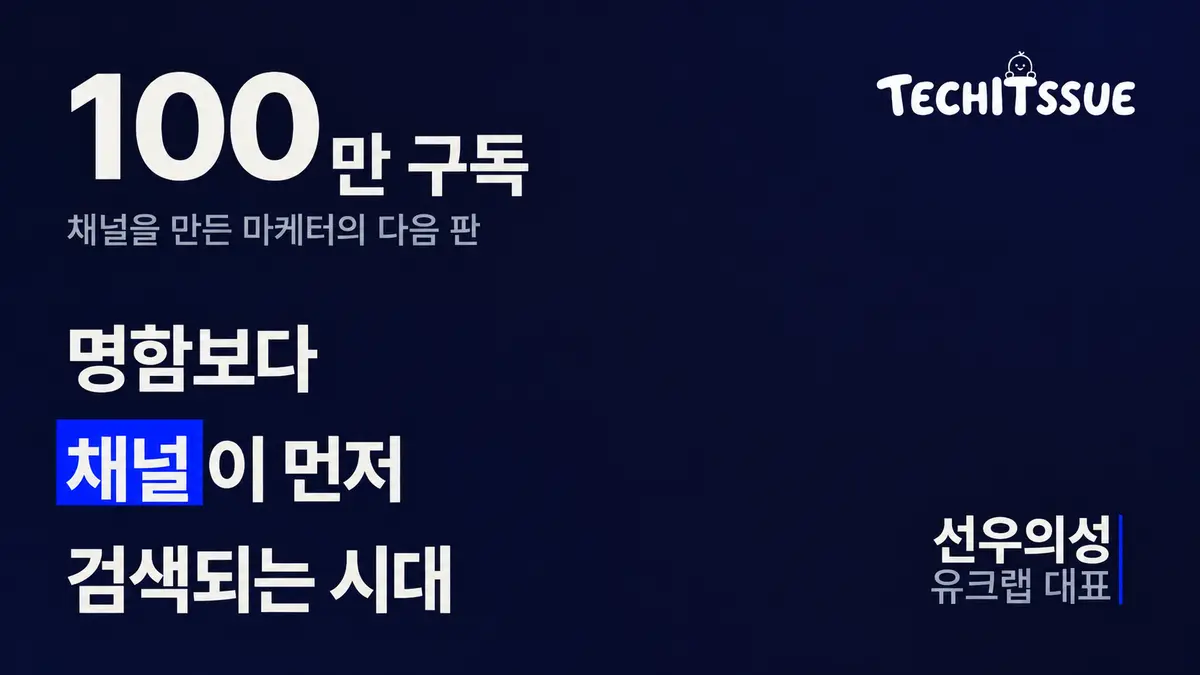
The channel that candidate took over went on to become the first corporate YouTube channel in Korea to pass one million subscribers. His name is Sunwoo Euiseong, now head of the consultancy Ucrab. He says he is watching the same sequence play out a second time — this time with individuals rather than companies.
"In 2018 there was an order to it. First people's attention moved to YouTube, then the production talent moved, and finally companies entered as content suppliers. That exact sequence is now repeating with individuals."
Why Personal Branding, and Why Now
If you have a good job, why build a personal brand at all? His answer is that the order of the search has changed.
"When people are hiring, LinkedIn gets searched before the résumé. When booking a speaker, people watch what that person has published first. Before proposing a collaboration, they check social. We are already living in an era where the channel gets checked before the business card. Your title is given by the company; your brand is what you accumulate. And these two do not conflict."
AI accelerates this, in his read. "Once AI levels up everyone's deliverables, 'good at the job' stops distinguishing anyone. The gaps in report polish, deck formatting, content craft — those keep shrinking. What is left is the question of what point of view someone brings to the work. And point of view does not fit on a résumé. It only lives in content."
That diagnosis shows up in survey data too: in Adobe: In the AI Era, Point of View Is the Differentiator, a large majority of small and midsize business respondents said the same thing.
Notably, he does not recommend going independent. He argues that being employed is the best time to start, for two reasons. First, source material arrives daily — the main reason people stop making content is running out of things to say, and working practitioners accumulate observations and questions constantly. Going independent cuts off that supply. Second, failure costs nothing. A salary is the only safety net under which you can experiment with a concept.
Production Got Easy, So Planning Got Hard
Asked where the leverage is for someone starting now, he answered in one sentence: "The barrier to production collapsed. The barrier to planning went up."
"There is an illusion here. Making things becoming easy also means making things is no longer worth anything by itself. If everyone can hit similar polish with the same tools, the difference happens upstream of the tool — what you say, why, in what order, from what angle."
So he keeps AI out of specific areas: planning, and anywhere differentiation is the point. "If I plan with AI I get maybe a 70 or 80 out of 100. It has become very easy to be adequately good. But in a field where you are trying to do something genuinely different, it actually erodes your edge."
He organizes what comes after into three conditions.
Condition 1: A Concept That Fits in One Sentence
He has long argued that "blunt channels have no future" for corporate YouTube. For individuals, he says, it applies more harshly.
"Blunt means you cannot answer in one sentence what this channel is for. Big companies get blunt because they have too much they want to say, which is why the good ones now split channels apart. An individual cannot split channels and cannot outspend the problem."
His example is Toss's Moneygraphy, a channel that turned the brand mission "make finance easy" into content rather than advertising financial products. The notable part is what it leaves out: the topics it covers and the topics it refuses are both clearly defined. Sharpness is the result of subtraction, not addition.
How do you find your own sentence? "It has to come from something you can prove and that nobody else has claimed yet. Differentiated content comes from what competitors are not saying, not from what you want to say."
His own sentence — "someone who designs brand fandom through content" — took nearly a year to arrive at. "I am not someone who invented a new job. I reinterpreted an existing one. Corporate YouTube existed before I started. I just defined it as a media asset rather than a promotional channel."
He flags two common mistakes. One is scoping too wide: "'I cover marketing' is a category, not a concept. Someone who speaks to everyone is remembered by no one." The other is confusing a concept with a bio: "A concept is not the line in your profile. It is the line other people use to describe you after you have repeated yourself enough."
Condition 2: A System That Removes Decision Fatigue
He defines the second condition in one line: "a state where content ships without planning it from scratch every time."
What stops people is not laziness but decision fatigue. "If every cycle starts from 'what should I make this time,' anyone burns out. And that decision usually resolves toward not making anything. A system is deciding those things in advance."
He names four things to decide up front:
- Fixed formats. Lock two or three repeatable structures. Planning cost drops, and the audience develops expectations.
- Fixed cadence. Not "when I have time" — nail down the day and frequency. Individual posts get forgotten; cadence builds the relationship.
- A source pipeline. Keep a running store of observations and questions from daily work. Separating the day you find material from the day you make content makes production much lighter. Most people who burn out are doing both on the same day.
- Production standards. Tone, banned phrasings, thumbnail rules. In a company this keeps the channel consistent across contributors. For an individual, it makes the version of you on a bad day produce like the usual you.
Layer AI on top of that, he argues, and one person can operate like a content studio. "Not using AI as a creative tool to make one video, but as operating infrastructure that runs the whole loop — planning, production, distribution, analysis, back to planning."
On quality versus frequency, he is unambiguous. "Energy should go into whether the series concept connects to your point of view and your definition. Editing polish is secondary. Publishing continuously beats posting one million-view piece a month."
Condition 3: Repetition That Accumulates
The third condition is where the repetition lands. But something has to be decided first: the purpose.
"Define what you are trying to get out of this, and agree on the success metric with yourself. Start without a purpose and you get dragged around by someone else's metric, like follower count, until you quit."
Low view counts do not automatically mean failure. "I know a tax channel with terrible view counts. But the channel's purpose was to fill seminars with actual clients. Ten people a month means the purpose is met."
There is also an order to accumulation, and most people run it backwards. "They start by trying to blow something up. But if the person who arrives from a viral moment finds nothing waiting, they just pass through. It is inviting guests before building the house. What you build first is trust content — content that answers the questions people in your field actually search."
That principle — laying down answers to real search queries as base assets — holds in AI search environments too. The "credibility stack" and the advantage of long-form described in LinkedIn Publishes an AI Citation Playbook point at the same structure.
He applies the same test to memes. "Some people just copy the meme and stop. Then five million views does nothing for the brand. But if your point of view is intact and the meme is folded into it, those five million views become a serious asset."
What It Comes Down To: Fandom
The word he keeps returning to is fandom, though he uses it differently than most.
"It is not enthusiasm. It is a repeated trust relationship — people who come back, who wait for the next piece, who think of you first when they need something. A like is a reaction in a moment. Fandom is repeated behavior."
Asked whether individuals really need it: "You cannot do without it. Media and companies walked this road first. When media lost its distribution monopoly, and when advertising alone stopped holding people for companies, the ones that survived had fans. Once anyone can make things, making things well stops distinguishing you, and what remains is how many people come back."
What Marketers Should Take From It
The framework is not personal-only. Concept, system, and assets work just as well as a diagnostic for a brand channel. Ask three questions about your own: Can you describe this channel in one sentence? Does content still ship when the owner changes? Are the views accumulating anywhere?
For more on how falling barriers reshape competitive position, see AI Removed Your Competitor's Barriers to Entry — and Yours Too.