Tech/AI모비인사이드
OpenAI DevDay 2026 Recap — ChatGPT Becomes a Shared Workspace for People and Agents
OpenAI DevDay 2026 introduced the always-on agent Dots, GPT-6.1 Sol and ChatGPT Spaces. A recap of the shift from model races to work platforms.
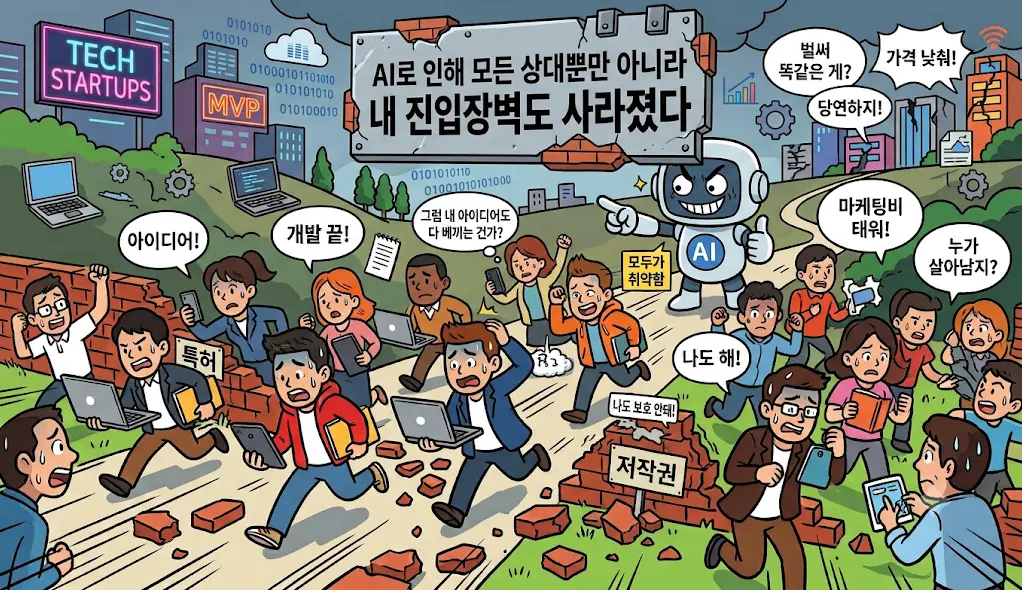
There is a strange familiarity to the AI startup scene right now. A service catches attention and within a week three or four look-alikes appear. Slightly different UI, but the logic, the tone, even the onboarding copy feel borrowed. A few years ago the reaction would have been "surely someone patented that." Nobody worries about it now — because there is no practical way to stop the pattern with a patent or copyright.
Building a service used to require assembling a dev team and burning at least a few months to reach a prototype. That slow, expensive process functioned as a filter. If you had not seriously asked whether the thing needed to exist, you could not even start.
Now AI writes the code, and an idea can become an MVP over a weekend. With the filter gone, the default became build first, ask later. "That worked — so this should too," and a dozen teams pile into the same category simultaneously.
Easier entry is genuinely good news. The problem is that the ease was not granted to you alone.
A barrier to entry is whatever makes it hard for others to follow.
But software startups long leaned on something else: locking the technology itself behind patents and copyright. I built it first, I can prove it legally, so you cannot simply take it.
That logic requires one premise: it must be clear that you built it. As AI moved deep into the development process, that premise started wobbling.
Patents hold firmly to the principle that an inventor must be a person. Applications listing AI as inventor are being rejected globally, Korea included. Using AI as a tool is not disqualifying — if a human is named as inventor and AI was clearly instrumental, the application stands.
Copyright is where it gets hard. The test is how substantially a human participated in the creation. If a developer set the structure and then revised and assembled an AI draft, creative contribution may be recognized. Throw one prompt and ship the output unchanged, and it is a different story. Korea's Copyright Commission has refused registration for AI images that were merely composited and retouched, finding insufficient human creative contribution.
Images at least leave evidence: sketches, revision layers, visible brushwork. Code leaves none of that. Only the working artifact remains. Which function a person designed and which block an AI emitted whole is invisible from the outside — making it far harder for a reviewer to judge substantial human involvement than with a drawing.
Hence the practical advice: preserve the process, not just the product. Commit history, design documents, records of why a human changed AI-written code and what they rejected.
Then another wall appears. Registration captures a snapshot in time. That version is protected; if AI rewrites the code the next day, that is a different matter. Partial revisions can be registered as a new edition, but a rewrite that breaks continuity with the original becomes a legally separate work. The registered v1.0 still exists; nothing guarantees that the v3.7 currently in production carries the same protection.
Given how often startups tear up their code, few teams have the capacity to keep closing that gap.
There is another reason the trail is hard to keep. Designing complex architecture remains difficult for AI. So code accumulates as employees across the company bolt on whatever they need via AI, and when the core destabilizes and something breaks, tracing who built which part and why becomes its own project. It is not code you wrote, so finding the cause and proving creative contribution are equally opaque.
Building got faster; fixing and protecting both got harder.
Building speed rose for everyone while the ability to legally lock the result narrowed. The inventor must be human, creative contribution must be proven, and the proof resets whenever the version changes.
When barriers are that hard to build, one strategy remains: ship fast and see.
The result is the landscape we have. A good idea gets copied by ten teams before a patent could be filed, and the differentiating feature shows up in a competitor's release notes within weeks.
And what floods out without a filter is not only necessary software. "Nice to have" solutions outnumber those solving fundamental problems by a wide margin. Options are abundant; picking the one you actually need became its own fatigue.
The problem does not stop there. When features cannot differentiate, price and marketing budget are what remain. Everyone sells something similar, so customers see little difference and drift toward whatever is slightly cheaper or slightly more visible. Every team burns more on ads, cuts price, extends the free trial.
The market pie stays the same while more mouths share it — a zero-sum game. Margin that used to come from technology now gets vomited back out as ad spend and discounts. Capital fills the space where technical barriers used to be, and that becomes a war of attrition won by whoever can bleed longest.
If patents no longer shield, what does? Data, brand, and network effects come to mind first, and all are valid. But something more fundamental precedes them: the speed and judgment of the organization actually operating the same technology. Code can be copied; a team's sense of why it was built this way and what to fix next cannot.
That question leads to a harder one: can these services actually make money?
In markets with weak barriers, customers hesitate to pay. The reason is simple: customers know that if they wait, someone will release something similar for free or cheaper. Substitutes are everywhere and building it yourself is plausible, so there is no urgency to buy now. Without a reason specific to your service, customers wait.
Which leaves businesses one option. When ideas, technology, and originality fail to differentiate, companies rebuild the barrier out of capital — the endurance to run losses longer, aggressive pricing, and marketing spend competitors cannot match. Where technology no longer protects, the size of the balance sheet does.
The irony: AI lowered the barrier so anyone could start, and the survivors may be the best-capitalized teams rather than the most creative ones. Building was democratized in a way that made earning harder.
If the era of locking the door with technology is ending, one question remains: in an era where you cannot lock the door, what are we building that is worth protecting at all?
For a case of finding opportunity exactly where incumbents cannot move without cannibalizing themselves, see She Built a Unicorn From the Idea Her Boss Rejected; for finding out what customers actually need, see YC's Approach to User Interviews.
The test is whether a human substantially participated in the creation. A developer who set the structure and then revised and integrated an AI draft may qualify; shipping raw output from a single prompt generally does not.
No. The principle that an inventor must be a person is firmly held, and applications naming AI as inventor are being rejected internationally. Filing remains possible when a human is the inventor and AI was clearly a tool.
Artwork leaves process evidence like sketches and revision layers. Code leaves only the final working artifact, with no external way to distinguish human-designed functions from AI-generated blocks.
Data, brand, and network effects are the usual answers, but more fundamentally it is the speed and judgment of the team operating the technology. In practice, however, capital tends to fill that space.
To apply what you just read to your own site, start with a free audit of where things are now.
A strategist replies within 24 hours on business days.
OpenAI DevDay 2026 introduced the always-on agent Dots, GPT-6.1 Sol and ChatGPT Spaces. A recap of the shift from model races to work platforms.

Zero-click GEO explained from TBWA's observations: 68% of U.S. Google searches end without a click, so extend existing SEO content into AI citations.
Claude Fable 5.1 improves coding and research while cutting cache costs, reducing false safety interventions, and introducing regulatory watermarking.