"That flyer stuck to the Burger King — is that real?"
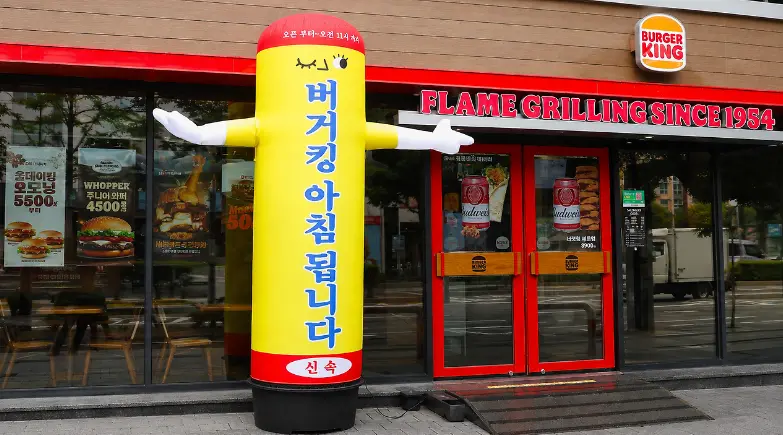
That was the common first reaction to photos of the stores. A standing sign in handwritten-style blue lettering reading "breakfast served here." Next to it, a yellow inflatable tube figure labeled "fast." These are not fast-food props. They are the exact furniture of a Korean gisa sikdang — the truck-stop style diners that feed drivers early in the morning.
What the campaign was announcing
On July 30, Burger King Korea expanded breakfast service from 58 locations to more than double, at 120. The lead new item is the "Croissantwich," a croissant-sandwich hybrid.
To announce the expansion, the brand borrowed the visual language of the country's archetypal breakfast establishment. Banners, standing signs, paper bags. Notably, the world wasn't confined to digital content — the same universe was carried through the physical stores.
Why the reaction was so strong
"Even the font is truck-stop diner style." "Looks like they stole it from a gukbap place." "Now I understand why Burger King Korea exists." Reactions like these spread across social platforms.
Foreign franchise brands rarely borrow Korean local sentiment at this density, which amplified the novelty. And the notable part is that the virality came not from media buys or influencers but from a single piece of paper stuck to a store. That paper planted the campaign's core message — you can eat breakfast at Burger King — directly in consumers' heads.
How the concept survived
The outcome looks simple; getting there was not. "Does truck-stop diner sentiment fit our brand?" "Is it right for our target?" "Isn't it too unsophisticated?" There is no chance those arguments didn't happen internally.
Had those opinions been split down the middle, the output would have been blunted. Burger King didn't compromise, and the sharp idea generated organic virality.
This isn't the brand's first provocation. In April 2024, Burger King Korea announced through official channels that it was discontinuing the Whopper after 40 years. It was noise marketing for a Whopper relaunch. Criticism about bait tactics followed, but the campaign goal — making sure the entire country knew about the change — was unambiguously met. The same grammar runs through the diner campaign.
The concept was never going to satisfy everyone. But for stamping the equation "Burger King equals breakfast" into consumer context, nothing else comes close. The sharper it looks, the further the ripple travels.
The paradox of nice marketing
Marketing has gotten polite amid AI and fragmented context. More brands avoid controversy. Enough brands have created incidents by missing social context that both brands and agencies now flinch by default.
But on the other side of that caution, the shared social consensus disappeared too. Which is precisely why commanding everyone's attention at once has become so hard.
Practitioners feel it. You sort the no-controversy options to the top of the deck. The time and cost of recovering from a negative issue caused by a small mistake is beyond what anyone expects. So brands and agencies drift toward safety, and forgettable content proliferates.
There's no need to chase controversy while carrying real reputational risk. But playing it plain never produces genuine interest in a brand. Whether it's content or a collaboration, attention only settles when consumers see the furthest a brand is willing to go.
What this means for marketers
The Korean bestseller A Book Is an Axe takes its title from Kafka: "a book must be the axe for the frozen sea inside us."
Marketing works the same way. To hold a consumer's eye for even one second amid endless content and fragmented attention, the work has to be an axe against frozen inertia.
Two practical readings.
First, concept strength is decided in the meeting room. Sharp ideas usually die at the internal alignment stage, not the creative stage. Absorb every department's concern one by one and what survives is something nobody objects to and nobody remembers. That the diner concept survived at all is this campaign's first achievement.
Second, physical objects still hit hard. The virality started with photos of a standing sign outside a store. A real object in the physical world provokes "is this real?" far more easily than content born digital. Like the tension Shinola built by keeping the watch out of frame until the last five seconds, or Crocs building Niles as IP rather than an ad asset, the campaigns holding attention right now tend to carry a single hard decision inside the format itself.
Is your brand's marketing the special one causing ripples, or one of the many quietly passing by?