A new front has opened in the fight over artificial intelligence: where the data centers get built. The 90-second music video Liquid Death and Garage Beer released on August 18 goes straight at it — through crude humor.
What the campaign does
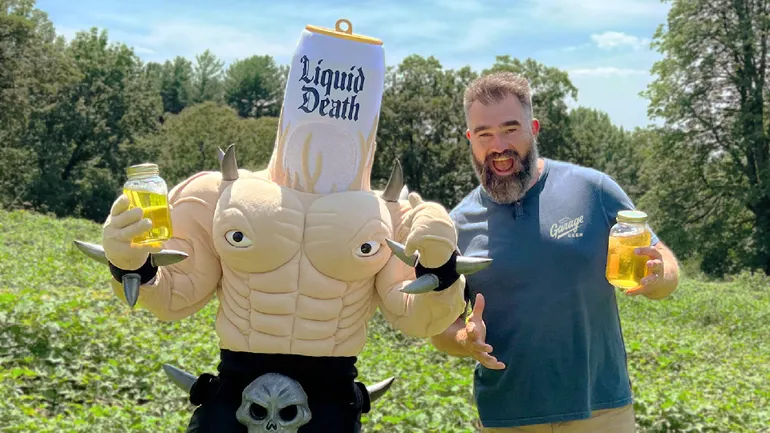
The video opens with NFL legend and Garage Beer co-owner Jason Kelce relieving himself into a jar while explaining the data center cooling problem. He walks outside and is joined by Liquid Death's Murder Man mascot and dozens of characters carrying containers of pee, singing a chorus that runs: "We want your pee, please give us your pee, let's pee on computers, together, to save humanity."
The spot also promotes a "Coolant Collector" product and encourages consumers to send their pee to an AI data center of their choosing. It runs with paid support across both brands' social channels and on connected TV.
Why data centers, specifically
The numbers made the choice. A Gallup poll found more than seven in 10 Americans oppose AI data center construction in their area, with nearly half strongly opposed. The fact anchoring that opposition: data centers can consume up to five million gallons of water a day to cool their servers.
Andy Pearson, Liquid Death's VP of creative, summed up the selection criterion: "When you look at the data, it is literally the one thing that unites all Americans right now, across the spectrum."
That condition is rare. Most social issues split consumers, so a brand taking a side loses one of them. Data center opposition is one of the few subjects where the whole spectrum faces the same way — a brand can raise its voice without shedding customers.
The production structure: a writers' room
The origin of the idea is worth noting. Liquid Death convenes a writers' room that includes outside comedians and writers. Comedian Sabrina Jalees came up with the original data center concept, which was later repurposed for the collaboration.
Writing the lyrics, the team looked at moments "when people felt like they could save the world with a song" — 1980s benefits like Live Aid and Hands Across America. Audio company Butter composed the music.
The structure produces a tone. Neither brand wanted the work to come off as preachy, and Kelce — a gregarious podcaster who has released several Christmas albums — anchors that register.
How the partnership started
This did not begin as a campaign brief. It began as a commercial conversation about co-packaging the two products in retail, and outgrew those ambitions along the way.
Pearson's reasoning includes a positioning argument: "We have a lot of affinity for what those guys are doing: they're doing comedy, and they're also an indie trying to break into the mainstream. We're positioning our energy drink as a light beer of energy — it's fewer calories, it's lighter, it's more drinkable." Garage Beer CEO Andy Sauer added that "the partnership felt natural from the start" given a shared sense of humor.
What this means for marketers
Separate the replicable from the non-replicable.
The tone is not replicable. Liquid Death has spent years accumulating provocative humor as a brand asset, which is why a pee joke reads as consistency rather than a lapse. The same material without that accumulation is just an incident. As with Crocs building Niles as IP rather than an ad asset, character and tone work when they compound at the asset level, not the campaign level.
The topic selection criterion is replicable. This campaign started from a Gallup number, not from a creative idea. Find a subject where strong feeling already exists and where consumers aren't split, then translate it into brand voice. Campaigns that run the sequence backwards — decide the message, then hunt for sentiment — fail here routinely.
The collaboration design is replicable too. Starting from a practical retail co-packaging conversation and expanding into a campaign is a way to merge two audiences without a large media budget. Like the four-minute parody in JCPenney's wellness retreat campaign, choosing a format that generates conversation on its own partially offsets a paid-spend disadvantage.
Finally, the risk. A campaign that asks consumers to actually mail urine to data centers creates outcomes nobody controls at execution. Brands considering provocation work should decide in advance where the joke ends and real-world behavior begins.