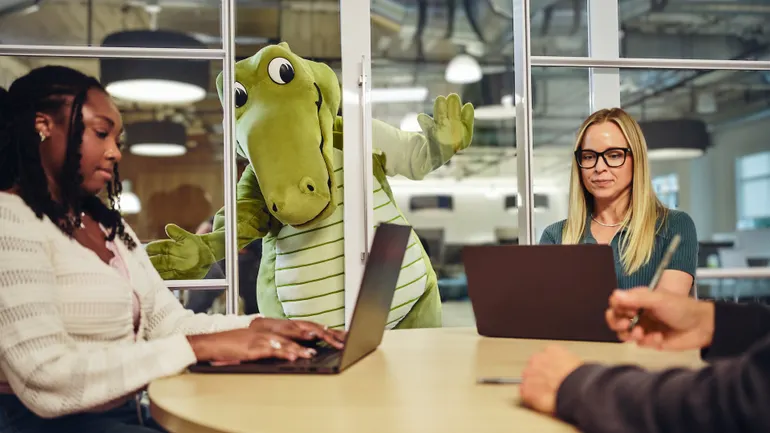
Crocs built a brand mascot. His name is Niles, he is a six-foot bipedal crocodile, he wears clogs, and he does not speak. Crocs CMO Carly Gomez called him "a long-term investment in scalable intellectual property that can grow alongside our brand and community." The phrasing matters: this is explicitly not a character built for one campaign and then retired.
What Crocs Actually Launched
Niles debuted in a microseries shot at Crocs headquarters, following his hatching and his interactions with real employees. In one clip he bursts out of his egg and celebrates, then realizes he has done so before an official 24-hour countdown timer hit zero and scrambles to reassemble the shell in embarrassment.
Crocs says the character has his own "personality, interests, flaws and ambitions." The company describes the approach as writing a sitcom character rather than casting a static brand ambassador. Niles has his own social account, @nilesthecroc.
The idea did not come out of nowhere. The Crocs logo has featured a grinning cartoon crocodile since the company's 2002 founding, and the chunky silhouette of the foam clog echoes a reptilian snout. Crocs describes the concept as having been "hidden in plain sight." The company seeded hints for months, including a large egg that appeared during TikTok Shop livestreams.
Why "IP" and Not "Ad Character"
The difference is what happens after the campaign ends. An ad character's value expires with the flight. IP gets reused across content, merchandise, experiences and partnerships. That is what "scalable" is doing in the CMO's quote.
The framing fits the company's recent direction. Crocs has been leaning into branded social content, including several microdrama series this year. One of them, "Déjà Shoe," included a TikTok Shop commerce component, making it the first shoppable series on the platform. The commercial backdrop supports the bet: Crocs recently passed $1 billion in quarterly revenue for the first time, with Q2 sales up 4.3%, and credited its TikTok Shop presence as part of the momentum. It also participated in the platform's first global Super Brand Day in July. Given that TikTok Shop Now Holds 2% of U.S. Online Retail, pairing serialized content with commerce is not incidental.
Niles is the fixed element that keeps those series from starting over each time. Instead of inventing a new concept per series, the team keeps a defined character and changes the situation.
Duolingo Set the Benchmark
Oversized plush animal mascots generating virality and favorability with Gen Z is a proven pattern, and Duolingo's owl is effectively the reference case. Liberty Mutual more recently turned a signature bit of its advertising into a puppet-like character that adapts across formats.
The common thread: the character does not live only inside ads. It holds its own account, speaks in its own voice, and reacts to cultural moments unrelated to the product. Crocs made the same argument in its announcement, saying consumers want brands that participate in culture rather than simply sell goods and services.
What Marketers Should Take From It
Four Conditions for a Mascot That Compounds
Pull it from something the brand already owns. Niles came out of the logo. A character with no existing link means paying to teach the association from zero. Audit the logo, packaging, product silhouette and founding story first.
Define the flaws, not just the personality. There is a reason the first film shows Niles botching his own hatch timing. A flawless character generates no repeatable situations. Flaws are what produce episodes.
Silence can be strategy. Niles has no dialogue. No dialogue means no per-market rewriting and less tonal drift across regions. For anything intended to travel internationally, that constraint is worth considering deliberately.
Attach the conversion point at the start. Crocs put commerce inside the series and removed the distance between watching and buying. A mascot measured only on awareness will stay on the defensive in every performance review.
Teams building serialized brand content should also read Cuisinart Built a 14-Episode Sitcom for the Feed. The character problem and the episode-structure problem are the same problem.