Pizza Hut is celebrating quarterbacks this football season with a new national campaign featuring Josh Allen. But the first thing you notice is not the ad — it is the name. The Yum brand temporarily dropped the word "pizza" and will be known simply as Hut, a nod to what quarterbacks say at the start of a play. The change runs until Aug. 31 and was promoted across the chain's social channels.
Turning the brand name into the product
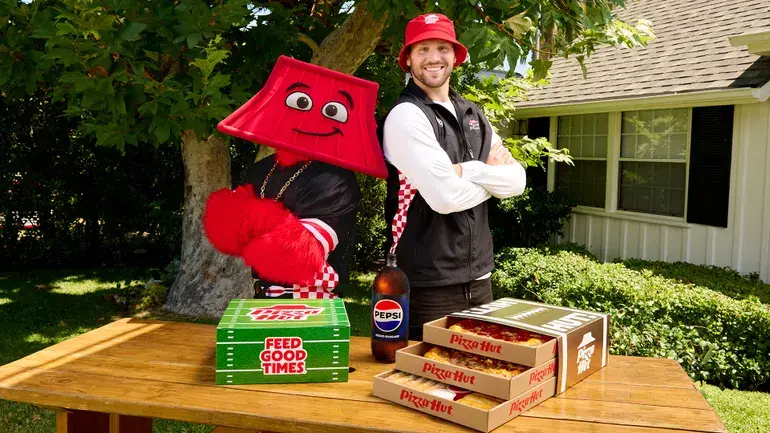
Wordplay is the central joke. The Buffalo Bills star appears in a 15-second spot alongside Pizza Hut mascot Hutty, delivering value boxes on a branded golf cart. A second 15-second ad features Hutty and kids playing football.
Allen emphasizing the "Hut" in the brand name mirrors what seven-time Super Bowl champion Tom Brady did during the lead-up to the Super Bowl earlier this year. This is not a new idea so much as an extension of a device the brand already tested.
The participation mechanic
The campaign showcases a game day edition of the Triple Treat Box and Pepsi products. Continuing the value focus, marketing coincides with a large three-topping pizza with choice of crust priced at $10. Limited edition pizza boxes that cut out into field goals tie the packaging back to the season.
The mechanic: fans submit a video of themselves shouting "hut" for a chance to win free pizza for life. That broadens the giveaway from the earlier Brady-centered campaign, where a city could win pizza if their quarterback said "pizza" right before "hut" during a game. The old version depended on an uncontrollable variable — whether an athlete said a word. The new one depends on something any fan can do.
A sale closing in the background
Context matters here. Yum's sale of the Pizza Hut business outside mainland China to private equity firm LongRange Capital is set to close by the end of August. The June announcement put the non-China business at $1.5 billion and the China business, going to Yum China Holdings, at $1.2 billion.
As the separation approaches, Pizza Hut is leaning on a familiar playbook: value plus seasonal excitement. On the numbers, Yum's Q2 revenue totaled $2.17 billion, up 12% year over year, while Pizza Hut posted $254 million, up 6%.
Value as the recurring axis
As consumers continue to feel the effects of economic uncertainty, Pizza Hut has repeatedly emphasized value in its advertising. In July it launched a nostalgia-inspired campaign under its "Hut Originals" platform, promoting a "Throwback Value Menu" inspired by the chain's buffet items.
The loyalty program has also been reworked. In April it shifted from point accumulation to experiences, aligning with a broader industry move toward adding perks to rewards programs.
When a temporary rename actually works
Changing a brand name for a month looks risky on its face — search visibility, recognition assets, and naming consistency all wobble. Several things make the risk low here.
First, the word was already inside the name. Nothing new was invented; something existing was trimmed. "Hut" is already brand equity, so there is nothing for consumers to relearn.
Second, the cultural context already exists. The snap call is a sound that repeats every week of the season. The brand does not have to manufacture the meaning; the sport reproduces it.
Third, the end date is stated. Running until Aug. 31 keeps it an event. Open-ended, it would be a rename. Bounded, it is a device.
Fourth, a prior campaign validated the angle. The Brady campaign tested the reaction; this one widens the participation condition. It is a second run of a proven mechanic, not a first attempt at a new one.
For a brand converting a season into repeatable IP, see Fanta Turns Halloween Into IP. For the compounding case of repeating one asset for years, see Six Years of the Same Jingle.
The pattern: temporary renames work when the brand is re-cutting something it already owns. Renames that try to manufacture a meaning that was never there just spend recognition and buy nothing back.