Jamiroquai's "Virtual Insanity" is one of the defining music videos of the '90s. Directed by Jonathan Glazer before his feature career began, it puts frontman Jay Kay in a blue tracksuit and oversized hat in a room where the floor moves and the walls seem to close in. Paired with lyrics about the "useless twisting of our new technology," the clip has survived three decades of parody and playlist nostalgia.
Pernod Ricard's Beefeater borrowed that asset for its alcohol-free Beefeater 0.0 product. London agency Lucky Generals recruited Jay Kay himself for a two-minute film that expands the original video's world rather than remaking it.
They Didn't Restore the Original — They Added a Chapter
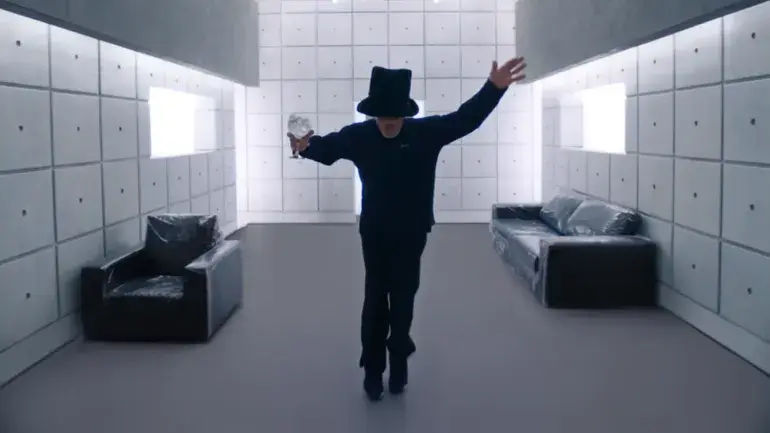
Jay Kay returns to a facsimile of the original set and reaches out his hand exactly as before, but pulls back a Beefeater 0.0 cocktail. He then dances through nine interconnected rooms: hat rooms, a gym full of treadmills, a pottery studio, a fine-dining restaurant, a wood-paneled sauna and an understated nightclub. He finally breaks the fourth wall to reveal the set and rides away on the motorized recliner from the opening scene.
The tagline is "Get More with 0.0." Damien Le Castrec, chief strategy officer at Lucky Generals, framed it this way: "You miss nothing with Beefeater 0.0. You've got a full taste experience of a gin, none of the alcohol, so you can go out on Monday, Tuesday, Thursday, stay until 4 a.m. — within reason — and you still feel fresh the next day."
The Category Usually Sells Absence
Non-alcoholic drinks marketing tends to run on subtraction: no alcohol, no hangover, fewer calories. This campaign inverts it. The hats are a metaphor for doing more, not missing out. The tension Le Castrec identified is London's own pace — Londoners adopt moderation strategies precisely so they can get more out of a hectic city.
The Ambassador Brief Had Four Constraints, Not One
Beefeater is the only London Dry gin still produced in the city, which narrowed the ambassador search to four criteria: British, associated with London, recognized across a wide age range, and affordable.
Jay Kay — his face, music and hats combined — showed roughly 60% recognition among 18-to-34-year-olds, per Le Castrec. On top of that, a man once known for hard partying who has since turned to moderation maps directly onto the product story. Pernod Ricard saw organic net sales fall 3.9% in fiscal 2026, with soft U.S. and China markets weighing on results; executives cited Beefeater 0.0 on the earnings call as evidence of accelerating consumer-centric innovation.
Skipping AI Wasn't a Preference — It Was the Premise
The team shot practically rather than using CGI or artificial intelligence. Shelley Smoler, chief creative officer at Lucky Generals, put it plainly: "The reason people have questioned how the hell they did the original for 30 years is because of that human ingenuity. It was crucial that we didn't lose that. From the start, we knew we needed to retain that element of mystique and 'how the hell did they do that?'" She added: "Not to mention that the song itself is called 'Virtual Insanity' — it would be wrong to go against that with AI."
Where the original used moving walls, the new film relies mostly on a moving floor across nine separate sets. No studio was long enough to house them all, so the video was shot in two parts and stitched to appear continuous. During the party scene, the room got heavy enough that the rig broke.
The Terms for Borrowing an Icon
One principle repeats throughout: do not try to beat the original. In Smoler's words, "We'd be lying if we said we could do better than that, but what we wanted to do was add the next chapter." Production partners who wanted to change the location or redo the original were ruled out before the pitch.
That is where most nostalgia campaigns break. The moment a brand overwrites the original's tone with its own, the feeling the audience remembers stops matching the feeling the ad is asking for. It is the same discipline behind United broadcasting ESPN's fantasy football show from 35,000 feet — demonstrate the claim instead of asserting it.
One more thing worth noting: the production method became part of the message. The handmade sets, the broken rig, the two-part stitch — all of it turned into coverage and conversation. As AI-generated work becomes ordinary, how something was made is increasingly as differentiating as what was made.