When regional brands expand, their websites expand right along with them. Over time that leaves hundreds of location-related pages, many targeting the same intent or serving no clear purpose.
More geographic pages do not necessarily create stronger local visibility. They can produce internal competition, fragmented authority, conflicting local information, and a growing maintenance burden.
The better approach to multi-location SEO runs the other way: create the smallest number of pages necessary to accurately represent the business, then make those pages as useful, connected and authoritative as possible.
How geographic page bloat happens
Most bloated geographic footprints do not stem from a single terrible strategic decision. They build over time, one seemingly reasonable page at a time.
One agency creates a page for every city with measurable search volume. A local team launches neighbourhood pages around an existing office. A franchisee builds its own service area section. Years later another vendor introduces a new URL structure without addressing the pages already in place.
Each decision may have made sense to someone at the time. Collectively, they create an architecture nobody fully owns.
The four assumptions behind it
- Every geographic keyword needs its own page
- A physical location and a service area can be treated the same way
- Swapping the city name creates enough differentiation
- More indexable pages automatically create more visibility
The problem is not duplicate content
Pages sharing content is not the issue. Reusable service descriptions, brand messaging and booking instructions are often necessary. You do not need to rewrite accurate information just to reach an arbitrary uniqueness percentage.
The real problem is that many pages cannot explain why they exist.
At the extreme, this resembles what Google defines as doorway abuse. That does not make every city page a doorway page. But "the keyword has volume" is not enough of a reason to publish one.
Separate the four concepts teams conflate
Before deciding which URLs should exist, map how the business actually operates. That exercise forces a distinction between four things routinely treated as interchangeable.
1. A physical location
A real, customer-facing facility with its own address, hours, staff and local experience. It generally deserves an authoritative location page.
2. A regional market
May represent a state, metro area, or operating territory containing multiple facilities. A regional page is useful when customers need help understanding the brand's presence or choosing between nearby locations.
3. A service area
A market served by a physical location or field-based team. It does not automatically represent a separate entity or deserve its own URL.
Google's service area and hybrid business guidance distinguishes businesses that serve customers at their location from those that travel or deliver to them.
Even so, Google Business Profile settings should not dictate website architecture.
Adding a city to a Business Profile service area does not mean you need a landing page for it. Publishing a page also does not establish a physical presence there.
4. A city the brand wants to rank in
A marketing goal, not a page type.
There is nothing wrong with wanting to attract customers from nearby markets. The mistake is assuming every target city requires a dedicated URL.
Give every page a job
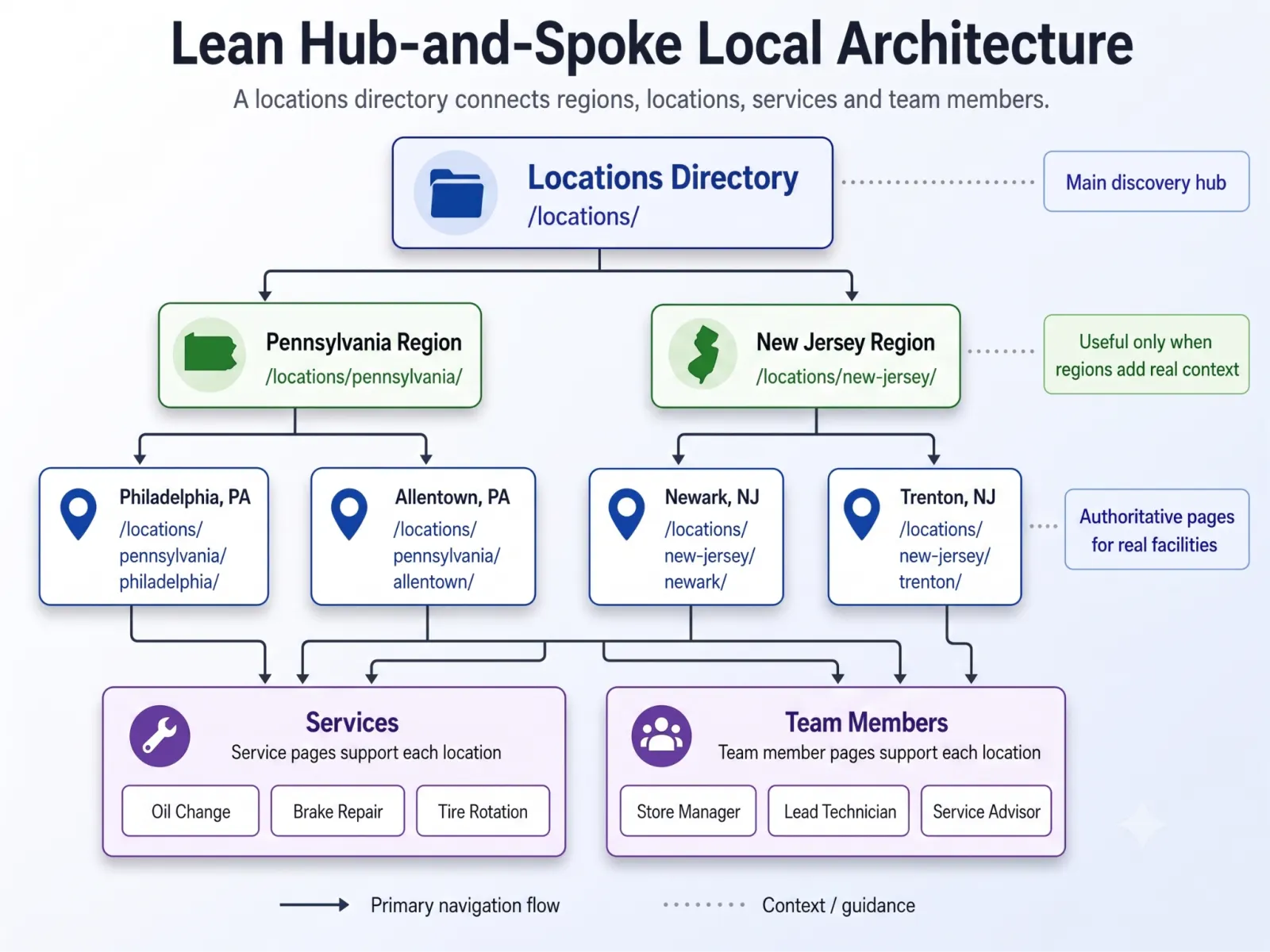
Most multi-location brands benefit from some form of hub-and-spoke architecture, but there is no universal folder structure.
A larger organisation may need:
/locations//locations/pennsylvania//locations/pennsylvania/philadelphia/
A smaller regional brand may be better served by:
/locations//locations/philadelphia-pa/
Neither is inherently more optimised. The right structure mirrors the business without adding layers for their own sake.
What each page type does
The main locations hub should help users understand the footprint and find the right facility. A location finder can support that, but the directory should still include crawlable links to important regional and location pages.
Regional hubs should exist only when they provide meaningful context or help users choose among several facilities.
Individual location pages serve as the authoritative digital representation of real locations, answering practical questions about address, hours, services, staff, directions, accessibility and what customers should expect.
These pages play a larger role than simply attracting organic traffic or functioning as a landing page. They help customers understand the location, take action, and confirm that the business has a credible local presence.
Service pages explain what the business offers. Location pages explain where and how that service is delivered. They should support each other rather than repeat one another.
Service area pages should be approved exceptions, not the default response to every city keyword. They make sense when a market has a dedicated team, distinct logistics, local regulations, or substantial project experience that cannot be handled on an existing page.
A service area page needs to do more than confirm the company is willing to travel there.
Ask whether the page deserves to exist
Before approving another city page, ask a harder question: does the website actually need it?
Search volume can point to an opportunity but does not automatically justify a new page. A geographic page should have a clear customer purpose, a defined place in the architecture, legitimate business relevance, and enough useful information to maintain over time.
Five questions
1. Is there a physical location in the market?
A legitimate facility generally supports a dedicated page. Without a physical presence, the case needs to be stronger.
2. Is the service delivered differently there?
Different staff, products, regulations, contractual requirements, pricing or processes can justify separate treatment.
3. Can the business prove its relationship to the market?
A dedicated team, defined service territory, completed projects, local partnerships, or a nearby facility responsible for the area.
4. Would the page help someone if search engines didn't exist?
Would a customer intentionally navigate to it? Would a support rep send it to someone? Would it answer a question another page cannot answer as well?
5. Can an existing page satisfy the intent?
Sometimes the better move is strengthening an existing regional or location page with service area details, directions from nearby communities, local FAQs, or clearer location guidance.
If the page only makes sense inside a keyword tool, it probably isn't ready to publish.
Reusable content isn't the enemy
Templates are necessary when a brand manages dozens or hundreds of locations. Repeating accurate information and using shared design elements is fine.
The real vulnerability is letting the template become the entire page without adding genuine local differentiation.
Fixed content may include brand positioning, service explanations, booking processes and compliance language.
Variable content should reflect the location itself:
- Address, hours and local contact information
- Services genuinely available there
- Staff and team member profiles
- Directions, parking and accessibility
- Original photography and facility details
- Local testimonials
- Region-specific pricing, regulatory or service information
- FAQs based on real customer questions
There is no useful universal percentage of content that must be unique. If the booking process is identical everywhere, repeating it is fine. If team, parking, hours and service availability differ, those need local handling.
Generic city histories, nearby attractions, and paragraphs describing every community as "vibrant" don't establish local relevance.
Local content should reduce uncertainty, demonstrate real-world knowledge, or help the customer make a decision.
Use internal links to explain the ecosystem
Internal links do more than pass authority. In a multi-location site they help define relationships:
- They show that a facility belongs to a region
- They connect services with the locations where those services are available
- They connect team members with the locations where they work
A strong linking model may include:
- The locations directory → regional or individual pages
- Regional hubs → facilities
- Location pages → available services
- Service pages → relevant facilities
- Team member pages → the locations where those individuals work
These relationships should be intentional. They shouldn't exist simply to force more city-and-service anchor text into the site.
Google's guidance on crawlable links recommends standard HTML links with descriptive anchor text — especially relevant for location finders. A JavaScript-powered finder should complement a browsable directory rather than replace it.
Important location pages shouldn't depend exclusively on XML sitemaps, footer links, internal search forms, or JavaScript interactions to be discovered.
Keep URLs and entity signals aligned
URL governance is not the most exciting part of local SEO, but ignoring it is how sites end up with several pages representing the same location:
/locations/philadelphia//service-centers/philadelphia-pa//auto-service-philadelphia/
All three may represent the same facility while dividing internal links, backlinks, engagement and reporting between competing destinations.
Choose one authoritative URL for each location and use it consistently across navigation, service pages, team member pages, internal directories, Google Business Profiles, structured data and controlled listings.
Create rules for how locations are named, when regional folders are used, how duplicate city names are handled, and what happens when locations move, close or merge.
The facts have to agree
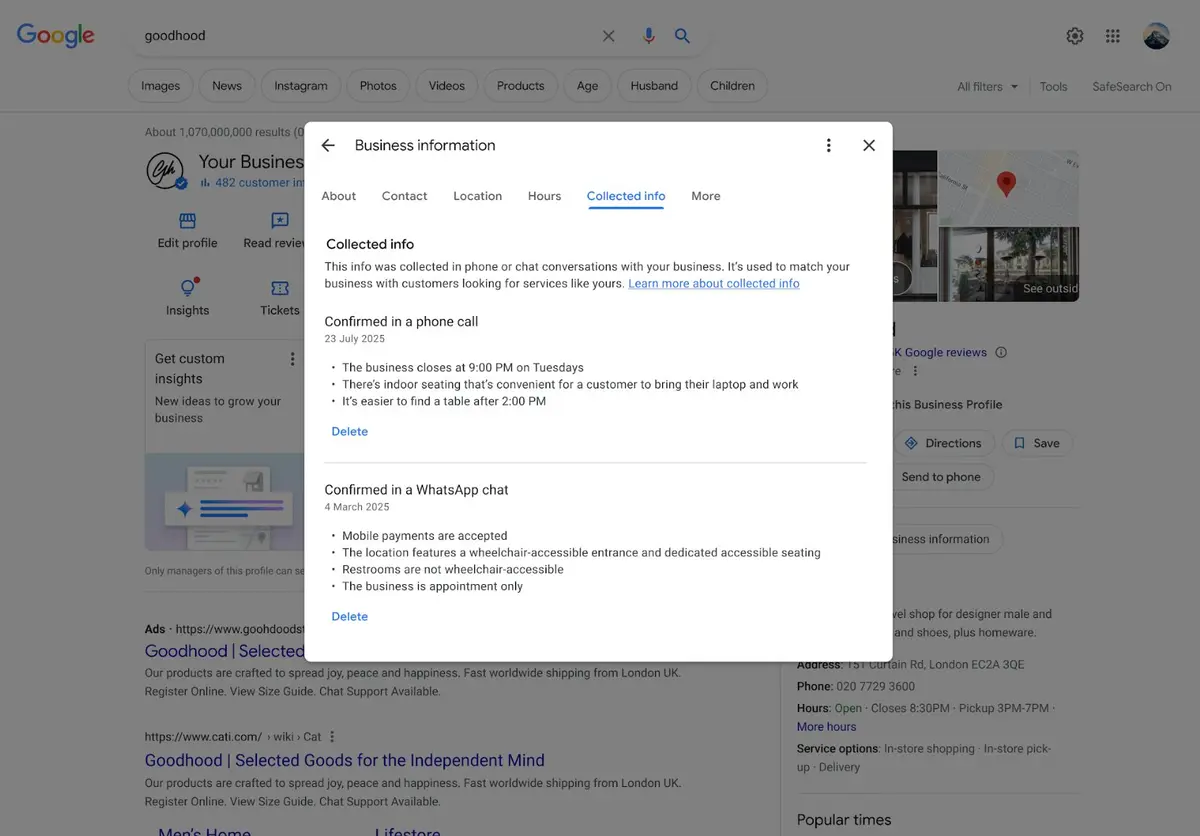
The location page, Business Profile and authoritative third-party sources should agree on the core facts: business name, address, phone number, hours, available services and operational status.
Google's guidelines emphasise that a company's online presence should reflect how it operates in the real world.
Structured data can reinforce consistency, but it can't turn an unsupported city page into a legitimate location. When markup contradicts Google Business Profile signals or on-page content, it creates conflicting entity signals.
The same principle applies to AI-driven discovery. Give each page a clear purpose, keep the facts accurate, and make relationships between business entities easy to understand. More geographic URLs won't make an unclear architecture easier for search engines or LLMs to interpret.
A working checklist
Make every existing page justify itself. If you cannot answer "what does this page tell someone about this market," it is a consolidation candidate.
Treat physical locations and service areas differently. A real address and a delivery radius need different information structures.
Do not let GBP settings dictate site structure. Adding a city to a service area and building a page for it are separate decisions.
Fix one authoritative URL per location. Three URLs for one facility makes all three weaker.
Read it alongside the GBP anchor problem. For hidden-address service-area businesses and map pin behaviour, see Changing Your GBP Address Does Not Move the Map Pin.
Keep local signals consistent. That matters more as local search gets absorbed into AI answers — see ChatGPT Gains Yelp Reviews.
Approach cleanup as technical debt — the triage framework in Technical Debt in SEO transfers directly.
Read it with the topical structure principle. Geographic pages and topic pages are both evaluated as category-level clusters — see Entity SEO: AI Search Looks for the Source of a Concept, Not a Keyword on silo structure.
Adding pages is easy; removing them is politically hard. Which is exactly why the principles you set at the start matter so much.