For many local businesses, the Google Business Profile drives calls, website visits, bookings, direction requests and customer trust. When it works, it is so embedded in the marketing that nobody considers what happens if it disappears.
That risk becomes real when a profile is suspended, transferred, merged or forced into reverification — or stays visible but loses ownership access or local visibility. Either way, the business may spend days or weeks resolving it while calls and leads decline.
Recovery advice only solves half the problem
Most guidance focuses on recovery: review the guidelines, gather documentation, submit an appeal, contact support. Necessary, but incomplete. Businesses also need a plan to maintain lead flow while recovery is underway.
What a real disruption looks like
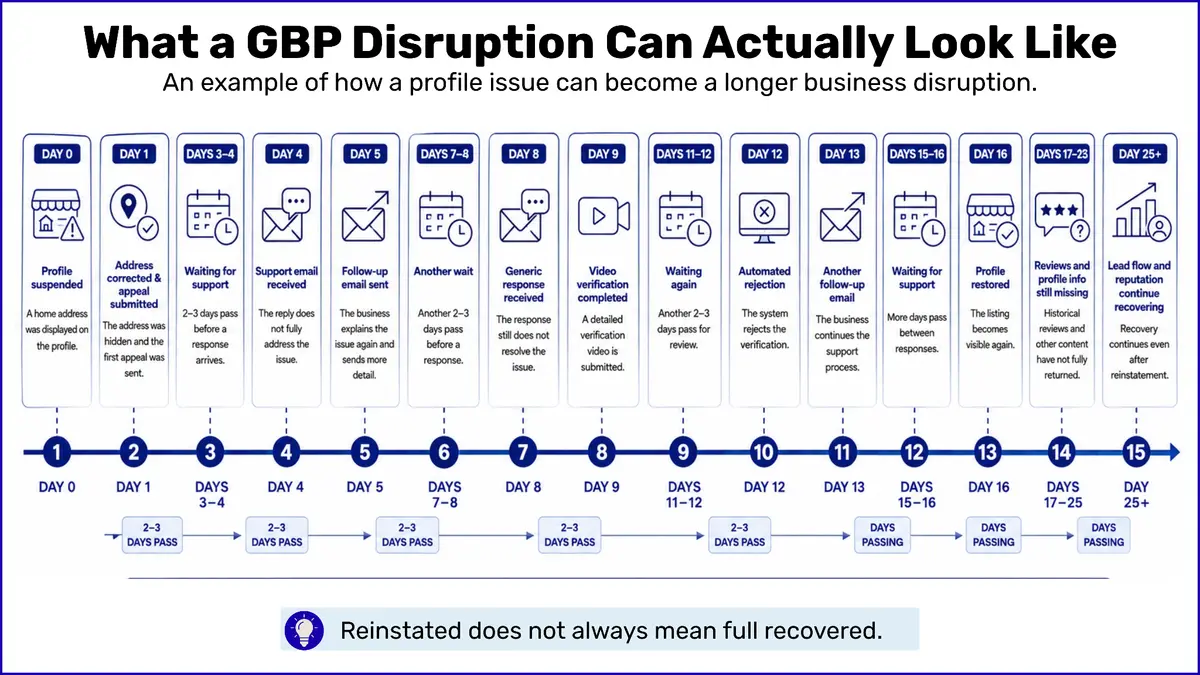
A local service business had its profile suspended for displaying the owner's home address. The company was legitimate but operated at customer locations and should have been configured as a service-area business with the address hidden.
Correcting the address was only the beginning. Google's responses took several days, and some support replies did not address the specific issue or evidence provided, forcing the business to repeat information. Video verification was required: the recording showed the surrounding area, street signs, property access, business documents, a branded vehicle, and tools and equipment. It met the requirements, and the automated system rejected it anyway.
The profile was eventually restored — but much of the previous information did not return. Historical reviews and other content were missing even as new reviews appeared, and historical performance data was gone. Technically active, functionally diminished.
Measure your exposure before anything breaks
Severity depends on how much business comes from Google. Some companies use GBP as one part of a broader mix that includes organic search, referrals, repeat customers, paid advertising, partnerships and email. Others rely on Maps and the local pack for most new business.
Review the previous six to 12 months of profile performance, website analytics, call tracking and lead records to estimate how many opportunities originate from your profile. Perfect attribution is unlikely; the goal is understanding exposure, not assigning every sale to one source.
The useful question: how long could the pipeline hold if the profile stopped generating leads tomorrow?
The four parts of a continuity plan
- Preserve: protect access, profile information, documentation and evidence.
- Recover: diagnose the problem and follow the right recovery process.
- Replace: activate other lead sources while the profile is impaired.
- Reduce: lower long-term dependence on a single platform.
These usually need to run simultaneously, so assign ownership. One person handles verification, appeals and support correspondence; another monitors lead flow and activates other channels. Even when it is the same person, treating them as separate workstreams stops recovery from consuming the entire marketing effort.
Preserve: what to have ready in advance
Document ownership and access first. Know who holds primary ownership, which accounts have management access, and whether former employees or agencies still have permissions. The business itself should retain primary ownership — agencies and employees generally belong at manager level.
Keep current copies of documents that verification or an appeal may require: business registrations and licenses, utility, phone and internet bills from the past three months, tax and insurance records, lease or ownership documents, DBA records. Names and addresses should match how the business is represented publicly.
Document the profile's current state — name, address or service area, phone, website, categories, hours, description, services, products, attributes — in one place. That makes unauthorized changes visible and missing details restorable.
Decide your visual evidence ahead of time. A storefront should show permanent signage, exterior, customer-facing areas and access to employee-only spaces. A service-area business should demonstrate legitimacy with branded vehicles, equipment, tools, work materials or documents. Figuring out what to show while verification is already running is far harder.
Diagnose before you change anything
When calls decline, owners often start editing immediately — category, address, service area, phone number, business name. Multiple simultaneous changes make the original issue harder to diagnose and create new inconsistencies.
Identify the problem type first: suspension or disablement, reverification, ownership or account access, duplicate or merged profile, missing reviews or content, incorrect information, ranking decline, a reporting problem, or a broader Google issue. A lead decline may come from ranking changes, competition or seasonality rather than any formal restriction.
Then review the profile against Google's guidelines, correct genuine errors, and keep the appeal concise and factual: what the business is, how and where it operates, what may have changed, and which documents support eligibility.
Define what recovery actually includes
Public visibility is one part. Recovery should also cover ownership, profile content, reviews, rankings and lead generation. After reinstatement, check ownership and management access, name and address or service area, phone and website, primary and secondary categories, services and products, hours, attributes, photos and posts, review count and rating, local rankings, calls and interactions, and performance reporting.
This often reveals that the technical issue is resolved while the commercial impact continues. Finding the listing in Search or Maps confirms it is live, not that it is working as before.
Keep leads moving during recovery
The website matters most in this window. Customers should be able to tell what the business does, where it operates, whether it is open and how to reach it without the profile. Make phone numbers and CTAs easy to find on mobile, test contact forms, state service areas and hours clearly. Testimonials, credentials and project examples replace part of the trust the profile's reviews normally carry.
Protect high-intent demand with paid search. Do not try to replace every lost profile view. Focus on branded searches, core revenue services, urgent needs, priority service areas and campaigns built to generate calls or estimate requests. Evaluate by calls, forms, appointments and sales — not clicks.
Reconnect with previous customers. Years of relationships already sit in a CRM, invoicing platform or email list. Seasonal reminders, maintenance, follow-up work, postponed projects and referral requests all work, and the profile problem does not need to be the centerpiece of the message.
Be where local conversations happen. Community Facebook groups, neighborhood pages and Nextdoor carry real-time requests for recommendations from people who never open Maps. Answer helpfully, disclose the business relationship, and avoid turning every thread into a pitch.
Keep building reputation elsewhere. A suspended profile blocks new Google reviews, so redirect review requests to credible secondary platforms relevant to your industry.
Reducing dependence is the actual goal
The fourth part is the conclusion. However well you document the recovery process, if single-platform dependence stays the same, the next incident repeats the same damage.
It helps to see where local discovery is heading. As covered in Business Websites Took 60% of Gemini's Local AI Citations — but Repeats Rarely Match, AI answers about local businesses lean most heavily on the business's own site. And Google is making accurate category declaration matter more, per Google Expands Local Services Ads Categories — Right Before the Google Ads Migration.
Both signals point the same way. Keeping your own website accurate and complete is insurance against a profile disruption and an investment in AI local search at the same time.