If you want better local rankings, start in three places: get specific with your Google Business Profile primary category, choose relevant additional categories, and complete the profile fully. That is the short version of a Whitespark study of 1.8 million Google Business Profiles across 4,209 categories, three findings from which founder Darren Shaw published at Search Engine Land.
Finding 1: specific beats generic, every time
That Google matches the primary GBP category to the search term surprises no local marketer. Search "hair salons" and the exact-match Hair salon category outperforms every adjacent one — average rank 49.9 with 11.3% in the top 10, against Hairdresser at 56.9 and 6.0%, Beauty salon at 60.0 and 3.2%, Barber shop at 79.5 and 1.3%, Nail salon at 81.3 and 0.0%. The same holds for "plumbers," and the pattern repeats across nearly every category in the dataset.
The less obvious variable is specificity.
Owners unfamiliar with local SEO are tempted to pick a broad primary category — Restaurant, Law Firm — to capture wider traffic. The data says otherwise. Across all industries, a specific primary category is associated with better rankings and a ~36% higher presence in the top 10 (12.5% vs. 9.2%). Generic-category businesses (55,091 of them) average rank 50; specific-category businesses (1,664,733) average 45.8.
Examples sharpen it.
Attorneys: criminal justice attorney 44.7 avg rank, 13.4% top-10 / personal injury attorney 48.4, 12.2% / generic attorney 57.1, 12.9%
Contractors: electrician 48.6, 11.2% / roofing contractor 53.1, 12.6% / plumber 53.2, 10.4% / HVAC contractor 53.2, 12.4% / generic contractor 57.7, 8.0%
Restaurants: tapas 28.8, 32.1% / Hawaiian 28.4, 27.1% / New American 30.4, 28.9% / French 37.0, 15.8% / Spanish 40.1, 18.5% / American 41.8, 17.8% / generic restaurant 49.7, 10.1% / Mexican 66.7, 2.7% / pizza 74.8, 1.6% / Chinese 73.2, 0.6%
Two reasons. Specific categories generally face less competition — compare the number of Hawaiian restaurants in your town to the total number of restaurants. And Google always tries to match the primary category to the query: search "plumbers" and Google wants to show businesses that specialize in plumbing, not general contractors.
Shaw's takeaway: if you want to rank for everything, you will end up ranking for nothing.
Finding 2: primary + additional combinations have winners
Once the primary category is set, additional categories are next. In the data, aligning specific additional categories with the primary tends to correlate positively with rankings.
The highest-ranking combinations in the database:
- Veterinarian + emergency veterinarian service — 33.9 avg rank
- Electrician + EV charging station contractor — 38.2
- Gym + athletic club — 34.7
- Plumber + drainage service — 47.3
- Roofing + gutter service — 47.1
- Personal injury attorney + business attorney — 40.8
- Dentist + cosmetic dentist — 47.6
Well-chosen, specific additional categories correlate with rankings 6 to 17 positions higher than businesses carrying only a single primary category.
Shaw is explicit that correlation is not causation. Owners who add additional categories are more likely to look after their local SEO generally — optimizing the profile, asking for reviews, doing SEO work beyond GBP — and rankings reflect all of that. That the correlation exists is still worth noting.
The inverse case is instructive: a broad, generic category like "Service establishment" that nobody ever searches is useless, and the data suggests adding that nothing-category to a profile is actively harmful. Nobody has ever typed "service establishment near me."
Finding 3: the GBP completeness index predicts rank
The researchers asked whether profile completeness differs systematically by category and industry, and whether completeness predicts rank. They built a 0-5 completeness index, one point each for the presence of:
- A website
- A business description
- Hours of operation
- Photos
- Claimed status
The index rests on the limited data gathered; business attributes, services, and products were not collected.
By industry, completeness splits clearly. Home services 4.4 (55% fully complete), professional services 4.3 (52%), automotive 4.2 (48%), beauty and personal care 4.1 (45%), legal/financial 4.1 (46%), retail 3.9 (40%), real estate 3.8 (38%), travel and tourism 3.6 (33%), community and organizations 3.0 (22%). Competitive industries where local SEO decides visibility maintain the most complete profiles.
Against rank, the relationship is stronger:
- 0 — avg rank 62 / 4% in top 10
- 1 — 58 / 5%
- 2 — 54 / 7%
- 3 — 50 / 9%
- 4 — 47 / 11%
- 5 — 43 / 13%
Moving from 0 to 5 improves average rank by roughly 19 positions and triples top-10 appearance rate. Again, correlation is not causation: owners with complete profiles are also more likely to publish Google Posts, request reviews, and mind their website, citations, and online reputation.
The checklist
- Always pick a specific primary category. Widening the net to capture more traffic lowers rankings instead.
- Do not neglect additional categories. Add all the ones your business actually offers — and skip "Service establishment."
- Full GBP optimization is nonnegotiable. In less crowded industries, this alone can be enough to stand out.
- Most businesses have to go beyond GBP. Optimize and maintain the website, build citations, be present on social, engage the community, and pay attention to AI SEO.
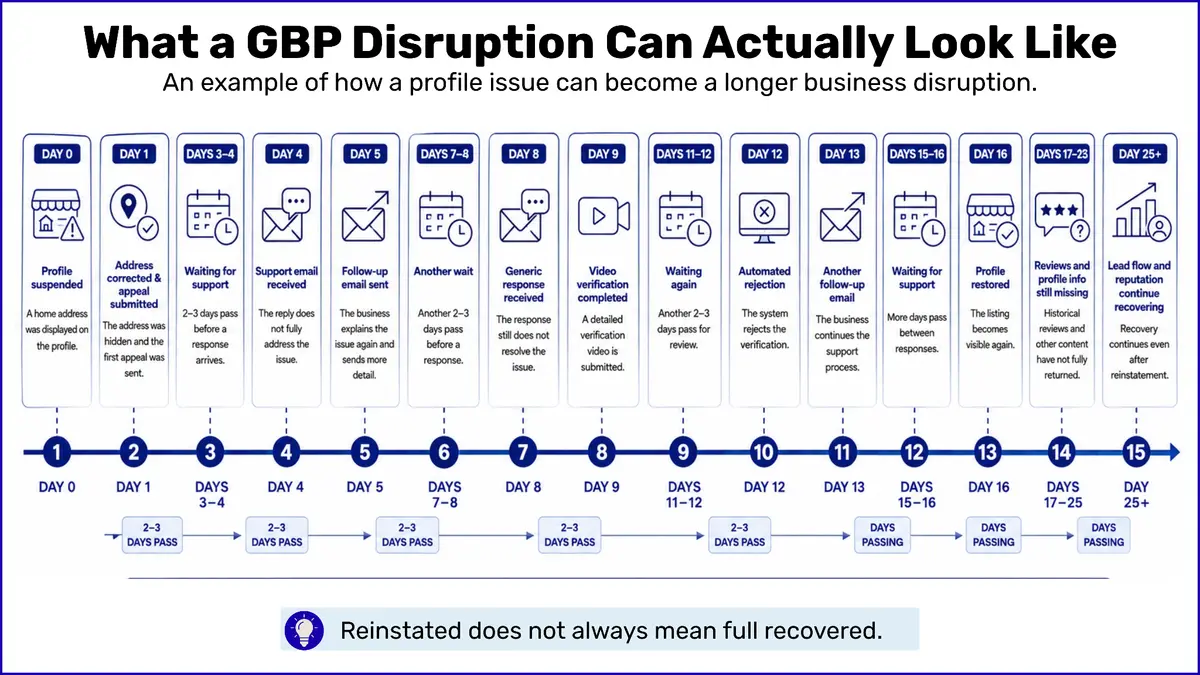
Profile work is not only ranking work. For continuity planning around suspensions and reverification, see Your Google Business Profile Needs a Continuity Plan. For the technical baseline beyond the profile, see Four Technical SEO Fundamentals for AI Search.
The one mistake worth fixing today
The recurring error in practice is exactly what Finding 1 names: broadening a category because broader sounds like more visibility. The data says the opposite. Narrowing reduces competition and matches search intent more precisely.
And the five completeness items — website, description, hours, photos, claimed status — are a 30-minute audit. Knowing whether you sit at 0 or 5 is the first move, not the last.