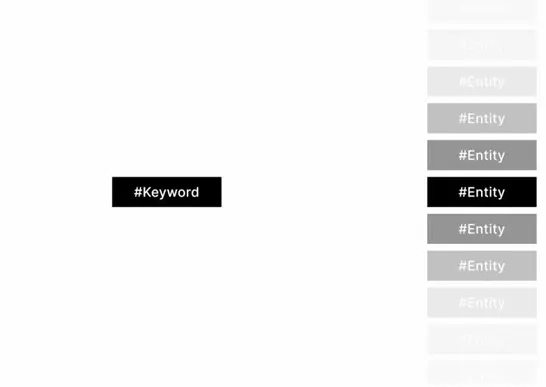
The biggest difference between SEO and GEO lies in what search engines use to understand content.
Traditional SEO operated on "which keywords does this contain." GEO first judges which concept this content is an authoritative source for.
What creates that difference is entity SEO. Content without entity structure struggles to become a candidate for AI answers even when keyword optimisation is strong. Conversely, a site recognised as the entity representing a topic gets called repeatedly into AI summaries and answers.
What entity SEO is
An entity is a distinct concept — an object search engines recognise as a unit of meaning. It is closer to the reality and context a keyword points to than to the keyword itself.
"Running shoes," for example, is one search term as a keyword. To a search engine it is a comprehensive concept with these attributes:
- A type of athletic footwear
- An object connected to foot strike, cushioning and running purpose
- An entity holding relationships with brands, products and usage contexts
Search engines and AI connect these concepts inside a Knowledge Graph. Rather than interpreting one keyword in isolation, they grasp how related concepts relate to each other — and use that structure to judge which site explains the concept best.
From keyword SEO to entity SEO
Traditional SEO built pages around a search term and placed that keyword in the title, body and meta tags. It worked for a long time and has not disappeared entirely.
But its limits are becoming clear in AI search. Search engines no longer look for "the page that used this keyword most." They select the site that has provided the most consistent explanation of the topic — a trustworthy expert that understands and explains the whole concept.
Princeton University's GEO research found that content with clearly optimised entity structure achieved 30–40% higher visibility inside LLMs than content without it.
| Keyword SEO | Entity SEO |
|---|
| Evaluation basis | Word matching, individual pages | Meaning, concept, topic |
| Objective | Drive clicks | Become the source of AI answers |
Topical authority is the trust criterion
Topical authority describes how trustworthy the knowledge a site provides is. Search engines synthesise these signals:
- Has the site covered the same topic repeatedly?
- Are definition, explanation, comparison and usage context sufficient?
- Are the pieces of content logically connected?
- Does the topic match the site's core identity?
Which means improving SEO with one well-written article is no longer realistic.
It extends beyond your site
In GEO, this standard applies beyond the boundary of your own site. It covers not only internal consistency but whether external media and platforms describe your brand in the same context.
When brand descriptions conflict across sources, generative AI either omits the entity from answers or handles it ambiguously.
That diagnosis points at exactly the problem addressed in The AI Entity Footprint Audit.
Three structural approaches
1. Design a clear heading hierarchy
Heading tags are frequently abused for font size or emphasis from a design perspective. But search engines interpret document logic through the H1–H2–H3 hierarchy. Headings listed without hierarchy or coherence blur the content's topic and lose visibility competition.
- H1: contains the single core concept the page addresses
- H2, H3: composed of questions users would realistically ask about that concept, with expert answers
Keep one central concept per page. The more concepts mix on a page, the weaker the topical clarity.
2. Reorganise site structure around topics (silos)
Topical authority is evaluated at the level of category content clusters, not individual pages.
Each category page should act as a central axis representing clear sub-concepts rather than a broad bucket containing every derivative. The more logically sub-content connects, the more the search engine recognises the topic as a single knowledge domain.
Internal link volume does not improve performance either. Links that follow naturally within the same topical context are more effective.
The same principle governs geographic page structure — see Multi-Location SEO: Why a Page per Geographic Keyword Is the Wrong Model.
3. Separate page roles to create depth
Sites with strong topical authority do not give every page the same job. Core pages define what the topic is and why it matters; sub-pages extend comparison, explanation and usage context.
For example:
- Parent: The most important spatial layout principles for studio apartments
- Child: Why bed placement matters in studio furniture layout / Three furniture layout guides for creating storage / How to find a desk position that improves focus / Common layout mistakes in small apartment interiors
Product and service pages are read not as sales pages but as case pages showing how the concept is actually implemented.
GEO as an opportunity
The "zero click" trend driven by auto-generated answers such as Google Overviews has reduced overall clicks.
But it is also an opportunity to exit superficial keyword competition that lacks substance.
Old SEO asked "which keyword will I rank for?" SEO in the AI search era asks "who is most trustworthy on this topic?"
Only brands that can answer that question structurally will continue to be selected in AI search.
For the wider measurement problem in AI search, see AI Halftime Report H1 2026.