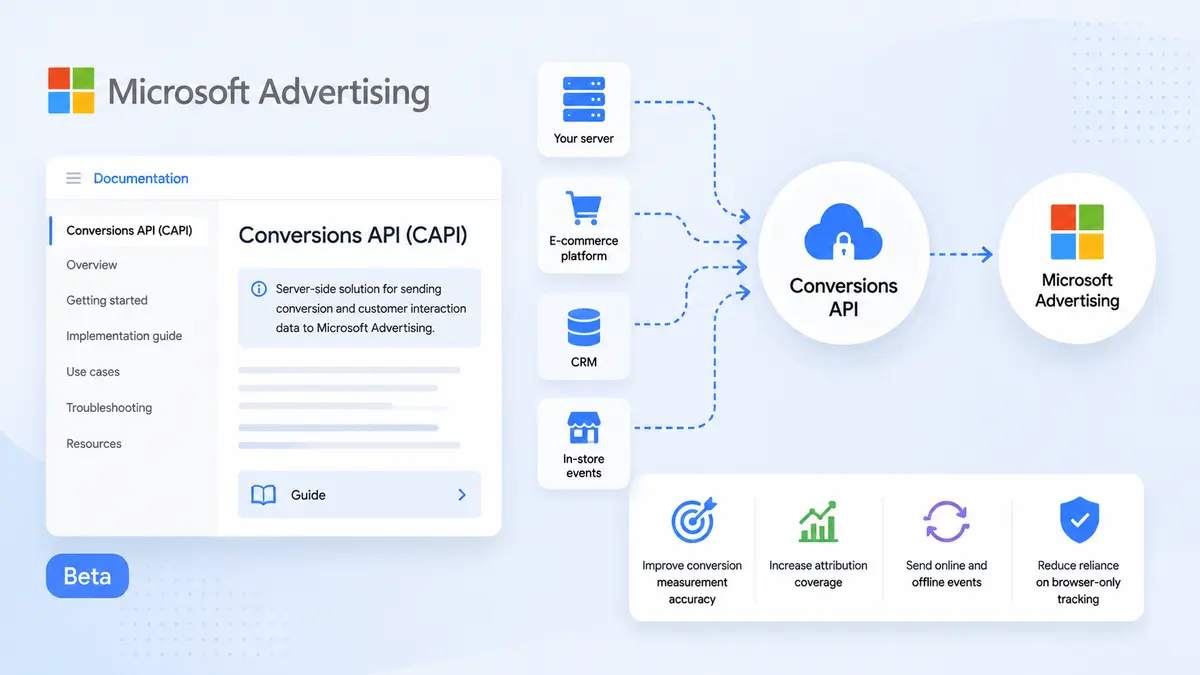
Microsoft Advertising has published documentation for its Conversions API (CAPI), a server-side measurement option currently in beta. It lets advertisers send conversion and customer interaction data from their own systems straight to Microsoft Advertising through a single connection.
What changes
Until now, conversion measurement on Microsoft Advertising has run through UET (Universal Event Tracking) — a JavaScript tag executing in the browser. CAPI adds a server-to-server path alongside it.
Microsoft lists the supported scenarios as:
- Sending online and offline conversion events through one connection
- Improving conversion measurement accuracy
- Increasing attribution coverage
- Reducing reliance on browser-only tracking
The important detail is that Microsoft recommends CAPI alongside UET, not instead of it. UET keeps capturing in-browser activity; CAPI fills the gaps where browser signals are unavailable or limited. Coverage is widest when both run.
Reasons to adopt now, and reasons to wait
The case for adopting is straightforward. If you already run server-side measurement on other platforms, CAPI reduces the numerical drift that comes from measuring each channel a different way. And for conversions that complete outside the browser — a store visit, a phone-closed contract — a server path is effectively the only route into ad reporting.
The case for waiting is equally clear. CAPI is still in beta and is not open to every account. Unlike dropping in a tag, a server integration needs engineering capacity to build and to keep running: event schema definitions, deduplication keys, retry handling when deliveries fail.
Reading it as part of the measurement stack
Taken as isolated Microsoft news, this looks small. Taken against the wider trend, it marks the point where server-side measurement moves from an advanced option to a standard component of the stack.
Adjacent moves point the same way. Google Analytics Adds Custom Conversion Attribution Windows handed advertisers control over the attribution window itself, and the Campaign Manager 360 API's new real-time query endpoint removed the report-generation step between advertisers and their data. All three shift a piece of measurement control from the platform UI toward the advertiser's own systems.
What this means for marketers
Split the decision in two.
First, is Microsoft Advertising a material line in your budget? If it is a secondary channel, building a server integration there first is poor sequencing.
Second, do you already run server-side measurement elsewhere? If so, the calculation changes. Adding CAPI is not building from scratch — it is adding one more destination to an event pipeline that already exists. The marginal cost is low enough to justify moving it up the queue.
Either way, one piece of prep is worth doing now: write down which conversion events your servers can confirm on their own. Purchase completed, contract signed, refund, cancellation. Without that list and a deduplication key for each, no platform's server API can be wired up, because you will not know what you are supposed to send.