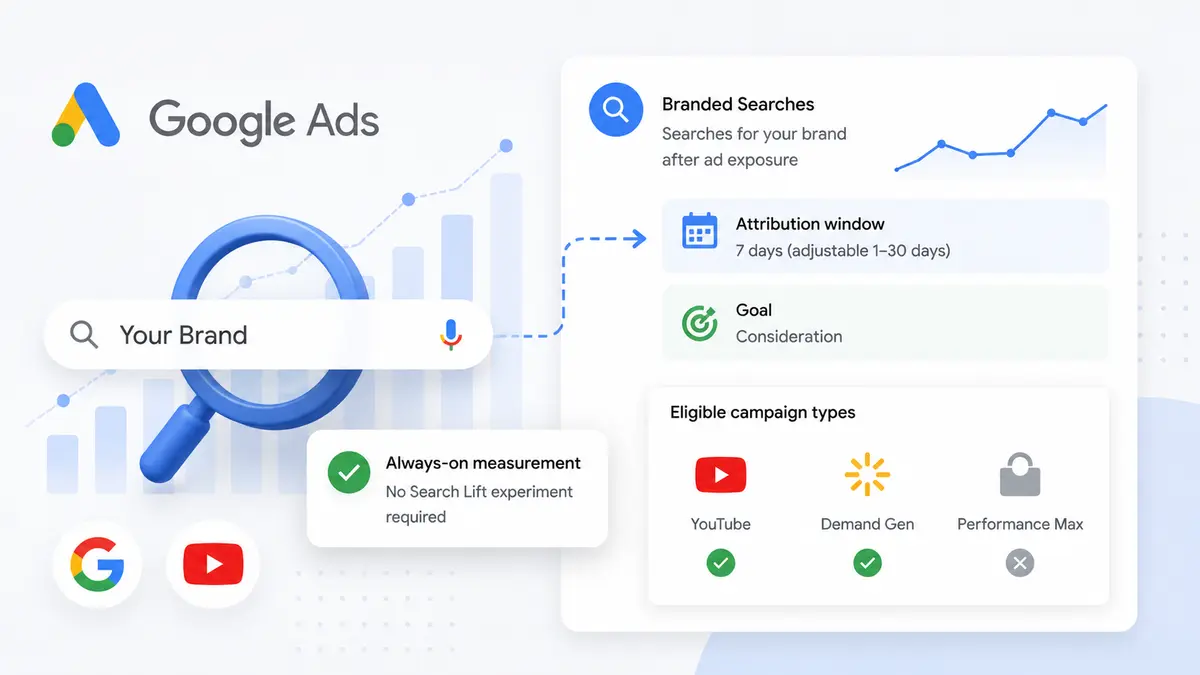
Google has updated its documentation for Branded Searches, the conversion type that measures when someone searches for an advertiser's brand on Google or YouTube after seeing an ad. The conversion type isn't new — Google introduced it in 2025 as an always-on alternative to running Search Lift experiments.
What's changed is how Google now defines its availability, attribution and reporting.
What the update says
Five points are introduced or clarified.
Seven-day default window. Branded Searches now uses a seven-day default conversion window, compared with the 30-day view-through window described at launch. Advertisers can adjust between one and 30 days.
YouTube and Demand Gen. Current documentation lists YouTube and Demand Gen as eligible campaign types. Performance Max, included when Branded Searches was announced in 2025, is no longer listed.
Consideration goal. Google now formally categorizes Branded Searches under the Consideration goal.
Reporting, not bidding. It is treated as a primary conversion action but isn't available as a bidding optimization goal. The data appears in Results and All Conversions rather than the standard Conversions column.
Brand mapping still matters. No Search Lift experiment is required, but Google says brand mapping must be configured for measurement to work.
Branded Searches can be viewed at campaign, ad group and asset levels, as well as through Report Editor. The update was spotted by Hana Kobzova, founder of PPC News Feed.
Why the metric exists
Branded search behavior is a useful signal sitting between an ad impression and a traditional conversion. Someone sees a YouTube ad, remembers the company, and searches for the brand days later without ever clicking the original ad. Branded Searches makes that influence visible inside Google Ads.
Practically, it lets advertisers assess whether upper-funnel campaigns are generating genuine brand interest rather than judging them solely on clicks and direct conversions.
The detail that matters operationally
The headline isn't a new conversion type or a new seven-day window. It is that current documentation lists YouTube and Demand Gen, and no longer Performance Max.
If you have been running PMax as an upper-funnel awareness play and citing Branded Searches as evidence, check whether the metric is still populating in your account. Removal from documentation and removal from an account are not the same thing — but if it underpins your reporting, verify first.
As with Google's confirmed AI Max migration timeline, Google keeps redrawing which capabilities belong to which campaign type. Building performance reporting on a metric unique to one campaign type means the report moves every time that boundary does.
What this means for marketers
The seven-day default deserves scrutiny. The behavior Branded Searches captures is, by definition, delayed — it counts people who search days after seeing an ad. Narrowing the default window from 30 days to seven pushes a large share of that delayed behavior out of the count. If upper-funnel performance suddenly looks different around the documentation update, this may be why.
Since the window is adjustable from one to 30 days, brand awareness campaigns are usually better served by a window matched to category purchase cycles than by the default. For considered purchases, seven days is short.
And remember the bidding constraint. Branded Searches is a judgment metric, not a signal to feed automation. As covered in Demand Gen Shows Why PPC Can No Longer Hide Behind Intent, upper-funnel performance ultimately rests on whether the creative made the brand memorable. Branded Searches is most useful as the instrument that confirms whether that memory actually formed.