U.S. consumer sentiment fell roughly 8% in August after two months of improvement, per University of Michigan research, while an IBM and National Retail Federation study found 39% of consumers trading down to cheaper alternatives. Into that climate, JCPenney launched a campaign that does not shout about price — it dramatizes the cost of trading down.
The structure: a retreat as a frame
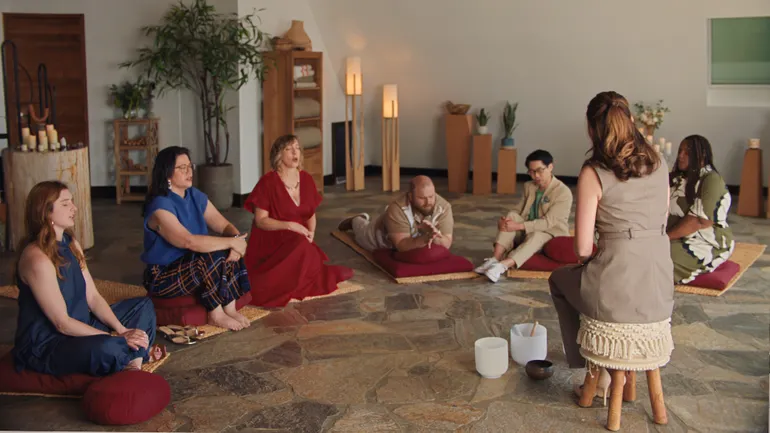
The centerpiece is a four-minute long-form video documenting the "Retail Rejuvenation Retreat," a fictional wellness gathering. Six real off-price shoppers work through mantras, trust falls and primal screams to break their retail habits.
They are encouraged to pass on goods that are stained, wrongly sized or otherwise lacking, and to make savvier choices instead — a Dolce & Gabbana fragrance from JCPenney over an aging bag of fall-themed potpourri. Created with agency Mischief, the four-minute film and 15-second cutdowns run across YouTube and Meta.
Why the message is not "we're cheaper"
Marisa Thalberg, chief customer and marketing officer at parent company Catalyst Brands, framed it as: most Americans are motivated to shop for deals, but deals aren't always all they're cracked up to be. The brand could say that plainly — and sometimes does — but dramatizing it is what makes people reconsider.
In a category saturated with price claims, another price claim disappears. Making the hidden cost of the alternative felt is what sticks. It is a standard workaround for low-involvement categories where price messaging has hit diminishing returns.
The length decision
A four-minute film is inefficient as ad inventory. This campaign treats the long-form as a content asset and buys reach with 15-second cutdowns — a two-tier structure. On designing long-form brand content as episodic rather than as advertising, compare Cuisinart Built a 14-Episode Sitcom for the Feed.
Connecting the film to an in-store action
The campaign does not stop at video. From Aug. 28–30, customers can bring in any "retail regret" and trade it for $15 off a $50 purchase, with the items donated through Good360. JCPenney ran a similar jewelry trade-in around Valentine's Day, and a July Fourth promotion that turned gas receipts into $10 discounts.
The creative idea — discard the regret, choose better — is the same sentence as the promotional mechanic. When those two come from one idea, media spend works harder.
Playing the underdog
JCPenney posted a difficult Q1 2026: total net sales down 4.6% year over year to $1.25 billion, with net losses narrowing nearly 6% to $65 million. Backing from Catalyst Brands, which also owns Aéropostale and Brooks Brothers, provides financial breathing room.
"We'll turn 125 years old next year," Thalberg noted. "We see ourselves as an underdog right now" — the goal being to make people see the brand with fresh eyes, not the existing customers but everyone else carrying nostalgic assumptions. For an old brand with awareness but no consideration, the move is to disrupt perception rather than re-buy awareness.
For another campaign that deliberately keeps the product out of the frame, see Shinola's First Brand Campaign Puts the Watch in the Last Five Seconds.
Takeaways
- When price messaging is saturated, talk about cost instead. The hidden cost of the cheaper option is open ground.
- Tie the creative concept and the promo mechanic to one idea. Otherwise the film entertains and the store stays quiet.
- Long-form does not buy reach — cutdowns do. Long-form earns back through search, sharing and PR.