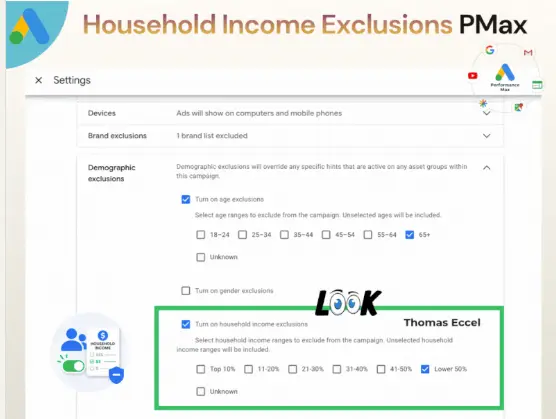
Google appears to be rolling out household income exclusions for Performance Max campaigns, giving advertisers a level of audience control that hasn't previously been available in PMax.
If the feature is widely released, it would allow advertisers to exclude specific household income segments directly at the campaign level.
What's happening
A new setting has been spotted in a European Performance Max campaign that enables advertisers to exclude users based on Google's estimated household income.
The available exclusion options:
| Segment |
|---|
| Top 10% of household income |
| 11–20% |
| 21–30% |
| 31–40% |
| 41–50% |
| Lower 50% |
| Unknown household income |
The feature appears within campaign settings, allowing advertisers to remove selected income brackets from targeting.
Why we care
Household income exclusions could help advertisers in industries where income is a strong purchase signal better align campaign delivery with their target audience.
Those industries include:
- Luxury goods
- Financial services
- Automotive
- Premium home services
Conversely, brands focused on value-conscious shoppers could exclude higher-income segments if appropriate.
Bottom line
Household income exclusions could become one of the more meaningful audience controls added to Performance Max, giving advertisers greater flexibility over who sees their ads while maintaining Google's AI-driven campaign optimization.
First spotted by paid search expert Thomas Eccel, who shared it on LinkedIn.
Practical takeaways
Be clear that exclusion is not targeting. This removes rather than pursues a bracket. It leaves PMax automation intact and only draws the outer boundary — a different kind of control lever.
Don't casually exclude "Unknown household income." It is the riskiest option on the list. Every user without estimated data lands there, so excluding it can cut reach far more than expected. Check that bracket's share first.
Decide whether income is a purchase signal in your category at all. Outside luxury, financial services, automotive and premium home services, exclusions show up as lost reach rather than improved performance.
Remember it is Google's estimate. Not actual income — an estimate advertisers have no way to validate. Testing one bracket at a time is safer than a broad exclusion.
Separate this from the no-impressions problem. Income exclusion is about who sees the ad; products getting no exposure at all is a different failure, covered in Reviving Zombie SKUs.
Read it as part of PMax gaining controls. Review and preview tooling appears in Microsoft Ads Brings Ad Preview Hub to Performance Max, and campaign-goal changes in Google Ads Editor 2.13. Handles are being bolted onto what was a black box.
Treat it as a sighting, not an announcement. This is one setting observed in one European campaign, not an official release. Its absence from your account is not a fault, and the spec may change during rollout.