Google Ads appears to be giving advertisers another way to expand the reach of first-party customer audiences by matching consented users across participating publishers.
What Appeared
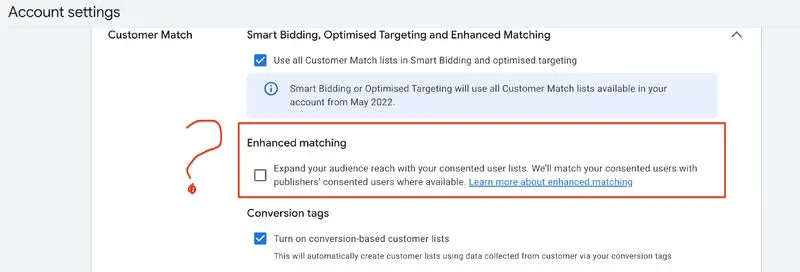
A new Enhanced matching option is showing up within Customer Match settings in some Google Ads accounts.
When enabled, Google says it can use connected customer lists to expand audience reach by matching consented users with consented users from publishers, where available.
The setting appears under Account settings alongside Google's existing Customer Match controls. It appears to be opt-in, shown unchecked in the interface spotted so far.
The setting was first noticed by Joey Bidner, who shared a screenshot on LinkedIn.
How It Relates to Existing Options
Enhanced matching joins several options advertisers can already use with Customer Match data:
- Smart Bidding
- Optimized Targeting
- Conversion-based customer lists
Why It Matters
Customer Match traditionally lets advertisers use their own first-party customer data to reconnect with known audiences across Google properties.
Enhanced matching could extend the usefulness of those lists beyond Google's existing matching capabilities by incorporating consented publisher signals — potentially giving advertisers greater audience reach from the same first-party data without requiring additional customer lists.
Between the Lines: The Word "Consented"
The language around consent is important. Google specifically describes the feature as matching consented users with other consented users from publishers, suggesting the expansion is designed to work within Google's evolving privacy and data-sharing framework.
It also reflects a broader shift toward advertising systems that combine advertiser first-party data with privacy-conscious signals from platforms and publishers.
What Google Has Not Said
Google does not appear to have publicly detailed:
- How much incremental reach Enhanced matching provides
- Which publishers participate
- How the matching process differs from existing Customer Match functionality
Availability also appears limited, suggesting the feature may still be rolling out or undergoing testing.
Practical Guidance
Use the opt-in status. With the default off, you can establish a baseline before enabling it, then test whether expanded reach preserves conversion quality before keeping it on.
First-party data quality is again the prerequisite. This feature amplifies the reach of a list, so a weak list produces weak expansion. Feeding CRM outcomes back into the ad platform follows the sequence laid out in how Google Ads lead quality gets decided in your CRM.
As automation grows, signal control is the remaining lever. Moving in the same direction, Microsoft Advertising is removing Max CPC from new campaigns in favor of target-based control. Whether the subject is audiences or bidding, what platforms leave advertisers to operate increasingly narrows to which data you supply.
Bottom Line
Enhanced matching could make Customer Match audiences more scalable by connecting consented first-party data with additional consented publisher signals while keeping Customer Match at the center of targeting. With incremental reach, participating publishers, and matching mechanics undisclosed, treat it as a controlled experiment for now.