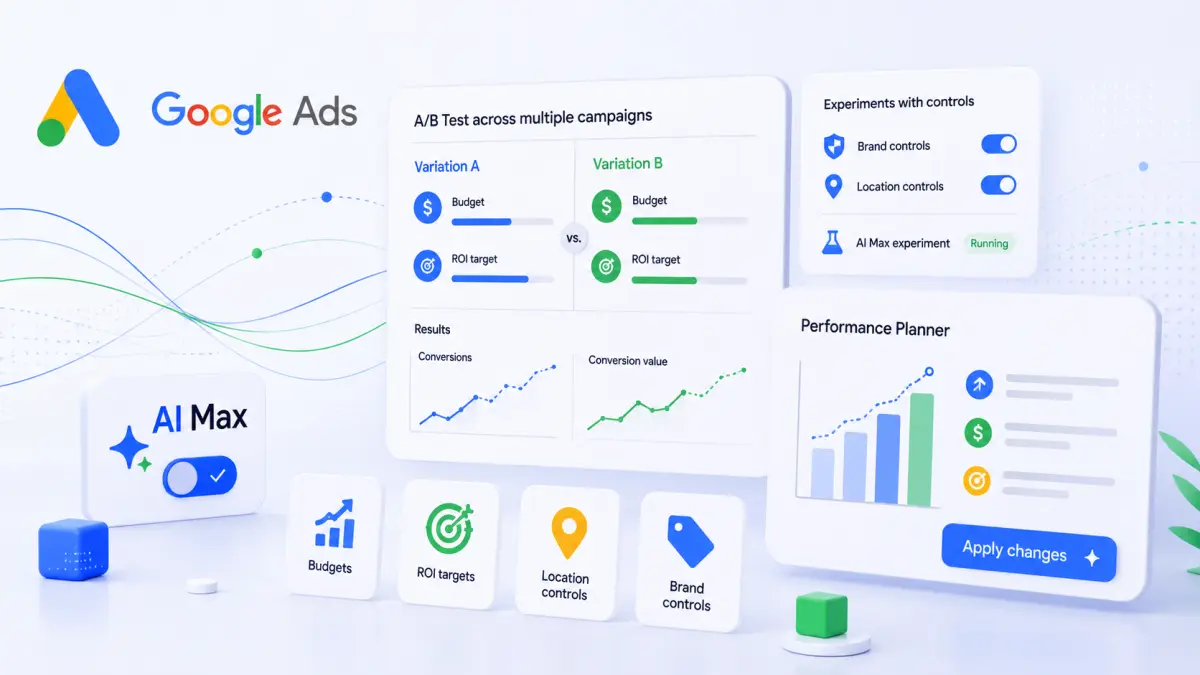
Google is extending AI Max for Search campaigns with testing and planning capabilities aimed at one purpose: letting advertisers understand the impact of budget, ROI target, and setting changes before committing to them.
Three updates matter — multi-campaign A/B testing, experiments that support brand and location controls, and expanded Performance Planner functionality.
From September: Test Multiple Campaigns at Once
Starting in September, advertisers can test different budgets and ROI targets across multiple Search campaigns in a single A/B test. It builds on Google's existing one-click AI Max experiments.
Previous experiments were campaign-scoped. That produced conclusions like "AI Max worked in this campaign" without showing what happens to overall business performance when campaigns scale at the account level. Multi-campaign testing targets exactly that gap.
Experiment With Guardrails On
Until now, advertisers relying on tighter campaign controls had to remove those guardrails to run an experiment. AI Max experiments now support tests with brand and location controls enabled.
This is more consequential than it sounds. Businesses with strict requirements about which brands or geographies their campaigns may target — franchises, dealer networks, regulated categories — no longer have to skip testing entirely.
Performance Planner Expands
Google is adding functionality to Performance Planner so advertisers can forecast how changes such as bidding or budget targets would affect existing campaign performance, then apply Google's suggested changes with one click. The distance between forecasting a change and implementing it gets shorter.
What This Means in Practice
The update reads as a feature release, but it is more accurately a response to the migration timeline. Google has already confirmed the AI Max automatic upgrade schedule. If the migration is happening regardless, the open question is not whether to use it but under what conditions it performs. These tools exist to answer that.
A sensible sequence:
- Test with guardrails on first. Now that it is possible, establish a baseline that preserves brand and location controls.
- Judge on incremental account-level impact. Multi-campaign experiments exist precisely because single-campaign wins can hide account-level cannibalization.
- Treat Performance Planner forecasts as hypotheses. One-click application also makes it easier to apply an untested change.
One broader pattern: as automation expands, the remaining levers are targets and signal quality. Moving the same direction, Microsoft Advertising is removing Max CPC from new campaigns. Platforms across the board are trading manual levers for target-based control.
Bottom Line
Google is pushing AI Max deeper into Search campaign management while building the experimentation and forecasting layer advertisers need to evaluate it. When multi-campaign testing opens in September, it is close to the last clean opportunity to establish a pre-migration baseline.