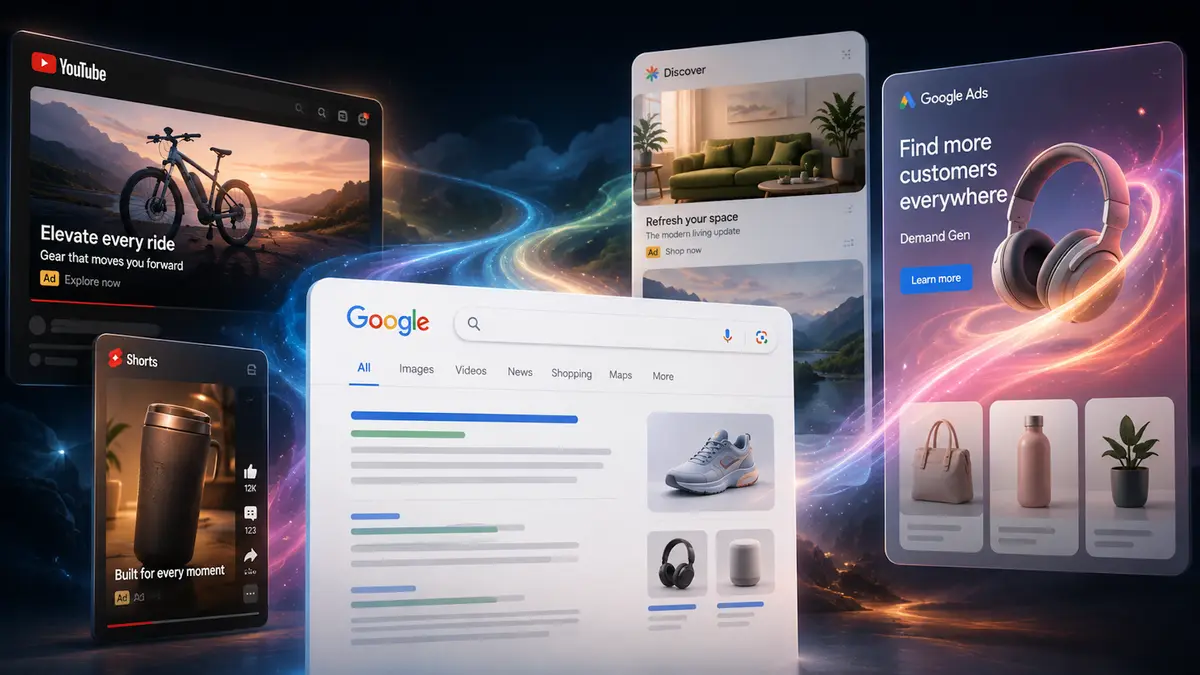
Demand Gen is pushing PPC beyond its traditional role of capturing existing demand. To succeed with it, you increasingly need to understand how interest gets created before someone searches.
Google describes Demand Gen as a campaign type built to drive engagement and action across YouTube (including Shorts and Discover), Gmail, Maps and the Google Display Network. It requires images, video, audience signals, creative concepts, and an understanding of what makes someone stop, watch and care before they have decided to search.
It is one of the clearest signs yet that the PPC specialist role is changing.
Paid search let PPC focus on the final step
Traditional paid search works because the customer tells Google what they want. A search for "buy king size ottoman bed" hands you the product category, approximate size, likely purchase intent and — depending on wording — style or price preference. Your job is to respond to that demand effectively.
That still takes skill. Account structure, bidding, feed quality, landing pages, tracking and query management separate profitable growth from wasted budget. But the customer has already done much of the strategic work: recognized a need, researched solutions, and reached the point of being willing to search.
Demand Gen inverts that relationship. Someone scrolling YouTube Shorts or browsing Discover never asked to see an ad for a sofa, a skincare product or a software platform. The ad has to earn attention and supply a reason to become interested.
Paid search answers an existing question. Demand generation has to make the question feel worth asking.
Demand Gen exposes PPC's creative skills gap
Many PPC teams still treat creative as something somebody else supplies. The specialist sends a designer a list of image dimensions, requests a few videos, uploads whatever arrives — and then discusses performance primarily through audiences, bidding and conversion data.
That position is getting harder to defend.
Google's creative guidance recommends combining images and videos, supplying assets in vertical, square and landscape formats, and creating content that feels native to the placement. Based on its own global campaign data, Google reports that advertisers using both image and video assets in Demand Gen saw 6% more conversions at the same spend than advertisers using images alone.
The exact uplift will not hold for every advertiser, but the broader point does. Creative variety is not decoration. It determines whether the platform has the assets it needs to reach people across placements, devices and stages of consideration. A horizontal brand video may work in a long YouTube session and feel completely out of place in Shorts.
You do not need to be a designer — you need to answer these
- What problem should the opening three seconds communicate?
- Which visual stops the intended audience from scrolling?
- Does the ad show the product, or demonstrate the outcome?
- What objection should the creative address?
- Should this ad educate, entertain, compare or reassure?
- Does the call to action match the audience's current intent level?
Creative strategy is becoming campaign strategy
Take a furniture retailer launching a modular sofa range. A traditional paid search approach targets "modular corner sofa" or "configurable sofa," capturing people already looking.
Demand Gen needs a different starting point. Not "which keywords describe this sofa," but concepts like:
- A small living room transformed by a flexible configuration
- A family adding sections as space or needs change
- Different layouts appearing in the same room
- A comparison between a fixed corner sofa and a modular alternative
- A customer explaining why they needed flexibility
The search campaign captures the person who already wants a modular sofa. The creative campaign gives someone a reason to decide a modular sofa solves their problem.
This changes briefing too. A useful brief identifies the audience, the problem, the desired emotional response, the key product proof, the placement and the next action. The media plan and the creative plan can no longer be separate documents.
Without a keyword, audience understanding matters more
Keywords are a useful shortcut for understanding motivation. Without them, the advertiser has to work harder.
Demand Gen offers first-party data, lookalike segments, optimized targeting, interests and behavioral signals. But selecting an audience in Google Ads is not the same as understanding that audience. A list of targeting settings does not tell you:
- Why the customer might care
- What they already believe
- What is preventing them from acting
- Which benefit feels most valuable
- What evidence they need before progressing
- Which message feels relevant rather than intrusive
In a Google-published case study, UK retailer Ocado found unexpected audience groups — cycling and environmentally conscious segments over-indexed among its customers. It continually tested creative, messaging and audiences rather than relying on a fixed demographic profile, running audience learning, creative development and measurement as one continuous process.
That is a very different skill from adding an in-market audience and checking conversion rate two weeks later.
B2B needs demand creation too
The shift applies squarely to B2B, especially for unfamiliar, technical or high-consideration products.
Consider a company selling an airport boarding ramp that reduces reliance on passenger steps. Search demand exists for "airport boarding ramp," but total volume is permanently capped by how many people already know the solution exists.
A demand creation campaign could instead show the time required to board using traditional steps, the operational impact of poor accessibility, a side-by-side comparison of boarding methods, a short customer case on reduced turnaround, or a demonstration in a live airport environment.
The immediate objective may not be a completed inquiry form. It may be an airport operations director watching a meaningful share of the video, visiting a technical page, downloading a specification, viewing a second case study, or searching for the brand later.
Attention is becoming a performance metric
PPC reporting has traditionally prioritized easily observable actions: clicks, conversions, CPA, ROAS. Those remain essential, but visual advertising raises a question search specialists rarely had to answer: did anybody actually pay attention?
Viewability only confirms an ad had the opportunity to appear on screen. Attention measurement tries to assess whether the user noticed or engaged. In November 2025, the IAB and the Media Rating Council introduced standardized attention measurement guidelines, reflecting how central this has become.
Emarketer notes attention can be evaluated through time in view, scroll behavior, audibility, screen orientation, eye tracking and brand lift research — while cautioning that attention should not be treated as the final business outcome.
That distinction matters. A video can attract attention without producing profitable customers. An ad with a low click-through rate may still drive brand searches, direct visits and later conversions. The aim is not to replace conversion measurement with softer engagement stats — it is to understand the sequence between exposure and conversion.
Indicators worth watching
Video completion and retention rates, engaged-view conversions, view-through conversions, brand search volume growth, new-user visits, follow-on YouTube views, assisted conversions, incremental search or conversion lift, and creative-level differences in conversion and engagement.
Search takes credit for demand created elsewhere
Someone sees a compelling YouTube ad for a beauty product. They do not click. Two days later they search the brand, arrive through a paid search ad, and purchase.
Last-click gives the sale to paid search. In account reporting, the brand campaign looks highly efficient and the video campaign looks like it produced nothing — when the search might never have happened without the original creative.
This is one reason upper-funnel campaigns get switched off too quickly: they are judged using the measurement model of a channel built to capture immediate intent. Google has highlighted Fospha research suggesting last-click attribution can significantly undervalue YouTube and Demand Gen.
Better evaluation combines platform attribution, GA4 journey analysis, CRM data, brand search trends, geographic or audience experiments, lift studies and marketing mix modeling. Not every advertiser has the budget or data for all of it. Smaller advertisers can still compare exposed and unexposed audiences, track branded demand, review assisted journeys, and give campaigns enough time to influence behavior.
Attribution settings themselves recently loosened, which bears directly on this: Google Analytics Adds Custom Conversion Attribution Windows now allows engaged-view windows well beyond the old three-day fixed limit.
Demand creation in practice
Ecommerce — show the outcome, not just the product. A cookware retailer could advertise a premium pan with a clean product shot and a discount. A stronger concept highlights a common problem — food sticking, needing several pans for one meal — before demonstrating the fix. The first ad displays an item; the second creates a reason to want it.
Professional services — turn an ignored problem into an urgent one. An accountancy firm targeting growing ecommerce businesses will struggle with generic "expert accountants" messaging. Creative could instead surface the warning signs of poor financial visibility: not knowing true acquisition costs, relying on incomplete channel reports, discovering unexpected VAT liabilities.
B2B software — lead with the inefficient process. Do not assume the audience is searching for your product category name. A short video showing the manual spreadsheet, repeated data entry or reporting delay works because the audience recognizes the frustration without knowing the category.
High-consideration purchases — create early intent. Zoopla used Demand Gen to reach people before they were ready to sell their home, with short video cut-downs and static imagery built on the emotional highs and lows of moving, plus a clear action: check a property valuation. Using life-event audiences and lookalikes from registered homeowners, Zoopla reported a 14% increase in valuation searches and a 28% increase in leads, alongside gains in ad recall and awareness.
What PPC specialists need to learn next
Technical foundations still matter — conversion tracking, commercial analysis, bidding, feeds, account structure. They now need company.
Creative diagnosis — explain why an asset is or is not working, beyond which image has a higher CTR: message, hook, format, pacing, product visibility, audience fit.
Research and customer understanding — search term reports reveal existing demand. Reviews, sales calls, CRM notes, social comments, customer interviews and competitor creative reveal why that demand exists.
Better creative briefing — define the customer problem, awareness level, promise, proof, objection, desired action and required formats. Not dimensions and character limits.
Experiment design — testing one random video against another teaches little. Compare a product-led concept against a problem-led one, testimony against demonstration, emotional messaging against rational cost-saving.
Full-journey measurement — separate the metrics used to optimize a campaign from those used to judge its business value.
PPC can no longer be separated from marketing
Demand Gen matters not because it is another campaign type, but because it removes one of PPC's traditional protections. There is no keyword supplying the complete message, no guarantee the audience is already interested, no search query confirming exactly what the customer wants.
The advertiser has to understand the customer, earn attention, communicate value and give a reason to take the next step. Those are skills PPC teams have sometimes dismissed as belonging to brand, social or creative. They are performance skills now.
Paid search will keep capturing existing demand. But businesses cannot grow indefinitely by competing for the same people already searching — volumes have limits, auction costs rise, competitors bid on the same terms. The bigger growth opportunity usually sits earlier, before a person has chosen a solution, searched for a supplier or formed a brand preference.
For creative designed as IP rather than as an ad asset, see Cuisinart Built a 14-Episode Sitcom for the Feed. On why a distinct point of view is becoming the differentiator, see Adobe: In the AI Era, Point of View Is the Differentiator.