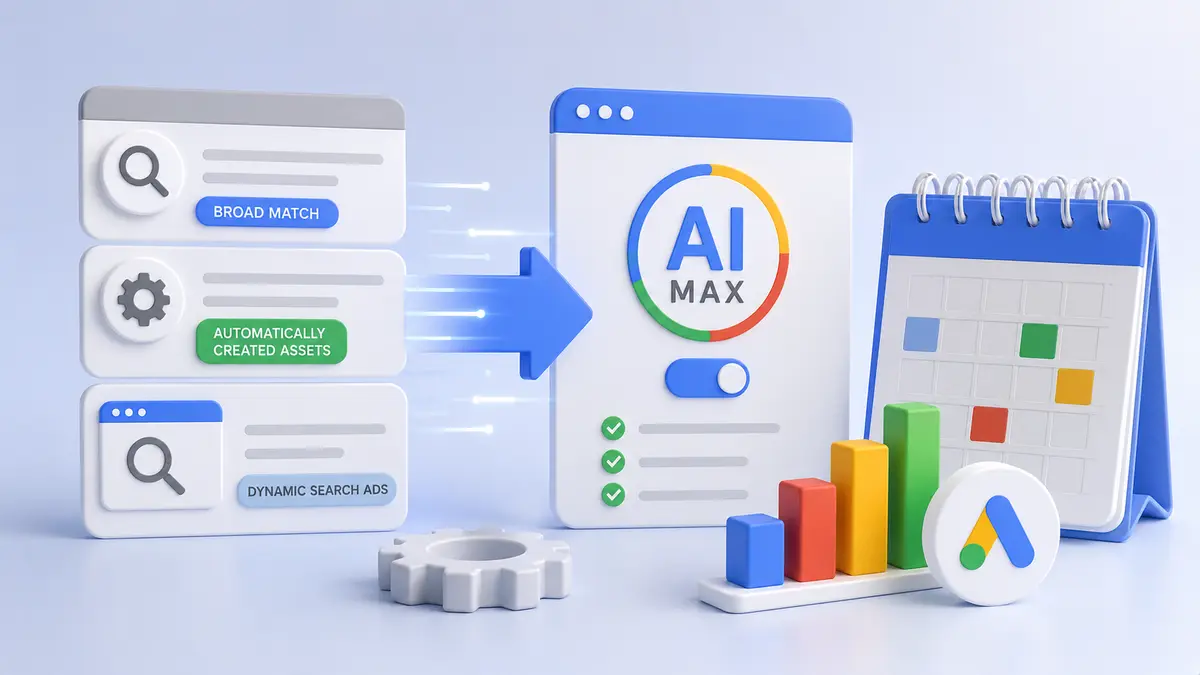
Google has published the timeline for automatically migrating legacy Search campaign features to AI Max. The transition begins in September 2026 and runs into early 2027, covering Campaign-level Broad Match, Automatically Created Assets (ACA) and Dynamic Search Ads (DSAs).
Automatic upgrades begin September 1
Starting September 1, Google will automatically upgrade Search campaigns using Campaign-level Broad Match or standalone Automatically Created Assets to AI Max. The rollout is gradual across the month rather than a single switch.
Google says campaigns will be migrated in place using equivalent AI Max settings to minimize disruption, and that existing brand inclusions and exclusions carry over automatically.
Creation was already blocked
The part that has already happened matters more. On August 3, 2026, Google stopped allowing the creation of new Campaign-level Broad Match configurations and legacy ACA campaigns — across the Google Ads interface, Ads Editor and the API.
You cannot create them now, and from September the existing ones go too.
Dynamic Search Ads get more time
Unlike Broad Match and ACA, DSAs do not migrate until February 2027. Google plans two rounds of warning: in-account notices encouraging voluntary upgrades starting in September, and reminder notifications in January, before automatic upgrades begin in February.
The dates, condensed
- August 3, 2026 — creation of new Campaign-level Broad Match and legacy ACA blocked across UI, Ads Editor and API
- September 1–30, 2026 — automatic migration of Broad Match and ACA campaigns to AI Max
- September 2026 — in-account notices begin, encouraging voluntary DSA upgrades
- January 15, 2027 — reminder notifications to advertisers still running legacy DSAs
- February 1–28, 2027 — automatic DSA migration begins; creating new DSA ad groups is permanently removed
- Approximately September 2027 — older Google Ads API versions supporting legacy Broad Match and ACA entities reach scheduled sunset
What API teams need to check
API versions released after September 1 remove support for legacy Campaign-level Broad Match and ACA entities entirely. Older versions keep working until their normal sunset — expected around September 2027 — which leaves roughly a year to update integrations.
Google recommends auditing scripts and tools now to confirm they use AI Max settings rather than deprecated structures.
The practical read for marketers
The most operationally important sentence in this announcement is not "campaigns will migrate automatically." It is that creation was already blocked on August 3 — an irreversible step had passed before the timeline was even published.
Three things to do now
1. Scope the impact. Pull a list of every campaign in the account using Campaign-level Broad Match or standalone ACA. You cannot control when in September each one flips, but you should know what is changing.
2. Save a pre-migration baseline. "Migrated in place" still means different bidding logic and different match coverage. Without August performance data stored separately, you cannot separate migration effects from seasonality after September.
3. Plan the DSA replacement early. February 2027 sounds distant, but accounts leaning heavily on DSAs need testing time to reproduce that coverage in AI Max. That is precisely what the voluntary upgrade window is for.
The larger pattern
Google's direction is consistent: remove manual switches from advertisers and move the decision into automation. Google Ads Is Removing Language Targeting From Search Campaigns, announced the same week, points the same way — and lands in the same month.
Two changes in one month means attributing any September performance shift to a single cause gets much harder. Keeping a dated change log has never mattered more.
The surface-by-surface exception pattern continues too, as Performance Max Adds Local Customer Optimization — but Not Alongside Merchant Center shows. The rules are not simplifying; the list of conditional exceptions is growing.