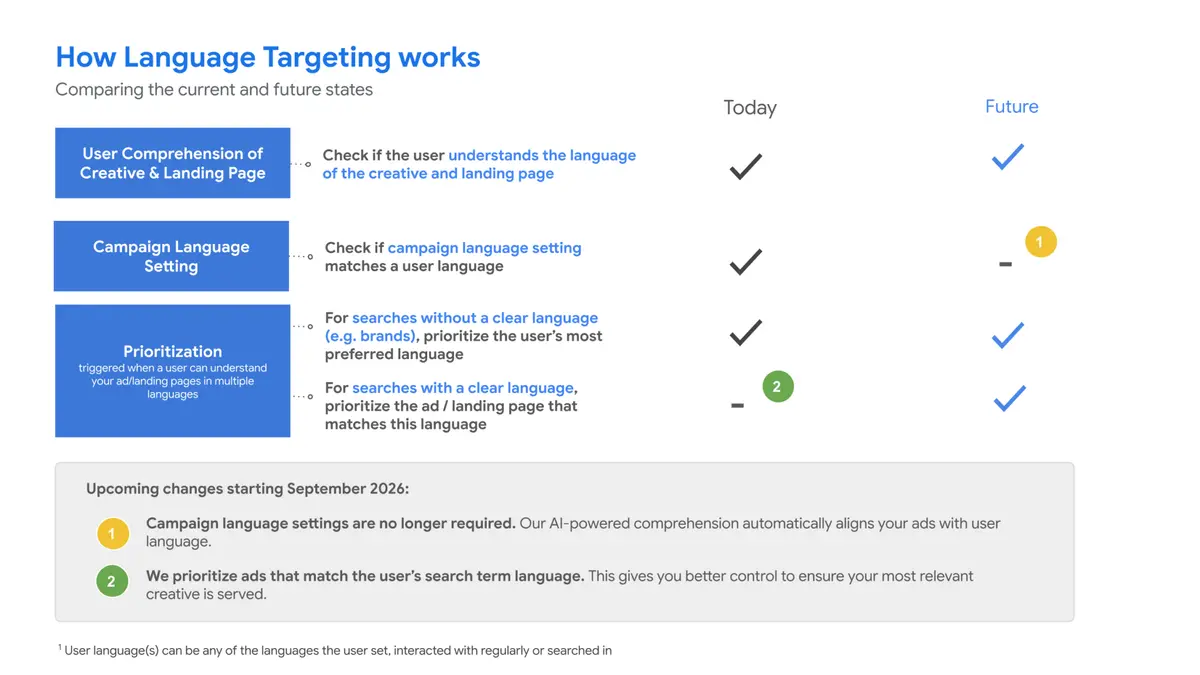
Google is removing campaign-level language targeting from Search and AI Max for Search campaigns, starting in late September 2026. Instead of advertisers explicitly selecting target languages, Google will decide which ads to serve using the language of the ad combined with signals about which languages a user understands.
What changes
Search and AI Max campaigns
The campaign-level language targeting setting disappears. Google says Search ads will match automatically based on the language of the ads.
Performance Max changes only halfway
Performance Max is more nuanced:
- Google Search placements: campaign-level language settings no longer apply; matching works like standard Search campaigns.
- YouTube, Display, Discover and Gmail: advertiser-selected language settings continue to guide delivery.
- Shopping ads within Performance Max: unaffected by language settings.
So language settings do not vanish from Performance Max — their applicability now varies by surface.
How Google decides language
Google already looks beyond interface language. On Search, the signals include the language of the search term, the user's language settings, and other preferences.
Someone whose browser is configured in Spanish but who habitually searches in English could receive ads in either language. When multiple eligible campaigns exist, AI-based ad group prioritization picks the candidate whose language best fits that user's context.
What API teams need to change
Teams creating or managing campaigns through the Google Ads API have work to do:
- Google recommends discontinuing the use of language criteria when creating or updating Search campaigns.
- Existing language criteria can remain but no longer affect targeting, and can optionally be removed.
- Attempts to add or update
CampaignCriterion.language on Search campaigns return a ContextError.OPERATION_NOT_PERMITTED_FOR_CONTEXT error.
- Performance Max does not return that error, because language settings still influence its non-Search channels.
The practical read for marketers
Google says no action is required for existing campaigns. Taking that literally is risky for one group: advertisers running multilingual campaigns.
When the manual switch disappears, the basis for the decision moves to the language of your creative and landing pages. Loose creative used to be survivable because campaign settings narrowed the audience. From late September, the creative itself is the targeting signal.
Three things to check now
- Creative language consistency — confirm no ad group mixes creative in multiple languages.
- Landing page language structure — a mismatch between ad language and destination language converts directly into bounce. Audit the multilingual structure,
hreflang included.
- Post-launch monitoring — track language-level impression distribution separately for at least two to four weeks after the change lands.
This fits a pattern: strip out manual controls, move to automation, but leave surface-specific exceptions behind. It mirrors Performance Max Adds Local Customer Optimization — but Not Alongside Merchant Center. The rules are not getting simpler — they are becoming a growing list of conditional exceptions operators have to keep current.