Snapchat is a key connective platform for many young users, with almost a billion people logging in every month.
What began as a tool for sharing risqué images and messages has grown into a serious contender in the social media space. It has lost some growth momentum, but still outpaces many apps in attention and engagement.
But Snapchat's more privacy-focused approach can make it difficult for marketers to penetrate. Brand messaging can fall flat and feel disruptive within the Snapchat stream.
Snapchat is addressing this with a range of new ad options. Still, brands looking to build a presence need to do their research first.
1. Research the competition
This is where Snapchat differs most from other platforms.
Snapchat does not have a comprehensive library or public trends tool, so research is a more manual process.
Marketers should combine in-app exploration with Snapchat's official business resources.
In-app exploration
Search the app for topic keywords, brand names and creators to get a sense of which profiles, content styles and Lenses are resonating with Snapchatters.
A deeper dive into results and related profiles provides useful insight into what connects with the Snap audience.
The Snap Map can also offer context around relevant locations, stores and local trends.
Official business resources
Snapchat provides guides, case studies, measurement materials, webinars and training content to help marketers understand its brand and advertising tools. There is a general overview of ad case studies, and the Snap Focus education platform covers brand tools in more depth.
2. Formulate a brand persona and strategy
Using insights from initial research, establish what works and what would work best for your brand in the Snapchat context.
That is likely to differ from other platforms, because certain styles of voice and video presentation stand out to Snapchat users more than others.
Brands should establish what other successful brands in their niche are posting and how, then work backwards to consider their guiding persona.
Snapchat provides campaign case studies highlighting successful ad approaches. The company also has new AI-powered capabilities spanning campaign setup and optimisation, creative development, shopping, creator partnerships and conversational experiences.
3. Create a public profile
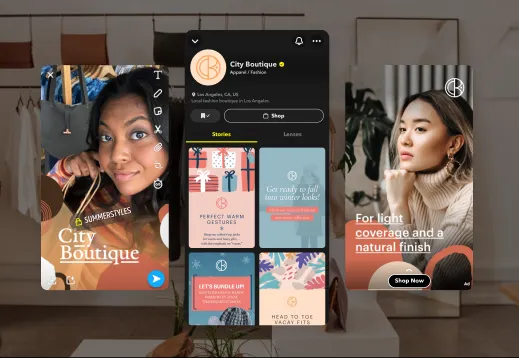
A public profile for brands is a must — it enables all Snapchat users to find and view brand content in the app.
Snapchat describes public profiles as a brand's permanent storefront, and marketers can use it to showcase products and services.
Brands should set up their profile to align with audience expectations.
The Snap Creator Network
The company also announced a Snap Creator Network launching later this year.
The AI-powered system aims to simplify creator discovery and campaign activation and help brands find the right partners.
Marketers will be able to describe the creators they are looking for — audience, tone, category and campaign goals — and AI will help find creators that fit.
4. Analyse and improve
With an organic strategy in place, use Snapchat's analytics to examine performance and improve.
Practical notes
Budget more research time. No public trends tool means higher research effort than other platforms. Failing to plan for that cost means launching unprepared.
Do not port creative from other platforms. The observation that brand messaging feels disruptive in the stream points precisely at the risk of format transplantation. Learn Snapchat's native expression first.
Design the public profile as a storefront. It needs treating as a permanent asset, not a campaign account.
Read it alongside the paid lead gen tooling. Organic presence and performance tools reinforce each other on one platform — see Snapchat Integrates With HubSpot.
Split the approach by platform. For the per-platform sequences see Six Ways to Build a Brand on Pinterest, and for the shared principle see The New Fundamentals of Social Brand Strategy.