Social media engagement has changed a lot over the past five years. With the rise of short-form video and algorithmically defined recommendations, social apps turned from connective tools into entertainment alternatives.
That matters for brand strategists for one simple reason: the actual reason people use social media has changed.
They are no longer looking to engage with brands via posts and uploads. Text updates with a few hashtags will not do it.
Shifting into an entertainment mindset
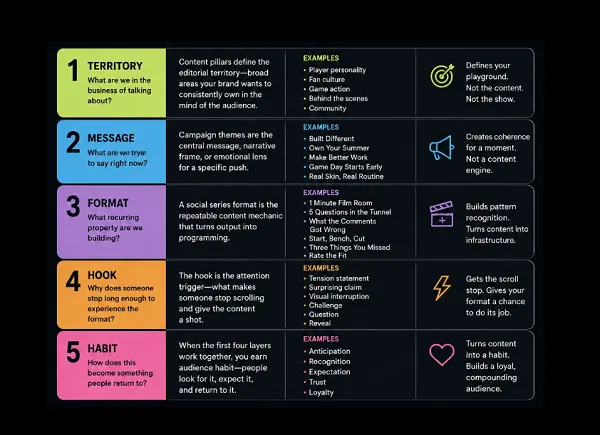
To connect, brands need to shift into the entertainment mindset too. Aligned with defined branding pillars, that means outlining a more consistent approach to brand building through dedicated formats.
Association via consistent messaging can be a significant driver of brand opportunity.
That is the focus of a brand strategy outlined by Nick Cicero, founder of Mondo Metrics, who has spent two decades in social media marketing focused primarily on metric analysis and optimisation.
The unit of value has changed
Cicero's framing carries the argument:
"The brands that will win are not just the ones with the most output, the fastest editors, or the best trend reflexes. They are the ones that understand the real unit of value in modern social is not the individual post. It is the recurring content property."
A repeatable format, recognisable packaging, consistent talent or premise, and structural familiarity help an audience build a relationship with a brand and come to expect their content in their feeds.
The instruction is to stop competing on post count. Making more is easier than making something recognisable — and worth considerably less.
The four-part framework
Cicero breaks the content strategy approach into four key elements.
1. Territory
Define the broad areas a brand wants to own in the mind of their audience.
A sports brand may focus on fan culture; a B2B brand could make executive insights their focus. Fail to narrow here and the other three elements scatter.
2. Message
The core message the brand wants to underline with its content approach.
Understanding the value of the brand's offerings to consumers is key. It requires considering why a product is important and what it helps address in the user's life.
3. Format
Cicero says a dedicated approach to a content format — a regular interview series, or explainer overviews of technical elements — reinforces brand association and habitual engagement.
This is where most brands come up short. Content made in a different shape every time does not accumulate, however good each piece is.
4. Hook
A content series needs a hook. But Cicero is keen to note that brands must also follow up on that initial hook to build community and audience.
The hook is an entry point, not a finished job.
Make it the guiding star
Cicero advises marketers to establish this approach as their guiding star and commit to creating content along that line in order to build habitual engagement with the target audience.
Using entertainment as the focus, aligned with these branding elements, reinforces core messaging and helps establish brand placement and value.
That is more in line with modern social media usage: people are no longer focused on connection and friend engagement so much as using social apps as an entertainment source, with recommended videos rolling through their feeds.
Putting it to work
Restructure the content calendar around series. Build it from two or three recurring properties rather than a list of individual posts. Give each series a name, a format and a publishing cadence.
Treat consistency as a staffing problem. Recurring formats depend on consistent talent or premise. If the format wobbles every time the owner changes, accumulation resets to zero.
Read it alongside declining posting volume. The trend toward posting less is covered in Social Media Is Becoming Less Social: 55% Post Less Than Five Years Ago. In an environment where output volume stops paying, a recurring-format strategy gets more persuasive.
Fix the platform basics first. A framework only works on top of solid execution. Five Ways to Build a Brand Presence on TikTok Before the Second-Half Push covers that checklist.
Chasing trends is fast. Building a format is slow. Only one of them compounds.