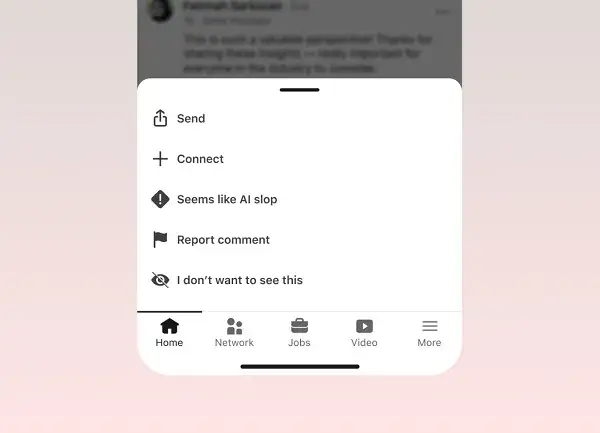
LinkedIn has shared early numbers on the "seems like AI slop" reporting option it launched earlier this month. In its first two weeks, more than a million people used it. And overall content LinkedIn classifies as AI slop is now seeing 40% fewer views than a few weeks ago.
What LinkedIn Means by 'AI Slop'
Sam Corrao Clannon, LinkedIn's Creator Product Lead, gave a precise definition:
"We internally define AI slop as content that is potentially sophisticated or polished in its presentation, but lacks substance. So it doesn't have any particular experience, perspective, or insight, but is sort of just empty text that's posted to take up space and garner attention without effort on the other side."
An important qualifier follows. The option is not aimed at AI use in post creation generally — using AI to refine your language is explicitly fine. The target is junk posts people do not want to see.
Reporting Is Feed Control, Not Enforcement
This is where marketers most often misread the feature. A report does not automatically suppress reach.
Corrao Clannon was direct that the option is not "a reporting path for policy violations." It gives individual users more control over their own feed while giving LinkedIn insight into what members consider low-substance, low-effort content.
Chief Product Officer Hari Srinivasan added that no single piece of feedback determines distribution.
"We look at many signals together, and we've built safeguards to help prevent individual feedback from being used to unfairly target other members."
So: a user who reports will likely see less from that creator. Overall post performance moves only when many users flag the same concern.
Notification Before Consequence
LinkedIn is rolling out notifications to users who accumulate a high volume of AI slop reports, alerting them to the issue.
That is informative rather than punitive — telling creators how their posts are landing instead of restricting the account. It fits the broader pattern of platforms building slop antibodies, though LinkedIn's version is notably gentler.
Verification connects to the same effort. LinkedIn continues pushing members through its process for confirming they are real people, and now uses that status as a signal so users can filter responses.
What B2B Marketers Should Check Now
1. Separate refining from replacing
LinkedIn stated that using AI to polish language is acceptable. The failure mode is handing over the whole post when there is no experience, perspective, or insight underneath. The same signal appeared when LinkedIn first opened AI slop reporting and simultaneously removed its 'Enhance Your Post' tool — the platform pulled back its own AI writing assist.
2. The 40% drop already happened
There is no basis for assuming you are unaffected. Slop-classified content has already lost 40% of its views. If your LinkedIn reach fell recently, the cause may be classification rather than an algorithm change.
3. Audit employee accounts the same way as the brand account
Thought-leadership posts going out from personal profiles are frequently template output. Personal accounts collect reports faster than company pages do.
Srinivasan's closing line frames the direction: "Despite the progress, we know we have more to do to ensure LinkedIn remains a place where you can find real people and real perspectives."