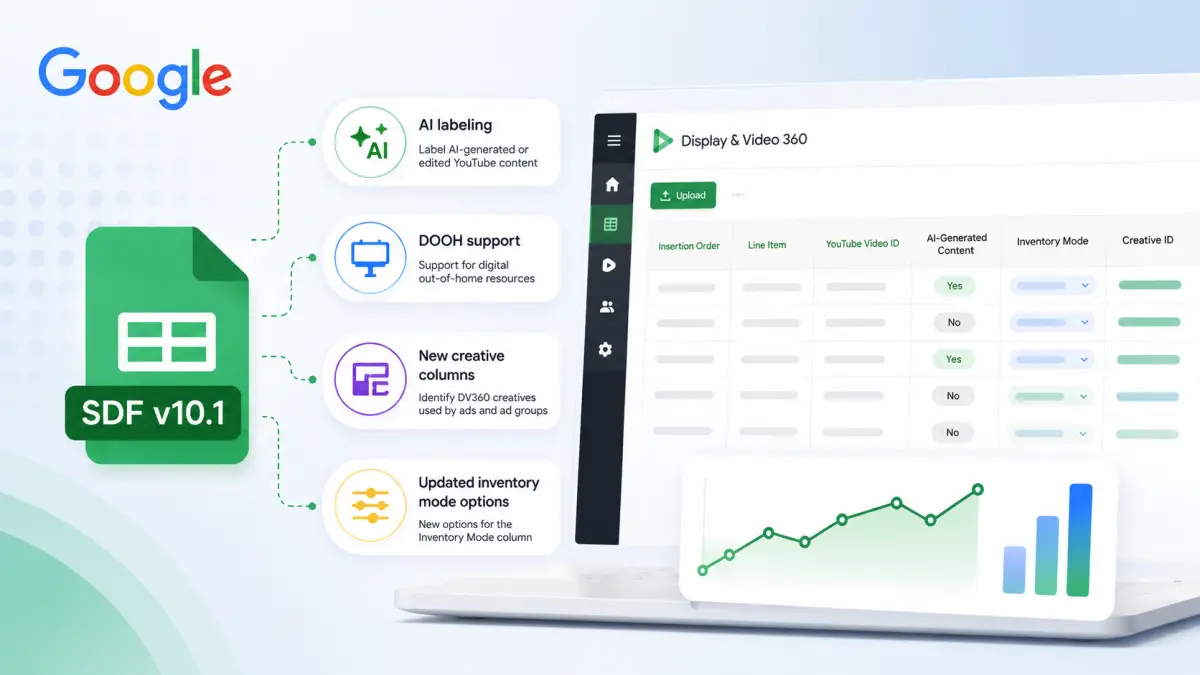
Google released Structured Data Files (SDF) v10.1 for Display & Video 360, adding support for AI transparency labels, digital out-of-home (DOOH) campaigns and new reporting fields, while deprecating versions earlier than v10.
The update gives advertisers and developers more control over campaign management through bulk uploads and downloads.
What's new
SDF v10.1 is now generally available for all Display & Video 360 users:
1. An AI creation option
A new option to specify whether a YouTube video asset was created or edited using AI, supporting Google's expanding AI transparency initiatives.
2. DOOH support
Support for digital out-of-home Insertion Order and Line Item resources.
3. Creative mapping columns
New columns that identify which Display & Video 360 creatives are associated with ads and ad groups.
4. Updated Inventory Mode values
Updated values for the Inventory Mode column in Line Item files.
Google has also deprecated all SDF versions prior to v10 and is encouraging developers to migrate using its published migration guide.
Why we care
Teams that rely on Structured Data Files to manage Display & Video 360 campaigns at scale will need to update their workflows.
- The AI labelling field aligns SDF with Google's broader advertising transparency efforts
- New DOOH support and creative mapping fields expand what can be managed and audited through bulk operations
Bottom line
Structured Data Files v10.1 brings AI labelling, DOOH support and new campaign management capabilities to Display & Video 360, while marking the end of support for SDF versions earlier than v10.
Practical takeaways
Deprecation is the real deadline. Ending support for everything before v10 takes precedence over any new feature — put the migration guide on the development calendar and start by identifying which SDF version you run.
Treat AI labelling as a bulk operation. Declaring AI creation or editing at the file level means not labelling hundreds of assets one at a time in the UI — a significant difference in the cost of regulatory compliance.
Manage DOOH through the same pipeline. Insertion Order and Line Item support brings digital out-of-home into the same bulk management system as other inventory. Teams running out-of-home from a separate spreadsheet should consolidate.
Use creative mapping columns for auditing. Seeing which creative attaches to which ad and ad group in the file makes cleaning up unused and duplicate creative far easier, affecting both storage cost and approval management.
Assign responsibility for AI label accuracy. A new field also means a new obligation to populate it. Without deciding who verifies and records AI usage in outsourced video, the field simply stays empty.
Read it against the whole AI disclosure trend. The same direction appears in Google Rolls Out AI Content Labels, and the Editor-side equivalent (the User Attestation field) in Google Ads Editor 2.13. Arriving in Editor, SDF and the ad platform simultaneously signals that disclosure is not optional.