"What should we do when AI does the work?" Mobiinside shared a Meta engineer's answer — twelve tips distilled from less than a year of AI-first work that, by his account, completely rebuilt his personal workflow. The framing is developer-flavored, but the rules apply to anyone whose job is being reshaped by AI, marketers included.
Using AI well is now the baseline
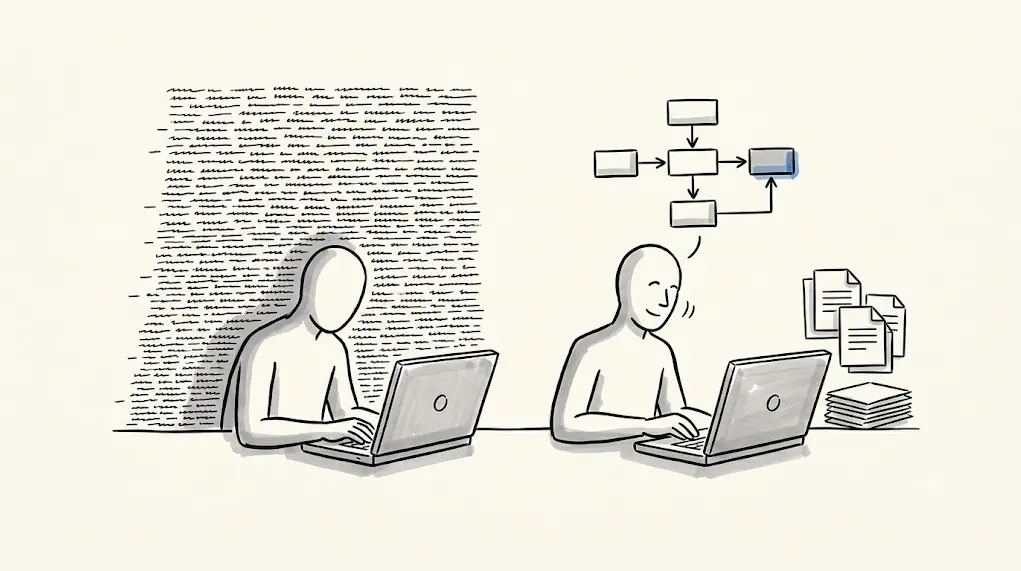
The first cluster is blunt. Being good with AI is no longer a differentiator — it's assumed (tip 1), and the gap is already widening: inside Meta, the best users generate 10–20x the impact while others' productivity barely moves. Becoming "agentic" — understanding prompts, context, token efficiency, and how to encode your company's context for an agent — is where the leverage lives (tip 2). So is using AI to learn (tip 3): the engineer routinely asks agents to visualize unfamiliar systems as infographics, interactive pages, or flow diagrams, which both speeds comprehension and exposes what he missed.
What AI can't give you: failure instincts and taste
The second cluster is the heart of the piece. Knowing where AI fails is learned by doing, not by reading (tip 4). One habit stands out: when a new model ships, he deletes his prompts and starts from scratch — accumulated prompt libraries matter less than quickly re-learning a new model's failure patterns. And taste is the moat (tip 5), with a definition worth keeping: "Taste is understanding the customer's mind." The details that decide quality rarely live in documentation, which is why — counterintuitively — the AI era argues for spending more time with customers, not less.
How he actually works: ship at 70%, ignore titles
The execution rules are concrete. The internal tools that succeed at Meta all shipped before they were finished (tip 6) — with the crucial distinction that "70% polish is not the same as 70% accuracy." Misaligned buttons can ship; wrong results can't. Role boundaries are dissolving (tip 7): PMs code, designers ship, engineers do PM work — through agents. And when you need another team's support, first ask whether an agent can do it instead of waiting in their queue (tip 8).
The rest is direction: aim for the top 1% of your org and have AI propose the ten highest-impact problems to solve, then pressure-test the list with your lead (tip 9); don't confuse using AI with solving problems (tip 10); find the best AI users around you and absorb their workflows (tip 11); and protect your health, because the ceiling on how well you run agents is your own condition (tip 12).
The marketer's translation
Swap "code" for "campaign operations" and every rule still holds. Delegating creative production and reporting to AI is already the baseline; the gap comes from how well you encode your brand's context — tone, red lines, why past work performed — into the agent. That's precisely the conclusion of What Socar and Samjjeomsam Learned the Hard Way — the AI Gap Is Accumulation, Not Tools. And if your team's AI got faster but outcomes didn't, the bottleneck is usually human review-and-decision points, not the tools — the exact pattern mapped in AI Got Faster — So Why Are We Still Busy? The Four Points Where AI Waits on Humans. The engineer's closing line settles the sequencing question: "The gap is smallest today." Skip the grand adoption plan; solve one of your own problems with AI today.