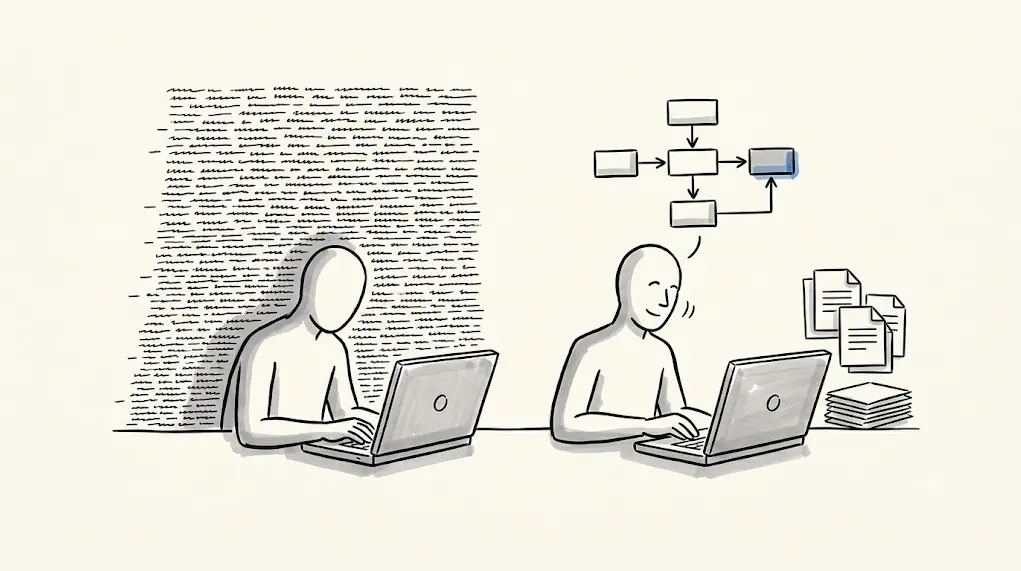
When people can’t keep up with the organization
When a small company becomes a large one, early members often fail to adapt and leave, or stay but stall in routine work. Teams keep their names while roles and goals shift, and constant reorganizations wear people down. Korean strategy planner PETER offers three mental models for career growth in a scaling organization.
1. Avoid operational work
Define “operations” broadly: anything that doesn’t create new change. Even in a planning team, reissuing last quarter’s plan with new dates is operations. It isn’t just setup and reconciliation.
Operational tasks eventually become common knowledge and get treated as simple work. When senior, well-paid people settle into operations, a career crisis begins. Two responses:
- Hand off or automate: find ways to transfer or automate work that scales linearly with time — build the fix yourself or propose it. It keeps you from working ten years as if it were one.
- Weave strategy into your work: if you’re changing something over time in a clear direction, operations becomes planning.
2. Absorb new knowledge
It’s painful when someone who only watched revenue must now understand profit, when supply chain specialists must read customer analytics, or when business leads must grasp product. But that discomfort becomes the foundation for growth. If you ignore topics while you’re only copied on them, you’ll soon be the one assigned. The longer your tenure, the more you need to move numbers that matter to overall performance. Corporate life, the author says, ultimately teaches you to think like a business owner — so explore widely now, while not knowing everything is still low-risk.
3. Shared change arrives fast
Assume any stated strategic direction will happen. There’s a big gap between people who proactively reflect it in their work and people who defend themselves when chopped-up instructions land on their desks. Saying “Here’s how I plan to do this — does that fit?” before being told “Do this” is how people move up.
Drawing rigid lines between “my job” and “your job” signals a desire to stay at the practitioner level — and such work tends to be operational. Review regularly: what can you stop doing, and where are you supplying work nobody demands out of inertia?
Applying it to marketing teams
Marketing teams face the same trap: the same monthly report format, the same campaign setup. Hand repetitive work to AI and automation, then spend the time on revenue, margin and customer data together. The shift toward role maps over tenure charts in startup HR hiring tells the same story. But organizations must give people reasons to grow, too: as research on why employees hide their AI use shows, if efficiency only earns more work, people hide change. Organizations evolve constantly; those who first ask what they’ll become keep growing.