Check ad performance in the morning, discuss creative strategy with an AI, iterate on copy drafts, set up the campaigns. The only visible change from a few years ago is one more AI window open on the desktop — individual tasks finish faster, but the shape of the day hasn't changed. That confession from a marketer at Korean adtech firm Buzzvil matches the macro numbers: Gartner projects that by 2028, 15% of day-to-day work decisions will be made autonomously by AI agents (effectively 0% in 2024) — while also predicting over 40% of agentic AI projects will be canceled by end of 2027, citing costs, unclear business value, and weak risk controls. Where does the gap come from? A former Buzzvil CPO, now founder of Silicon Valley AI-teammate startup RunBear, offers a precise diagnosis: AI waits on humans at exactly four points.
Who's in the driver's seat?
The framework starts with two modes of AI use. AI-assisted: the human decides, asks the AI, gets an answer, and executes. AI-driven: the AI carries the work forward and calls the human only when judgment is needed. It's the difference between the human staying in the driver's seat and the AI driving, handing over the wheel only at key moments. The constraints on AI-powered work have fallen in order — tokens, then compute — leaving one final bottleneck: human attention. Paradoxically, the better AI gets, the more the blockage shifts from the tool to the person.
The four points where AI waits
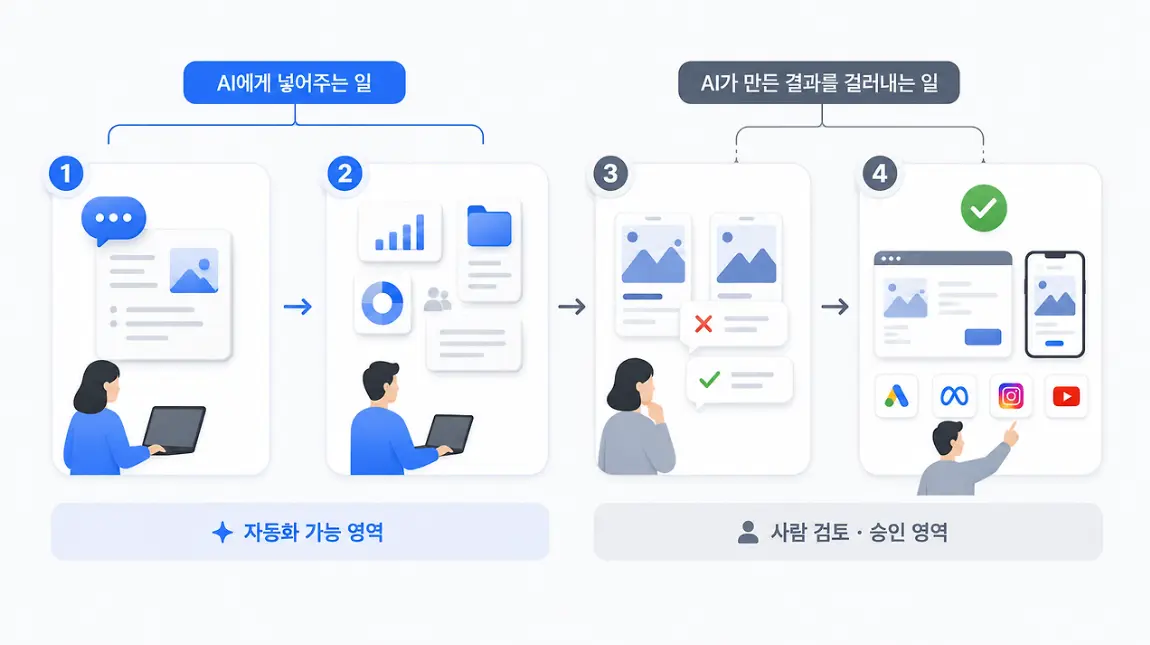
Mapped onto a marketer's day: you instruct (write the brief), inform (dig up past campaign results, brand guidelines, audience definitions), review (read every generated ad and copy variant), and release (get approval, set the campaign live). Most AI use today requires a human at all four.
The crucial insight: the four points differ in kind. The first two feed things into the AI; the last two filter what the AI produces. Automate only the front half and you create a problem — if creative output grows tenfold but review and approval stay manual, organizational throughput doesn't grow tenfold. The bottleneck didn't disappear; it moved downstream. That's exactly why teams often feel busier in their first months of serious AI adoption.
What remains is defining "good" in words
When you could only produce three creatives, the skill was choosing which three to make. When you can produce thirty, the skill becomes judging which of the thirty are good. The problem: most teams don't hold that standard in explicit language. A few reference images and "something like this" worked when the recipient was a human who remembered past work and filled gaps with intuition. Hand the work to AI and every piece of tacit knowledge comes due: what makes a creative good, which phrasings are on-brand and which never are, what you won't run even if it lifts CTR, what can ship automatically versus what needs human eyes. Without written standards, you re-explain the brand voice every request, outputs vary wildly, and the team concludes it's faster to do it themselves. Not because the AI can't — because nobody ever defined what passes.
Our take: diagnose the bottleneck before buying another tool
Ask where your team's AI stopped today: did work stall waiting for the next instruction (instruct)? Did someone paste the same brand deck into a chat for the third time this week (inform)? Has generated creative volume exploded while shipped creative volume stayed flat (review)? Is approval wait time the longest stage of the lead time (release)? This isn't just a Silicon Valley story — Korean companies converged on the same conclusion through trial and error, as we covered in What Socar and Samjjeomsam Learned the Hard Way — the AI Gap Is Accumulation, Not Tools.
And the fix for the review bottleneck is ultimately the craft of delegation: deciding which gates require your judgment instead of inspecting every step — precisely the frame from Jensen Huang Broke the Seal — What Separates Micromanaging From Delegation Is the Kind of Gate. Write the standards down, choose the gates, delegate the rest. Only teams with explicit standards get to move humans from execution to judgment.