Socar product lead Lee Woo-cheol and Samjjeomsam marketing lead Kim Bo-kyung of Jobis&Villains sat down for a conversation with one question: how does a platform that outgrew its flagship service build the next stage of growth?
Both companies operate at scale. Socar runs roughly 5,000 pickup zones and 20,000 vehicles with over 10 million members. Samjjeomsam has 24.5 million registered users and 2.076 trillion won in cumulative refund claims — 70% of Koreans name it first when they hear "tax refund," and 90% recognize the name. Kim calls that recognition "an asset that costs nothing to explain."
The most useful part of the session was not how well either company used AI. It was where each of them failed — and the failures, drawn from different industries, pointed at the same thing.
One hundred people were building one hundred different services
Socar ran a company-wide new business idea competition early this year with a substantial prize. Ideas and prototypes poured in. What Lee found when reviewing them was 100 employees building 100 unrelated services.
Everyone had free access to AI. But their understanding of what the product should be varied, so the output fragmented accordingly.
The fix was a standard, not a better tool
Socar's answer was a design system — a company-level parts bin standardizing button shapes, colors, font sizes and spacing. The team accelerated work started the previous year, shipped it company-wide, and rebuilt it into a structure AI could read and apply. From then on, whoever built something produced output that looked like Socar.
The speed gain was dramatic. A recent new service went from front-end UI to admin, back end and database design in one month with one PM and one engineer. Simple prototyping now takes hours; a finished service with consistent UI takes days.
The most telling example was a booking calendar UI — built by a marketer, not an engineer. Working from the design system, they had AI write the code and shipped it with their own booking copy. Previously that request would have sat in an engineering queue until it quietly died.
They delegated who to message, not what to say
Samjjeomsam started from the opposite direction and landed in the same place.
Its main acquisition channel is messaging and push notifications to existing users. Message too often and opt-outs rise; message too rarely and users drift to competitors. It was the longest-running debate in strategy meetings.
This year the company handed target selection entirely to a probability model that calculates, in real time, how likely each user is to respond right now. Messages go out in descending order of that probability, and the results feed back as training data. Against random sends, performance differed by 6x.
What Kim highlighted was not the multiple. It was that the long meetings about who to message disappeared — targeting moved to the machine, and people moved up to designing goals and criteria.
The message itself was another story
Content behaved completely differently.
In tax services, an error in the statutory content becomes a compliance problem immediately. AI-generated blog content produced plausible wrong answers frequently. Samjjeomsam now requires legal-team fact verification before any AI-written piece reaches a customer.
Performance and CRM creative proved harder still. Two people eligible for the same refund can be in entirely different situations, and AI kept producing generic messaging. In live A/B tests, creative planned by experienced marketers consistently beat AI-produced creative.
Companies rarely say this out loud at an industry event. It is the part usually left out of AI adoption case studies.
Both solutions turned out to be identical
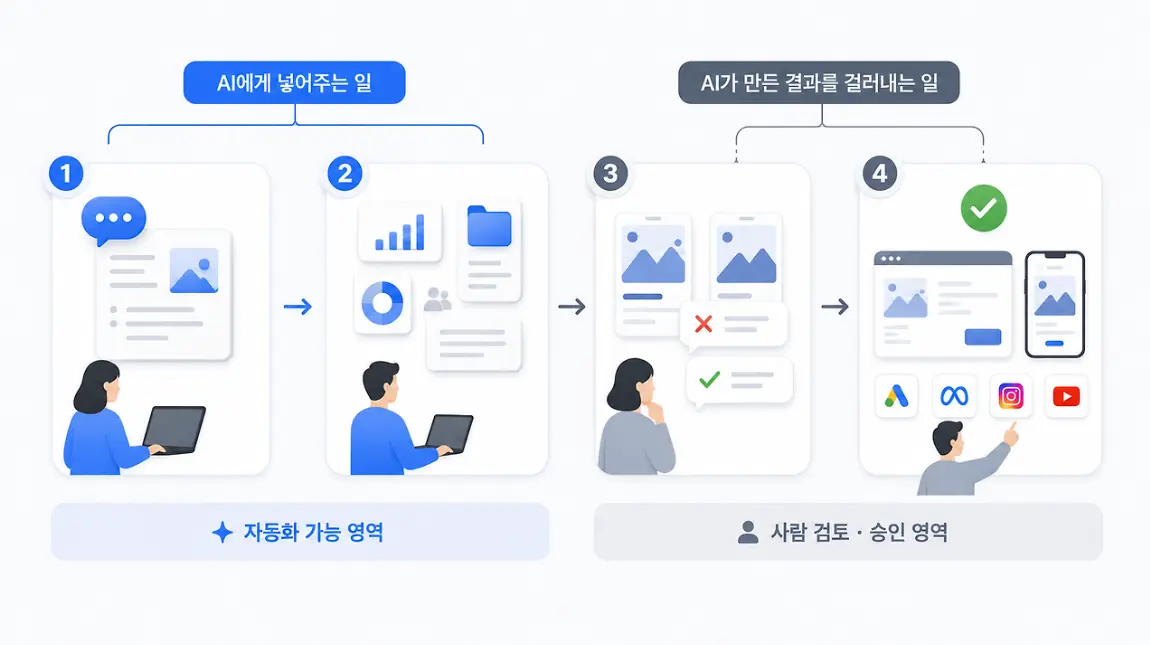
Just as Socar standardized and distributed a design system, Samjjeomsam is rebuilding its systems so that detailed segment definitions, historical performance and the success factors behind winning creative become a pipeline the AI can learn from.
Neither company swapped in a better model. Both organized knowledge they already had into a form a machine can read.
The gap opens at the density of what you have accumulated
When a powerful tool is handed to everyone like currency, advantage stops coming from the tool. It comes from what the company has accumulated, and how densely that has been organized into machine-readable form.
Seen that way, marketers beating AI on creative is not evidence that AI is weak. It is evidence that the marketer's know-how and intuition have not been documented anywhere in the company's systems. That knowledge is a personal asset, not a corporate one.
The same principle shows up in why clean role separation improves output, covered in Why You Keep Rewriting What AI Drafted — the Roles Overlap, Not the Sentences, and in what it actually takes to build a working content pipeline, where inputs and standards — not the model — set the ceiling: How to Build an AI Content Workflow From Scratch — Design Backward From the Finished Piece.
It also matters that falling barriers to entry cut both ways, as argued in AI Removed Your Competitor's Barriers to Entry — and Yours Too. Once tools level out, one difference remains: whether what lives in someone's head has been moved into the system.
Kim defined the marketer's actual job as reading consumer psychology and validating it with data. That does not change in the AI era — validation just got much faster.