MetaSocial Media Today
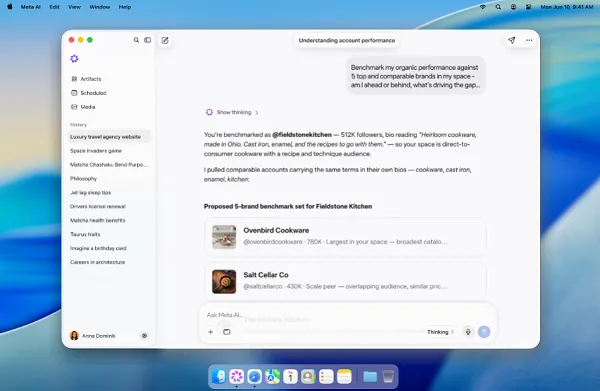
Meta AI Arrives on Mac — Free Until You Depend on It, Then Meta One
The Meta AI Mac app adds window sharing, system-wide dictation, and business benchmarking. The endpoint of that design is a paid subscription called Meta One.
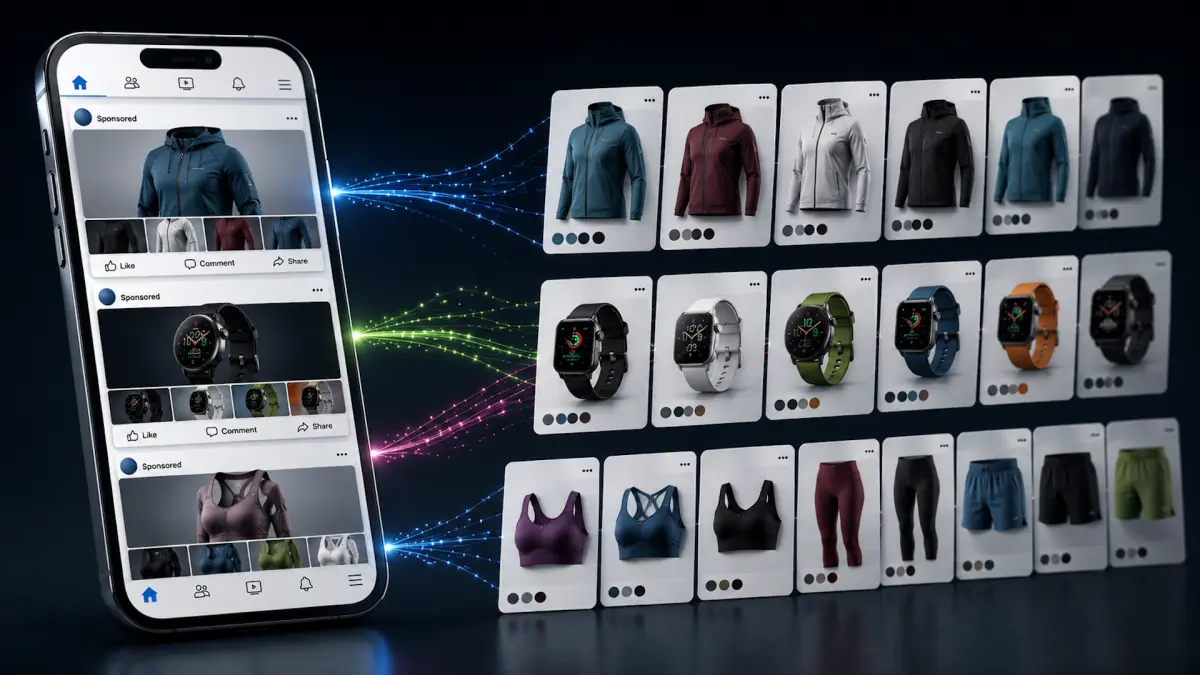
It's time to stop cloning your winning ad and start planning creative like a media buyer, with one distinct message for every audience you want to reach. Meta creative fragmentation happens quietly inside the creative, not the account structure.
Audience fragmentation has long been structural in Meta advertising: too many ad sets chasing overlapping audiences, splitting conversion data, driving up costs. Meta addressed much of that by limiting interest targeting and pushing advertisers toward fewer, broader ad sets with Advantage+.
Traditional fragmentation had two costs:
Today, settings play a smaller role in deciding who sees your ads. Meta's AI analyzes what each ad actually says and matches it to users most likely to respond to that specific message. In practice, every ad functions as its own targeting criterion. An ad opening with a pain point should find problem-aware buyers. An ad built on social proof should find skeptics. An ad leading with a discount should find price-driven shoppers.
The problem starts when you launch 10 ads that all essentially say the same thing. Meta doesn't receive 10 targeting instructions — it receives one instruction repeated 10 times. All 10 target the same portion of your market, compete against each other in the auction, saturate that segment until it fatigues, and never touch your other buyers. You pay more to reach fewer people while massive audience segments sit untouched.
Creative fragmentation doesn't show up as a warning in Ads Manager. It shows up as a pattern across familiar metrics:
The fix is something you may think you no longer need — audience planning. You just build it into the creative rather than the ad set settings.
Define each distinct audience: the problem-aware buyer, the skeptic, the price-driven shopper. Most accounts believe they already do this while running creative that speaks to only one of them.
Each persona gets its own hook, core message and offer. If two ads could trade their first lines without anyone noticing, that's a strong indicator they're using the same angle. When each ad carries a genuinely different message, you give Meta's AI a reason to deliver each to a different audience.
Segments fatigue at different speeds. The persona with the biggest population might sustain for weeks while a narrow segment burns out in days. Track frequency and results per audience, and when an ad fatigues, write a new hook aimed at the same audience. Every audience should always have an ad talking to it.
Once the angle-per-persona structure is in place, a few habits keep fragmentation out:
Ask of every ad: who is this for that my other ads aren't already reaching? If there's no good answer, you don't have a new ad — you have a new way to pay twice for the same audience.
This is the other face of the problem behind Meta scoring creative diversity over creative volume. And the raw material for new angles comes faster from mining customer reviews than from the meeting room.
You won't get a warning. Watch for rising frequency with stalled reach, new ads plateauing immediately, faster fatigue on each new variation, and CPCs creeping up without an obvious cause.
Swap their first lines. If nobody would notice, they're the same angle. Hook, core message and offer all need to differ before Meta has a reason to deliver them to different audiences.
The problem is redundancy, not count. Assign one angle per persona and consolidate whenever more than two or three live ads carry the same core message.
To apply what you just read to your own site, start with a free audit of where things are now.
A strategist replies within 24 hours on business days.
The Meta AI Mac app adds window sharing, system-wide dictation, and business benchmarking. The endpoint of that design is a paid subscription called Meta One.
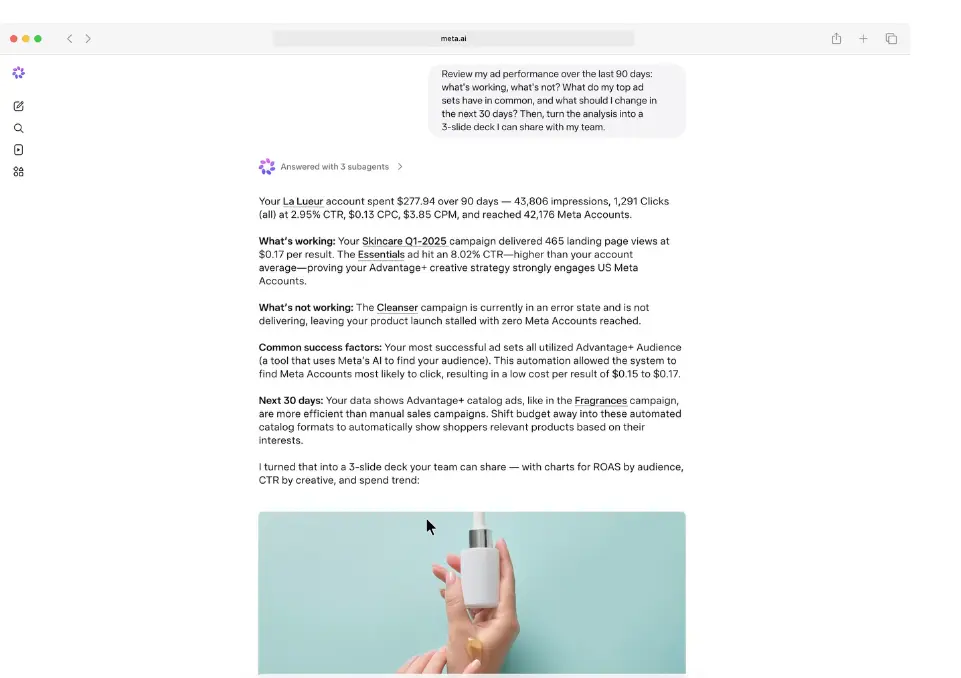
Meta AI ads optimization is live. Advertisers can connect campaign data and Google Workspace to get performance analysis, creative diagnosis, and automated reporting conversationally.
Reddit Ads Manager is adding a campaign planner that forecasts reach and cost, a 0–100% optimization score and automatic budget shifting. Advertisers scoring 80%+ saw 19.6% lower blended CPA.