The industry has been bracing for a layout problem: one AI panel merging sponsored ads, organic citations and product cards. The real problem turned out to be different. An AI Overview confident enough to directly contradict the paid ad sitting immediately above it, on the same page, in real time. That is a trust and attribution problem, not a layout one.
Two verdicts, one page
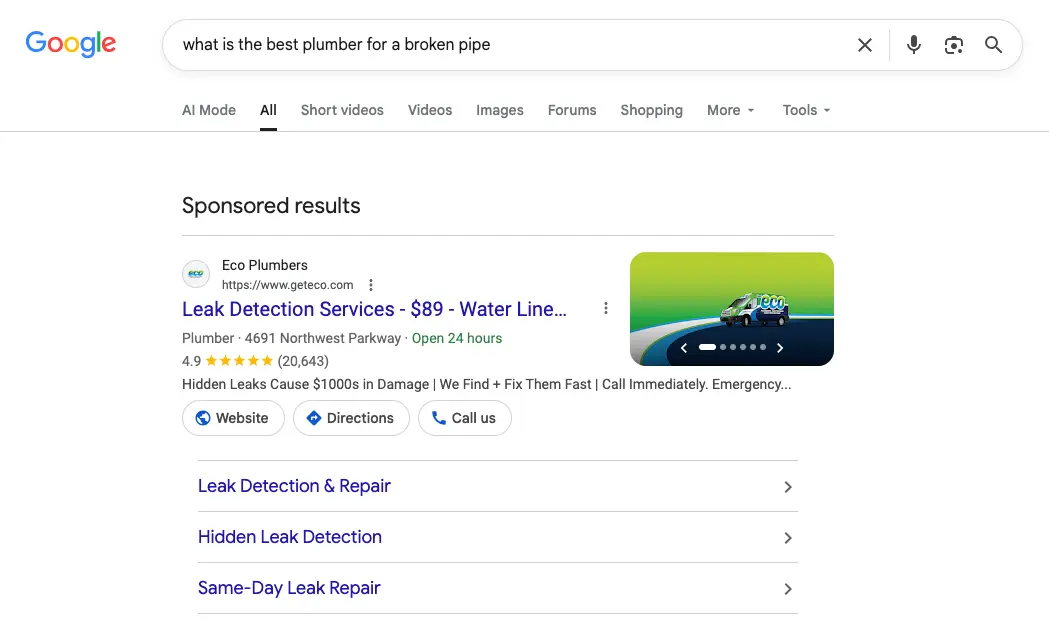
Take a classic transactional query: "What is the best plumber for a broken pipe?" At the top sat a textbook high-converting sponsored ad from Eco Plumbers — an $89 leak detection promo, 24/7 availability, 4.9 stars across 20,000+ reviews, a video carousel and location extensions. Every conversion signal an advertiser can pay to deploy.
Directly below, the AI Overview said, with zero hedging: "The best plumber for a broken pipe is a local 24/7 emergency plumbing company like Roto-Rooter Plumbing & Water Cleanup or Amanda Plumbing." The advertiser paying premium CPCs for the top position was not mentioned at all.
From options to verdicts
For two decades organic search was a candidate pool. Searchers scanned ten blue links, weighed meta descriptions and brand familiarity, and calculated their own trust. Ads sat above or beside them with clear "Sponsored" labels, and users treated both as raw material for a decision they still had to make.
AI Overviews eliminate that evaluation phase through phrasing. They do not offer candidates; they issue conclusions — not "here are options to consider" but "the best plumber for a broken pipe is…" delivered with identical authority whether the underlying data is exhaustive or thin. The Overview is not just competing with the ad for a click; it replaces the user's internal decision process with an algorithmic verdict the ad team had no say in.
One word flips the citation set
The same behavior shows up in ecommerce. For "sweatshirts for anxiety," the standard SERP showed a Shopping carousel of six products from brands like Cloud Nine and Comfrt ($39–$89.95), followed by a Cloud Nine text ad. Cloud Nine dominated the paid real estate across two formats.
Prompted directly on which sweatshirts are best for anxiety, the AI Overview recommended weighted and sensory hoodies — Comfrt ($75), Thera ($158) and Cozy Ghost ($118). Comfrt earned both a paid slot and an organic citation; Thera and Cozy Ghost appeared with no paid presence at all. Cloud Nine, spending aggressively for top-of-page placement, was omitted entirely.
Shift to the informational variant "what is an anxiety sweatshirt," and the model's logic flips: Cloud Nine appears alongside Etsy sellers, reclassified under "graphic and affirmation apparel" rather than "weighted hoodies."
The operational reality is that the auction engine and the retrieval-augmented generation (RAG) engine run on entirely separate logic. Neither the PPC team nor the SEO team controls how they interact, and the logic can flip on subtle prompt variations.
SEO still decides who gets cited
The brands cited had classic fundamentals in place.
- Entity clarity and structured data: Roto-Rooter was not cited by luck. The source panel referenced two distinct landing pages optimized with hyperlocal structured data and consistent name, address and phone (NAP) information.
- Granular product specifications: The cited ecommerce brands featured detailed schema and on-page copy specifying exact weight, materials and functional benefits.
- Multi-platform footprint: Cloud Nine's citation on the informational query was backed by indexed TikTok content appearing in the Overview's reference panel.
SEO has not vanished. The goal moved from earning a position on the page to earning a citation in the answer.
The hidden PPC cost: Quality Score
Here is the downstream sequence when an Overview interrupts the funnel:
- You bid aggressively on transactional terms and win the top spot
- An AI Overview below names two competitors as the authoritative answer
- Searchers act on that recommendation and convert with the cited brand, never scrolling back to your ad
- Google Ads registers an impression without a click, so expected CTR relative to position falls
- Quality Score drops and effective CPC rises for future auctions
The Quality Score algorithm does not adjust for an AI Overview undermining your ad's credibility on the same SERP. It registers lower expected CTR, penalizes the keyword and raises your cost — so you pay a premium for diminished traffic on queries where an AI module assigned brand trust to a competitor first.
Four diagnostics to run
- Erosion diagnostics: if paid CTR is declining while impression share holds steady, audit the AI Overviews triggering on those keyword clusters
- Quality Score attribution: reevaluate penalties whose root cause is a citation decision made outside Google Ads
- Bidding strategy: recalculate target CPA and ROAS thresholds for campaign types hit by AI-driven CTR suppression
- Semantic volatility: map and optimize prompt variations across high-value intents, since minor syntax changes rewrite the citation set
For a parallel case where AI text lands inside the ad unit itself, see Naver Tests AI Summaries in Power Link Ads; for the blurring line between answer and advertising, see Ads Arrive Inside Conversational AI.