The most common sentence in a campaign meeting: "if we just had more budget, we could really blow this up."
But trace the campaigns that made marketing history and an odd pattern appears. The ones made under financial duress blew up most often. Choices that would never have survived a healthy budget got made because there was no money to make any other choice.
This isn't consolation. Constraint genuinely pushes creative work. With money you buy every channel, cram in every message, and produce several safe options. Without money you have to bet on exactly one — and that one gets sharp.
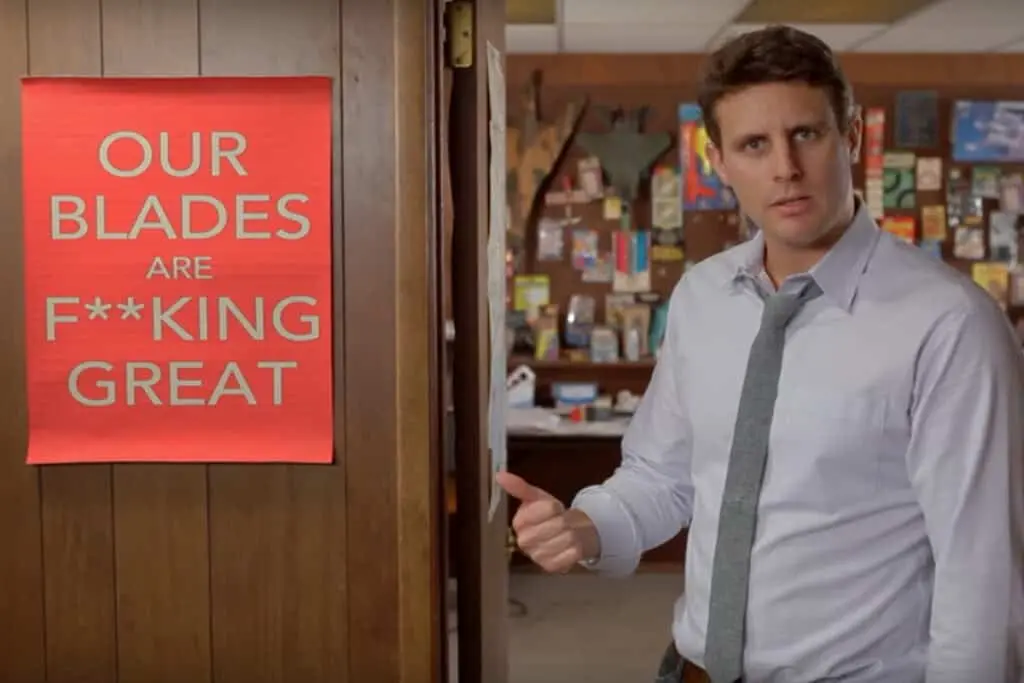
One $4,500 video — Dollar Shave Club
In 2011, Michael Dubin and a partner launched a razor subscription service. The next year they had to tell the world about it with effectively no marketing money. TV was out of reach. What they had was $4,500 from personal savings and one friend from improv comedy.
With that they shot a 90-second video in a single day. The founder walking through a warehouse talking straight to camera — visibly cheap.
The results: 12,000 orders within 48 hours of release, and the servers went down. The video passed 26 million YouTube views, and by 2016 the brand held roughly 16% of the U.S. razor cartridge market. Unilever acquired it that year for about $1 billion.
Why it worked
No budget meant one channel: YouTube. No need to fit a 30-second TV slot meant 90 seconds of attitude. And instead of listing product specs — blade counts, titanium coating — it pushed one line: "aren't you tired of spending $20 a month on razors? Ours is a dollar a month."
That tone could never have emerged from a large budget. Add several agency people and a legal review and the sentence gets deleted in the first meeting, replaced by five inoffensive alternatives. Having no money is what protected the tone.
The conclusion
With no money, narrow to one channel and one message. Spread thin across channels, a low-budget campaign burns out without reaching anywhere.
$50 and a question — Blendtec
In 2006, a marketer named George Wright joined blender company Blendtec. He asked about the ad budget and was told there effectively wasn't one. What he did see, on the factory floor, was founder Tom Dickson grinding wooden boards into sawdust to test blender durability.
Wright spent about $50 — a lab coat, a bag of marbles, some golf balls. Dickson put on the white coat, asked "Will it blend?" and put marbles, golf balls and eventually an iPhone into the blender.
The first videos hit 6 million YouTube views within five days, and cumulative series views are reported in the hundreds of millions. Revenue jumped sharply after the campaign — case studies repeatedly cite roughly 700% growth over two years, though that figure originates with the company and should be treated as indicative.
Why it worked
The lesson isn't "an eccentric founder blended an iPhone." It is that with no ad budget, the product itself became the content — and crucially, that it became a repeatable format rather than one hit.
Given the question and the white coat, the next subject is easy. Marbles, matches, the latest smartphone — same format regardless. Change the subject and you don't rebuild the concept.
The conclusion
Don't trap the demo inside an ad; take it out and make it entertainment. Then lock it into a format. In low-budget marketing, having a frame that makes the next episode cheap matters more than making one piece well.
One character, 123,000 followers — Binggrae
On February 24, 2020, a character in prince's clothing posted a selfie on Korean food company Binggrae's official Instagram. His name was Binggraeus the Delicious: a prince of the Binggrae kingdom who inherited Instagram duties from his father and must grow the follower count to claim the throne.
The core ingredient wasn't media spend. It was a densely constructed fictional world and character.
The response was fast. Within two months, followers grew by more than 25,000 to 123,000. And not just the number — people started recalling the character before the products, leaving comments like "I buy Binggrae products because of him." The account won the grand prize in social communication at the 2020 Korea Advertising Awards.
Why it worked
Instead of burning media spend, they invested in an asset that keeps working once built. Advertising reach vanishes the day you switch off the budget. A narrator and a fictional world survive into the next post, the next campaign, the next product launch. Convert followers from a monthly reach number into fans who follow a story, and your next piece of content starts from accumulated affection rather than zero.
The conclusion
Before burning ad budget, establish one recurring narrator or world. The moment it's clear who is speaking on a brand account, the felt impact of the same budget changes.
What all three say
Dollar Shave Club narrowed to one channel. Blendtec locked one format. Binggrae established one narrator. None of them did it from abundance. They did it because no money meant betting on one thing.
The real power of low-budget marketing isn't producing cheaply. It is the focus that constraint forces. Plenty of budget scatters; scarcity sharpens.
What this means for marketers
The principle still holds. Recent campaigns that traveled tend to carry one hard decision inside the format. The 90-second video in Liquid Death Turned Data Center Backlash Into an Ad spread on the sharpness of its subject choice rather than its spend, and Crocs building Niles as IP rather than an ad asset rests on the same logic as Binggraeus — investing in a reusable asset instead of media weight.
So when you reopen the campaign doc tomorrow, don't start by asking for more budget. Ask this instead: "what would I choose if I could only choose one thing — the choice I'd never make with infinite budget?"
The moment you pick that one thing, the power that scarcity generates enters the campaign.