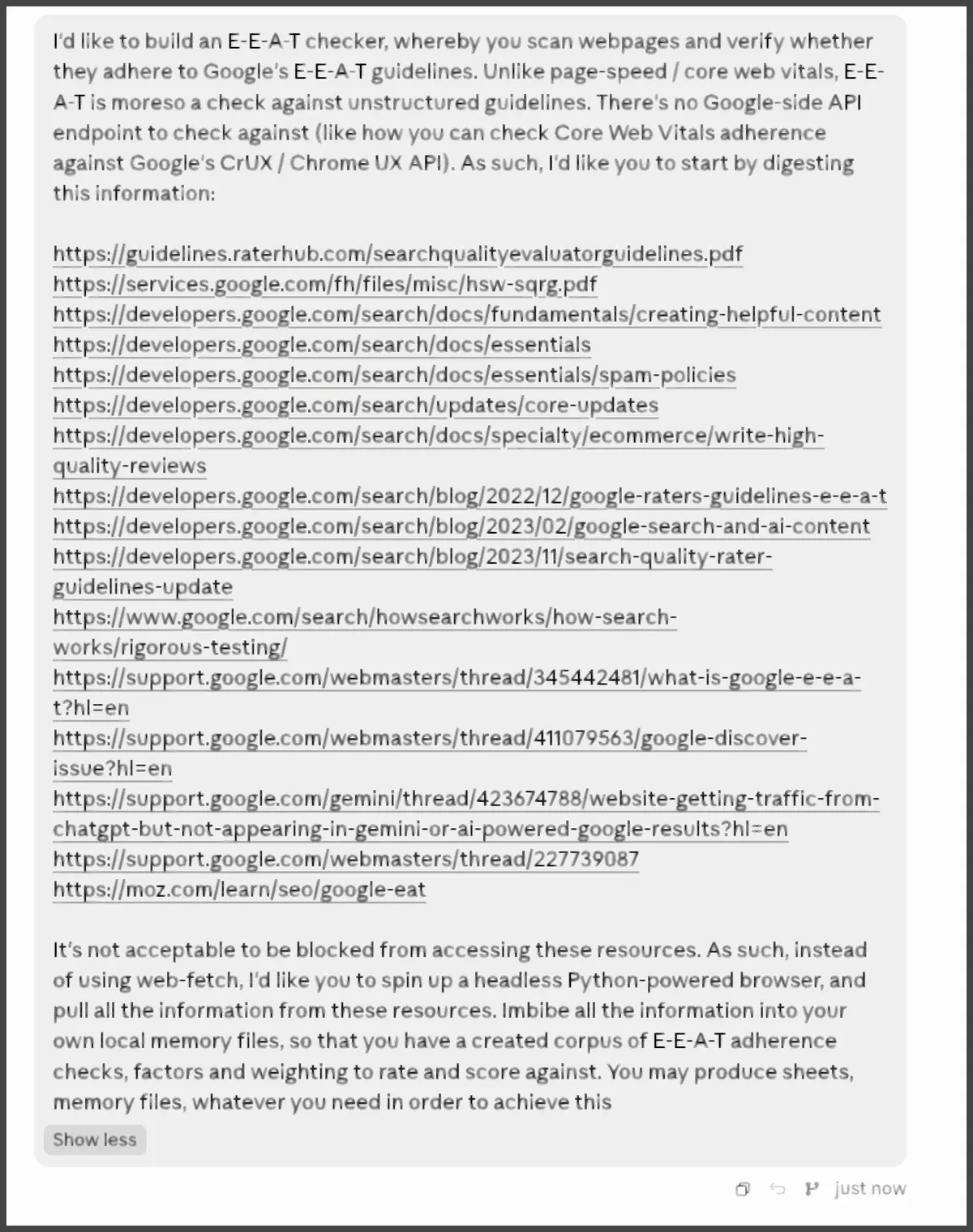
An E-E-A-T checker was never a standard tool for a simple reason: unlike page speed or Core Web Vitals, Google's E-E-A-T guidance is not exposed through an API. Google supplies a framework and a broad methodology, and applying it has always been human judgment work.
James Allen's build, published on Search Engine Land, handed that judgment work to an AI coding agent — on the theory that processing large volumes of unstructured guidance and applying a framework is exactly what these systems are good at.
Two Paths, One Choice
There are broadly two ways to build a marketing tool with an AI coding assistant.
Build it inside the AI platform and reuse it across sessions. Or use the assistant to write a standalone application deployed independently on a hosting platform.
Allen took the first path, because it needs no deployment or infrastructure knowledge and is therefore reachable for marketers.
How It Was Built
Prerequisites
- A plan that supports Claude Code (Pro, Max, Team, or Enterprise), or separate API credits
- A GitHub account for backing up the project
- Office for the Word audit output — an HTML app or LibreOffice works as an alternative
Another AI IDE or desktop agent follows substantially the same workflow.
Crawl with a headless browser, not the built-in fetch
Give an assistant a list of URLs and it will normally use its built-in web fetch, which a meaningful share of sites block. So Allen instructed it to launch a Python headless browser instead, and the agent chose the Chromium engine.
That choice has a second benefit. A headless browser executes and renders the page before analysis, so it captures both the raw HTML and the rendered result. On sites where author bios or trust signals are injected by JavaScript, that difference decides whether they are seen at all — the same failure mode documented in JavaScript Links Are Invisible to AI Search.
Knowledge base and scoring rubric
The agent processed Google's quality documentation into its own data structures, built an E-E-A-T knowledge base and a scoring rubric, and set up a strategy for keeping verbatim copyrighted material out of the GitHub repository.
There is an important alternative here. Rather than scraping source material from the web, you can supply your own tailored standards and reference documents — which is the better option if your trust criteria differ by brand.
Sample representative pages, not the whole crawl
One page cannot support a site-level E-E-A-T assessment, and a full crawl is usually unnecessary. Allen selected roughly 15 representative page types: homepage, staff page, author pages, about, latest posts, an individual article, guides, events, contact, privacy policy, and terms.
Sample design effectively determines the quality of the tool. It has to be chosen by someone who knows where the author and organizational trust signals live.
Two passes
The first run already produced a solid audit; a second pass improved formatting and readability. The finished project was backed up to GitHub. Once memory files, prompts, and scripts are pushed, the tool's entire knowledge base is preserved and a machine failure costs one clone to recover.
When This Approach Transfers
E-E-A-T was a deliberate pick because it evaluates unstructured guidance rather than an API. The same approach moves cleanly to brand guideline compliance, editorial standards, and accessibility reviews — anywhere a documented standard has always been checked by a person reading it. Look for the areas where your standards exist as a document and the review is still manual every time.
Be Explicit About the Limits
E-E-A-T is not a direct ranking factor, and no checker can guarantee improved rankings. What this measures is how closely a site aligns with the guidance Google uses to evaluate content quality. That is a legitimate benchmark, but it is not a performance metric.
Treat the first output as a strong draft, not a finished document. Review it, correct it, and feed those corrections back into the project so future audits improve — the tool stores its knowledge in local memory, which is what makes that accumulation work. It is the same dynamic covered in Why You Keep Rewriting What AI Drafted.
What It Actually Caught
Auditing Search Engine Land itself, the site performed well overall — but the audit flagged stale legal pages and an undisclosed lead-generation hub. Both are the classic misses when a human reviews a site: pages too old for anyone to open, and pages whose purpose is never stated.
That is the real return on handing an audit to an agent. Not novel insight, but re-reading every page nobody re-reads, every time.