The most expensive mistake in review content incrementality is reading affiliate-attributed revenue as customer acquisition. Adam Riemer calls the failure state parasitic — a strong word with a specific definition.
Over time, a review publisher keeps earning commissions from customers who already knew the brand, were already researching it, or were already inside the funnel. The review may still build trust and help close the sale. That is not acquisition.
Paying One Person Four Times
Review creators typically work with several teams at once: affiliate, PR, AEO/GEO, SEO, brand, social, and influencer management.
The problem appears when those teams do not talk.
- PR pays a media fee and ships the product.
- The affiliate manager adds the same creator to the affiliate program, stacking commissions on top of the fee already paid.
- The AEO/GEO team sees the publisher being cited in AI answers and pursues more coverage.
- The social team notices the creator's momentum and starts collaborating and amplifying.
At which point the company mistakes momentum it created for independent third-party validation. It pays multiple times for one relationship, then reads the resulting visibility as organic reputation.
None of this means the publisher creates no value. It means the value gets bought more than once when teams operate separately.
The Question Attribution Cannot Answer
An affiliate platform can tell you a publisher participated in a transaction. It cannot tell you whether that publisher caused it, or whether the customer would have purchased anyway.
So a publisher generating $100,000 in attributed affiliate revenue does not mean losing that publisher costs you $100,000. To judge it, ask six things:
- Was the customer new to the brand?
- Had they already visited your website?
- Had they searched for your brand before finding the review?
- Were they already an email subscriber or existing customer?
- Was the review the first meaningful touchpoint, or one of the last before conversion?
- Would they have purchased without the affiliate review?
If customer reviews or non-affiliate creators surface for the same queries and deliver the same confidence, you keep more margin because no commission fires on every conversion. That is the case for flat-fee arrangements and authentic customer reviews running alongside the affiliate program.
This is not an argument that affiliate reviews are a bad investment. It is an argument to evaluate them on incremental value rather than platform-attributed revenue — a calculation that collapses when each team defines its metrics differently, the same trap covered in A View Means Something Different on Every Platform.
What Review Content Still Delivers
Riemer splits the value into six uses.
Countering negative PR and misinformation
When outdated or inaccurate information persists in search results and AI-assisted discovery, accurate current third-party content competes with it. Paid promotion alone will not make a review rank or earn an AI citation; the goal is making genuinely useful content easier to find.
Measure it through conversion rate, customer reviews mentioning specific use cases ("it works for XYZ"), and fewer support questions about that feature or compatibility.
Early sales, later margin leakage
A new review first reaches the creator's existing subscribers. With engagement, it keeps surfacing through search, recommendations, and social, introducing new customers. Later, when most viewers already know the brand, the same commission shifts in character from acquisition cost to margin leakage.
Third-party trust
Watching a product arrive, get used, and produce a result is a different class of evidence than a brand claim. But an audience does not confer trustworthiness on its own. Actual testing, expertise, transparency, clear disclosure, a relevant audience, and a track record of useful information do.
AEO/GEO signals
Riemer is careful here: niche creators and influential sites appear to influence AI answers, and he frames that as observation and correlation rather than proof of causation.
One plausible explanation is retrieval. Many AI search systems pull current information from the web at answer time, so third-party reviews and comparisons become source material. The staged view of how a brand gets there is laid out in Earning AI Citations Takes Three Phases.
His sharpest warning is definitional. Training, retrieval, grounding, and citation are separate concepts. A crawler reaching your content does not mean a model was trained on it, and it does not mean the system will retrieve, cite, or recommend you. Reporting coverage as "we trained the LLM" corrupts the decision that follows.
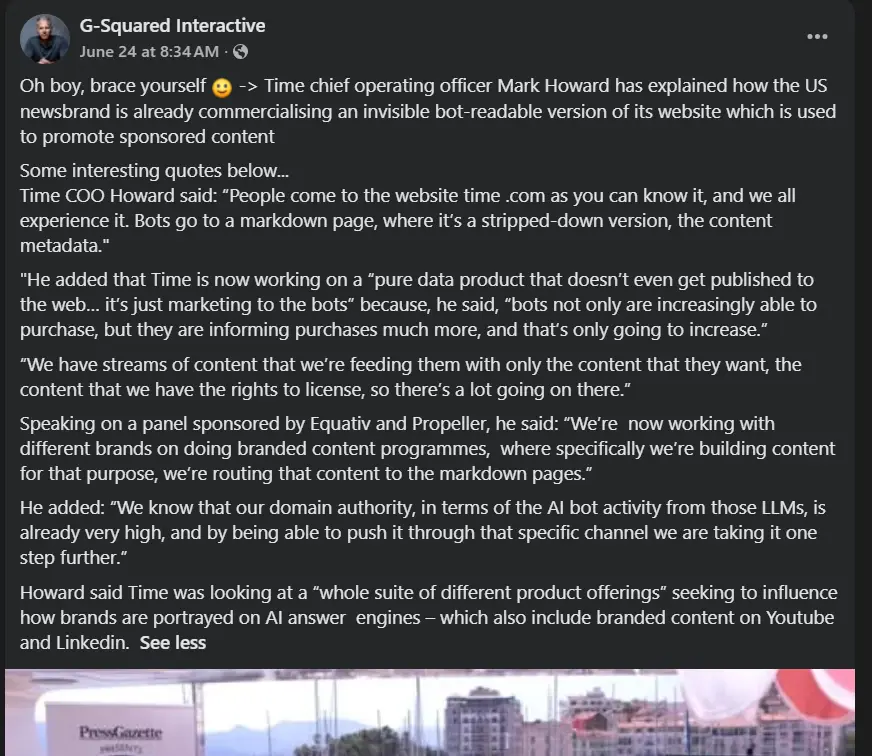
Separately, 2026 reporting found that Time served machine-oriented versions of some pages to AI crawlers, including sponsored content not presented the same way to human visitors. If commercially influenced material enters an AI answer with no way for the consumer to know, what disclosure should eventually apply? Riemer does not claim current FTC guidance requires that today — he flags it as a question regulators, platforms, and advertisers will have to answer.
Shaping how the brand is understood
The same product carries different value for different audiences. For one undershirt, parents want to know whether it is tagless so it will not scratch, budget-conscious buyers care about durability, and fashion-focused buyers care how it layers.
As both AI and traditional search deliver more specific, personalized answers, these niche reviews gain value precisely because they create explicit third-party links between a product and a particular need or use case.
The line is clear. Asking a creator to cover specific factual features is different from asking them to reach a predetermined conclusion. The second destroys the trust you were buying and creates regulatory exposure.
Conversions on site and in ads
Riemer's team embeds reviews on product, category, and landing pages, and — with permission — uses them in advertising. Real people demonstrating a product consistently lifts conversion. Where the agreement includes paid media usage rights, repurposing creator video into paid social also cuts production cost.
Regulation Is the Starting Point, Not a Footnote
Before the incrementality work, any brand exposed to the U.S. market should read the FTC's Endorsement Guides and their FAQ, plus the Consumer Reviews and Testimonials Rule. They cover material connections broadly: sponsorships, affiliate relationships, pay-to-post arrangements, and free product. The same applies to Reddit users, TikTok creators, YouTubers, and bloggers alike. Consult a licensed attorney for how it applies to your situation.
Putting It to Work
Riemer's client process has two steps. First, map which creators and media companies are working with which internal teams. Then build a measurement framework that tracks those relationships across channels.
That coordination is what lets you ensure important use cases are actually represented, keep creators honest, amplify valuable content with paid media, and put third-party evidence in front of buyers who still need proof.
The closing point is the one to keep. Review content changes role across its lifecycle. Early on it introduces the brand and generates incremental customers. Later the same review works as comparison content, social proof, objection handling, reputation support, or a final trust check before conversion. All of those create value. None of them should be measured the same way.