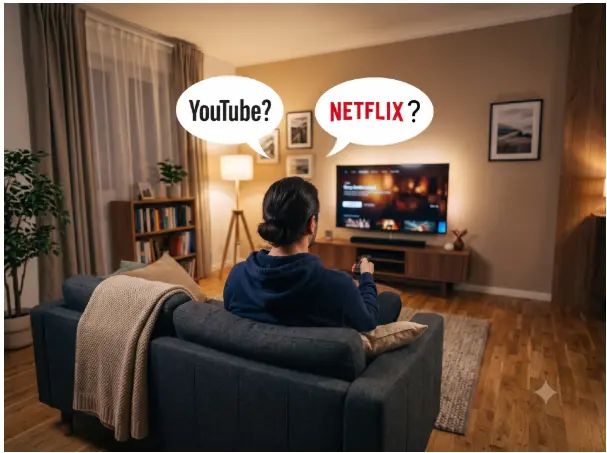
Netflix is leveraging a subscriber base of over 325 million to offer YouTube stars simultaneous release deals. YouTube is countering with multimillion-dollar compensation packages and penalty clauses.
Why are a content giant and a platform giant suddenly fighting over the same creator pool? This isn't simple recruitment competition. The creator talent war started when the battlefield moved from the smartphone to the living room TV.
YouTube Went Back to Studio Logic
YouTube scaled back YouTube Originals in 2022, declaring it would focus on an open platform ecosystem. But when Netflix moved to absorb top-tier creators with its capital, YouTube reached back for the traditional studio's exclusivity playbook.
It's a process of bulking up the platform for a full-scale fight with legacy streaming. It's also double-edged: YouTube's long-standing strength — an open algorithmic ecosystem available to anyone — mutates into a closed studio directly managing a small number of top IPs.
The problem is the enforcement mechanism. YouTube has built its core value on the growth narrative that an individual can become a global star through creation. Creators are independent operators, not employees, and paying properly for exclusivity is normal business. But giving implicit penalties — algorithmic deprioritization, exclusion from marketing — to ordinary creators who attempt simultaneous distribution can read as abuse of platform dominance.
The Real Battlefield Is the Living Room
Why is Netflix recruiting YouTubers instead of buying expensive Hollywood films? Why is YouTube spending enormous cash to stop it? Because the fight moved from the phone to the TV.
By Nielsen's media distributor gauge, the top share of U.S. living room TV viewing time belongs not to Netflix but to YouTube: 13.8% versus 8.0%.
Netflix's motive is reducing the exhaustion of producing originals that cost hundreds of millions, and extending session time with proven, low-cost, high-efficiency IP that Gen Z already watches on the living room screen.
YouTube's defensive line is that dominant share. If Netflix erodes it, the most profitable large-screen TV advertising market shakes with it.
Appearing on broadcast or streaming used to be a YouTuber's promotion. Now the power map has flipped: creators are core IP suppliers that giant platforms compete to court. It's the same board as YouTube moving TV controls to the phone and Instagram's creator-led connected TV push.
What Consumers Get
Short term, "I can watch my favorite creator on Netflix too" feels like a win. Three costs follow.
One, content fragmentation. Some of a creator's videos, previously free on YouTube, split off behind a paid platform. Watching the same creator now costs another subscription — streaming reproducing the paid-channel fragmentation problem of the cable era it marketed itself against.
Two, less upload flexibility. Netflix's requirements for advance submission and removal of sponsored segments have already led some creators to decline collaborations. The rawness and speed characteristic of creator content risks being diluted in studio-ification.
Three, algorithmic distortion. If YouTube tiers exposure and marketing to keep top creators, ordinary users' feeds get reshaped around the small number of IPs YouTube is strategically pushing — colliding head-on with the long-tail discovery that was YouTube's original strength.
What the Platforms Get
Netflix gains low-cost, high-efficiency content compared with originals costing tens of millions per episode, with pre-validated fandoms lowering failure risk. The risk is that forcing YouTube's grammar — short, improvisational — into Netflix's programming logic — polished, cleared — could shake the premium brand image if it fails. Creator pushback on pre-approval is an early sign.
YouTube gains retention of top creators and protection of its dominant living-room TV ad share — defending its core revenue engine. The risk is that if the penalty approach becomes known, the "ladder for individual creators" narrative collapses, with a long-term backlash reducing new creator supply.
Not a Creator Golden Age — a Redistribution of Distribution Power
It's clearly good for creators, but the calculation is complicated for both consumers and platforms. There's no need to read it romantically: it also hardens a winner-take-all structure concentrating capital and opportunity in a small top tier.
The biggest beneficiaries are a handful of top creators. The biggest risk-bearers are consumers (narrowed choice, fragmented content) and YouTube (damaged platform identity). Netflix has relatively little to lose.
Reading this as a redistribution of media distribution power is more accurate than reading it as a creator golden age.