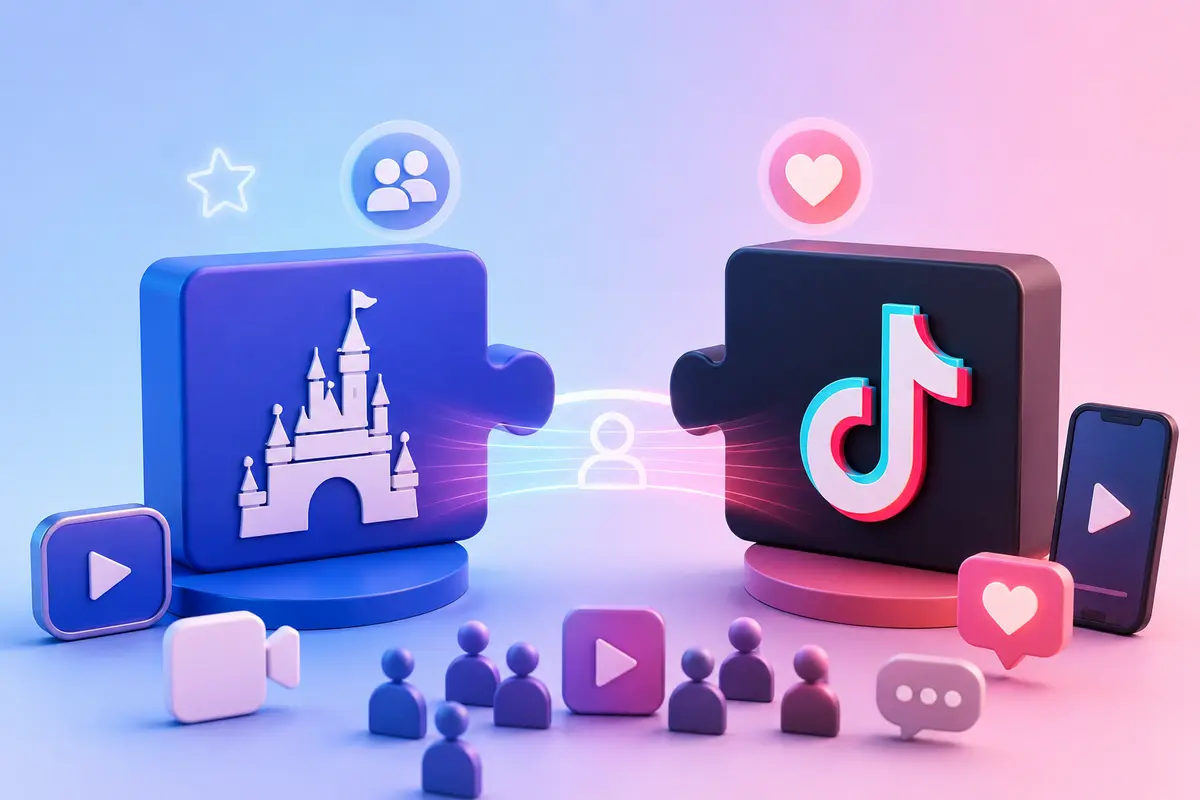
Disney and TikTok announced a partnership widely described as the first of its kind between a major Hollywood studio and a social platform. The notable part is the terms. No monetary compensation structure or revenue share was disclosed — effectively, neither side pays the other, and both walk away with what they came for.
What the Deal Actually Contains
Two components.
TikTok fan videos move inside Disney+. Selected TikTok creator videos built on Disney IP — Marvel, Pixar, Star Wars, FX — will surface in "Verts," the short-form feed tab inside the Disney+ app. It pilots in the U.S. before expanding globally.
A Disney Creator Ambassador Program launches. A tiered program giving selected creators licensed access to official Disney library sources (clips, audio), increased exposure, invitations to exclusive events, and career opportunities. No compensation structure was disclosed.
The timing was deliberate. The announcement landed alongside Disney's fiscal Q3 results, immediately after SVOD operating income more than doubled year over year to $712 million from $329 million. It is also the first major initiative under Josh D'Amaro, who became CEO in March.
What Disney Gets: a Fandom Channel at No Cost
Three lines of reasoning on Disney's side.
Time spent. Streaming services are shifting from places you watch content to places fans hang out with derivative work. This gives subscribers a reason to stay in the app after the main title ends.
Reclaiming Gen Z attention. Younger audiences spend more time on short-form than on long video. Rather than shutting TikTok out, Disney chose to pull that energy inside the app to reduce churn and increase visit frequency.
Retention as the next problem after profitability. With SVOD profit expanding, the next challenge is churn. Short-form UGC functions as a retention lever.
The cost structure is the point. Disney pays ambassadors in access and exposure rather than cash — a promotional channel for its IP with no production budget attached.
What TikTok Gets: Copyright and Political Cover
Four lines on TikTok's side.
A cleaner copyright image. TikTok creators' derivative work has always carried DMCA takedown risk. Legal use of Marvel, Pixar, Star Wars and FX assets gives the platform a case that it is not a haven for unlicensed distribution.
Reduced political risk in the U.S. Partnering with Disney, a symbol of American culture, is itself the message: a partner to the media industry rather than a target for sanction. Read alongside The U.S. Federal Device TikTok Ban Is Gone, the direction is clear.
Creator lock-in. In the fight with YouTube Shorts and Instagram Reels for creators, having your video surface on a major streaming service's main stage is a strong incentive.
Negotiating leverage. A completed Disney partnership becomes a card in future talks with Warner Bros., Universal and other majors.
Why the Risk Is Low
The obvious question is whether regulatory exposure makes this unsustainable. The short answer: the risk of an outright legal ban has eased, but geopolitical uncertainty has not disappeared. For Disney, however, this is a deliberately minimized "plan B" style collaboration.
First, TikTok has avoided the worst-case scenario through the sale of its U.S. entity and a joint venture structure with American capital participation (Oracle, Silver Lake) and domestic data storage.
Second, the deal does not put Disney+'s core engine in TikTok's hands. It is content-level curation: selected TikTok videos surfaced in the Verts tab. If regulation tightens again, Disney can swap the content source to YouTube Shorts or Instagram Reels. The structure borrows a fandom ecosystem rather than creating platform dependency.
Third, security exposure is limited. Disney+ subscriber data and core algorithms are not moving to ByteDance; the integration happens at the level of creator-made content.
IP rights are managed as a walled garden. Disney is not releasing its library indiscriminately — only creators registered and approved through the ambassador program receive official source licenses. Deepfake and unauthorized remix risk does not vanish, but the approach pulls creators into a sanctioned lane with incentives instead of leaving them unmanaged.
The timing invites another reading. With unauthorized IP replication through generative AI under active dispute, choosing a human-creator ecosystem over unproven AI tooling is itself a position.
What Marketers Should Take From It
Three transferable structures.
Opening IP is not all-or-nothing. A tiered approval structure buys control and distribution at the same time. The same design works for brand assets in UGC: separate who gets access, which sources, and under what conditions.
Cash is not the only incentive. Official source access, exposure priority, event invitations, career opportunities. A lot of what creators want is not money. Worth reviewing when designing an ambassador program — though the undisclosed compensation terms also mean weaker creator leverage. On how creator payout criteria are shifting, see Creator Payouts Shift From Views to Originality.
Dependency and collaboration are different things. Disney keeps its risk low because it designed the source to be swappable. Before entering a platform partnership, define what stops working if the relationship ends. That answer determines your negotiating position.
The open question is Netflix. Attention turns there next.