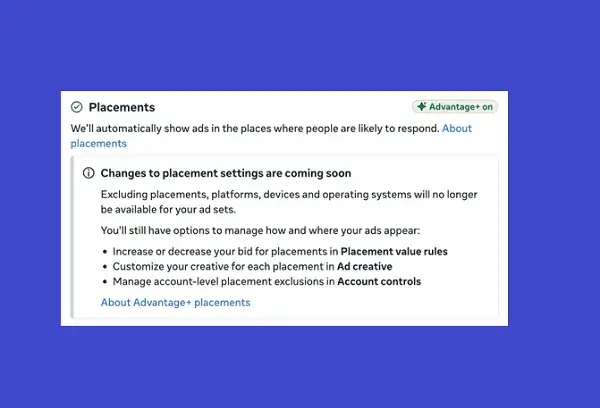
Meta has started alerting advertisers that it will soon remove the Placements option from ad sets. The notice surfaced in a screenshot shared by Meta ads expert Jon Loomer. No timeline has been announced.
What Disappears: Placement and Platform Exclusions
Until now, the placements option let advertisers exclude specific Meta surfaces from a campaign. If you did not want your ad appearing in Facebook search results, or in in-stream slots between Reels, you opted out. It was how brands managed the context they appear in.
That option is going away.
Loomer also noted that Meta is removing the ability to exclude platforms as well. Meta's system will be free to display a campaign's ads across any of its apps, based on a systematic assessment of where they will perform best.
The Endpoint Is Already on Record
This is not a feature trim — it is one step along a stated direction. Mark Zuckerberg drew the picture himself in an interview with Ben Thompson of Stratechery last year:
"We're going to get to a point where you're a business, you come to us, you tell us what your objective is, you connect to your bank account, you don't need any creative, you don't need any targeting demographic, you don't need any measurement, except to be able to read the results that we spit out. I think that's going to be huge, I think it is a redefinition of the category of advertising."
The destination is a campaign that runs from a URL. Removing placement exclusions is a notch on that path.
The same movement is happening across the industry at once. Microsoft Advertising removing Max CPC from new automated bidding campaigns and Google expanding its AI Max testing and planning tools are the same trade: strip manual controls, defer to system judgment.
Two Places This Could Bite
Brand safety changes hands
Placement exclusion was a safety control before it was a performance tool. The advertiser held the authority to decide a given surface's context did not suit the brand. That judgment now moves to the system.
Meta's system picking surfaces on performance and a brand avoiding contexts it does not want to appear in are different objectives. When they conflict, advertisers have fewer levers left.
Ad homogenization and the data loop
The structural concern is real. If all ads are automated, the system will generate new ads based on its own prior generations. Ads converge, and that convergence becomes the next round of training input.
That is not just a current-exposure problem; it is a slow erosion of effectiveness. Meta presumably has mitigations in place, but advertisers have no way to verify them.
What to Prepare
The direction of travel showed up already in Meta AI analyzing and optimizing ad accounts directly. As controls shrink, concentrate on the levers that remain.
- Creative becomes the only variable. If you cannot choose the surface, you need assets that work on every surface. Verify that the message lands in vertical, square, and in-stream formats before launch.
- Shift from exclusion to post-hoc measurement. Placement-level performance reporting remains. If you cannot block in advance, set the criteria and cadence for filtering after the fact.
- Document your brand safety standard. A judgment that used to live in a settings screen returns to being a human one. Your team needs agreement on which contexts are acceptable.
If the results genuinely improve, handing over control may not be a bad trade. The problem is that the data needed to make that call is shrinking alongside it.