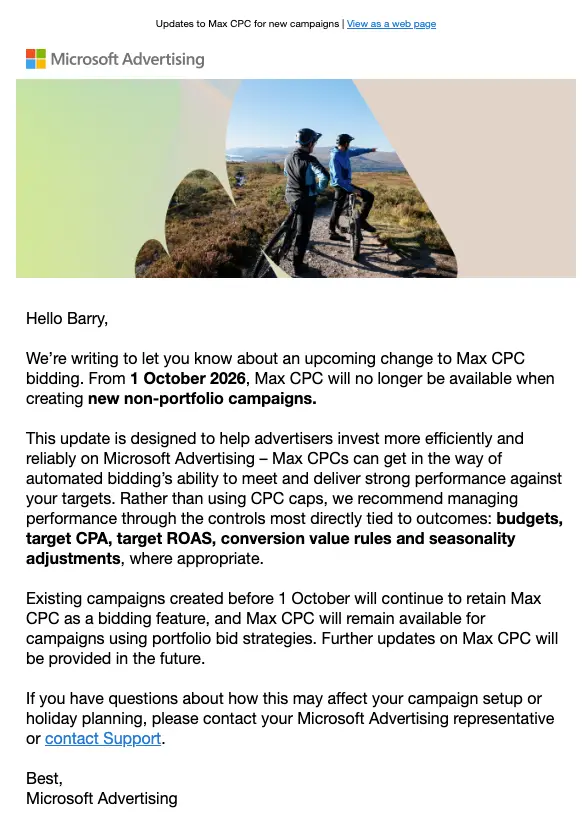
Microsoft Advertising will stop offering Max CPC limits on new campaigns using several standalone automated bidding strategies, effective October 1. One of the last manual guardrails on click cost is being retired.
What Changes
From October 1, advertisers creating new campaigns with these standalone strategies can no longer add a Max CPC:
- Maximize Conversions
- Maximize Conversion Value
- Maximize Clicks
These retain the control:
- Campaigns created before the deadline
- Target Impression Share
- Enhanced CPC (eCPC)
- Portfolio bid strategies
Microsoft Advertising Product Liaison Navah Hopkins confirmed the scope.
Microsoft's Reasoning
Microsoft says Max CPC limits interfere with automated bidding by overriding an advertiser's stated performance goals and potentially creating spend pacing irregularities. Its position is that advertisers using conversion-based bidding with target CPA (tCPA) and target ROAS (tROAS) reach their goals more easily than those relying on legacy controls.
Instead of CPC caps, Microsoft points advertisers to four levers: budgets, tCPA and tROAS, conversion value rules, and seasonality adjustments.
Existing Campaigns
There is no immediate migration. Campaigns created before October 1 keep their Max CPC settings. The distinction matters: advertisers do not lose Max CPC across their accounts on October 1 — they lose the ability to apply it when building certain new campaigns. Microsoft says further guidance on the future of Max CPC will follow.
Act Before the Deadline
Hopkins encourages advertisers to run optimization experiments that remove Max CPC from existing campaigns before the cutoff. That reveals how campaigns behave when automated bidding gets more freedom, while the option still exists to reverse course.
Timing is the practical concern. October 1 lands exactly when advertisers launch or restructure holiday campaigns. Skip the experiment and the first encounter with this restriction happens mid-season, in a new campaign build.
The Real Issue Is Signal Quality
The substantive risk here is not lost control — it is conversion data quality. Max CPC functioned as insurance against thin or noisy conversion signals. Remove the insurance, and whatever the bidding system learns becomes the ceiling on performance.
So the audit order is: does your conversion definition match business value, is conversion volume sufficient for the algorithm to learn, and are you protecting signal with server-side measurement? Microsoft already published its Conversions API documentation, pointing the same direction. Trading manual bid controls for stronger signal requirements also mirrors Google's AI Max migration timeline.
Bottom Line
Microsoft Advertising is making automated bidding target-driven. From October 1, Max CPC disappears from new standalone Maximize Conversions, Maximize Conversion Value, and Maximize Clicks campaigns, while existing campaigns and portfolio strategies keep it for now. Testing before the deadline is the only real preparation.