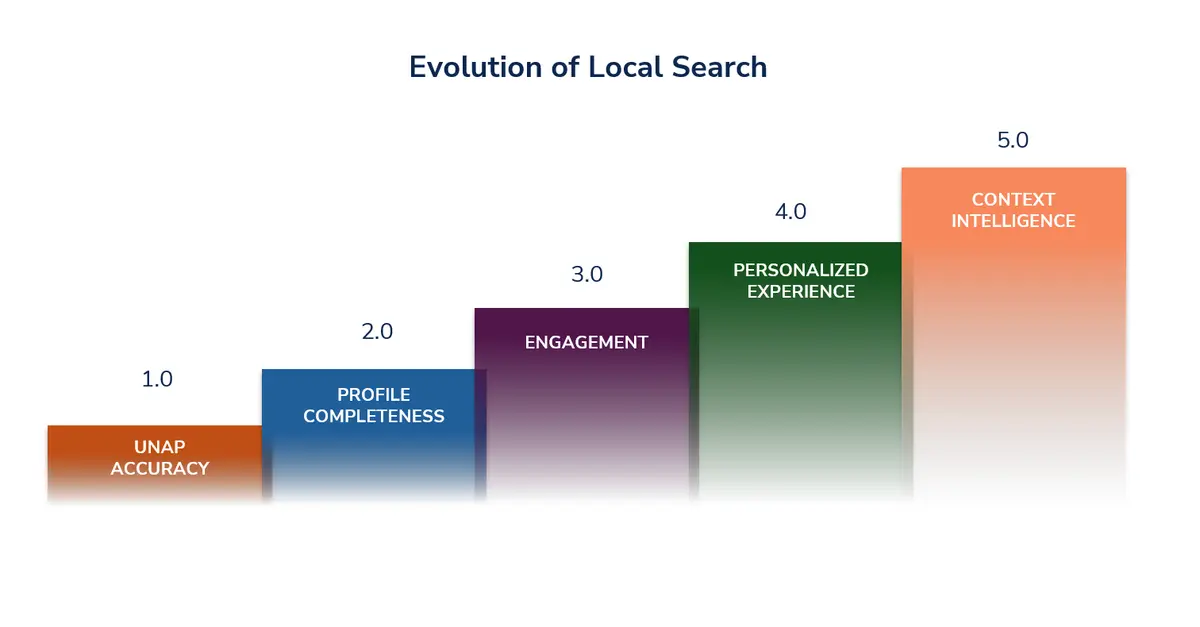
Local SEO has evolved through distinct stages, and each one added a requirement on top of the last rather than replacing it. The current stage — Local 5.0 — is the first where the deciding factor isn't what a brand publishes about itself, but whether AI has enough connected context to understand, trust and recommend each location.
Five stages
- Local 1.0 — listings and basic NAP consistency: the goal was presence, being indexed and included.
- Local 2.0 — map pack optimization and reviews: visibility driven by proximity, profile completeness and reputation.
- Local 3.0 — location pages, content and ROI: local became a traffic and conversion driver tied to websites.
- Local 4.0 — AI-mediated discovery and recommendation: focus shifted to decision infrastructure rather than a channel.
- Local 5.0 — context intelligence: AI interprets intent, evaluates evidence and recommends. Visibility depends on connected, validated context across everything above.
Local search has compounded rather than cycled. Every stage still matters, and AI evaluates them all at once. Listings, reviews and location pages remain the foundation. What changed is that the foundation alone no longer decides the outcome.
What's different
Earlier stages rewarded completeness: be listed, be reviewed, be optimized. Local 5.0 rewards something else. AI doesn't assume a location is a good fit. It looks for proof, and that proof has to exist somewhere it can read.
Four ways this shows up.
AI works on evidence
Google's AI-first direction plus rapid adoption of ChatGPT, Gemini and Perplexity marks the start of Local 5.0. AI doesn't simply index business information — it determines which brands are discovered, understood, trusted and ultimately recommended. Strong entity authority and the elimination of ambiguity become essential.
Brand consistency with local relevance
For multi-location enterprises this is both opportunity and challenge. Traditional local SEO focused on websites, listings and reviews to rank in the SERPs. AI evaluates something broader: whether a brand delivers complete, consistent and locally relevant information across every digital touchpoint. Every location must be both brand-consistent and contextually relevant to its market.
Trusted: an AI-ready foundation of location data
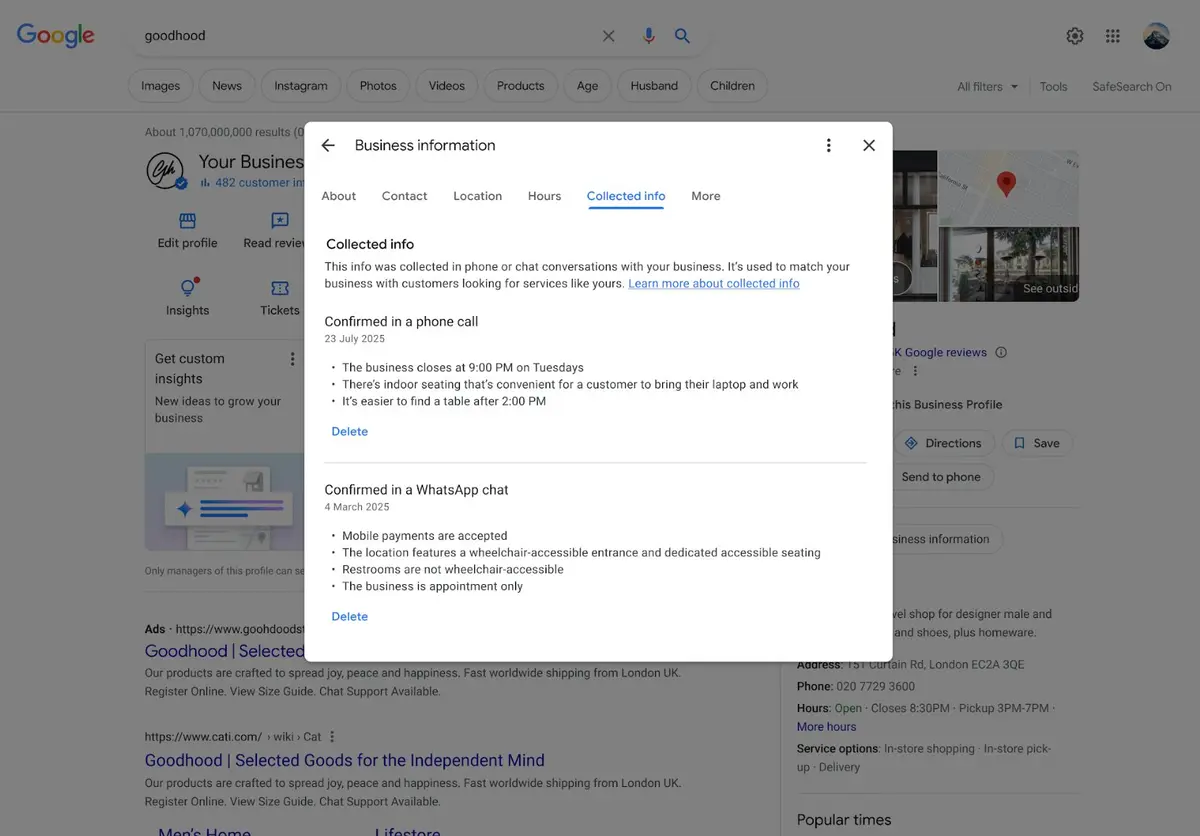
Most enterprises suffer from disconnected data. Customer information, listings, booking systems, CRM, reviews, operational systems and local content sit in silos, creating conflicting signals that reduce AI's confidence in understanding and recommending the business. A trusted, AI-ready foundation of location data is now a competitive advantage.
Rich context wins
Generic location pages are no longer sufficient. AI is expected to answer highly specific questions: whether a hotel is family-friendly, whether a clinic accepts a particular insurance plan, whether a bank branch offers same-day appointments. That requires rich, location-specific context that is continuously updated, accurate and trusted.
Verification didn't disappear — it moved
A customer who once typed "banks near me" now says to an AI agent: "I just moved to Denver and I'm self-employed. Which bank near me has free small-business checking and is open on Saturdays?"
The old query returned a local pack and a page of links, ranked mostly on proximity and prominence, with nothing tied to small-business checking or weekend hours. The customer had to click into each listing and confirm the details themselves.
The new query is likely to return three specific branches meeting those conditions, with distance and Saturday hours stated. Answering it requires account eligibility, fees, weekend hours and proximity to be pulled together and verified across sources.
The verification step didn't disappear. It moved from the customer to the machine — and the machine only verifies what it can find.
The sources AI trusts also vary by question. First-party websites are primary for factual information such as hours, services, policies and availability. Reviews, directories, publishers and third-party platforms carry greater weight for subjective questions like "best," "most convenient" or "recommended." Maximizing visibility means building authority across both.
AI-driven local visibility follows a clear progression: information must first be discoverable, then credible enough to serve as evidence, and finally authoritative enough to earn a recommendation. Being indexed or cited is no longer enough.
The Local 5.0 roadmap
Step 1: build a trusted digital foundation. Establish a governed source of truth for every location by connecting your knowledge graph, structured data, website, Google Business Profiles, maps and directories. Consistent, machine-readable data matching across every AI touchpoint eliminates entity ambiguity.
Step 2: add context that answers customer intent. Facts alone don't earn recommendations. Connect location data with reviews, customer intent, local demand, operational updates and competitive insight. A location page should know what that site actually offers, what customers in that market ask about, and which of those questions the page doesn't yet answer — then fill the gap, whether that's a parking and transit block for a downtown branch or an accepted-insurance list for a clinic. Social and GBP posts should answer what that market is asking now rather than recycling a national message. The human role shifts to approving and governing rather than writing from scratch.
Step 3: deliver consistent, localized experiences. Every touchpoint tells the same story while staying locally relevant, with each location free to highlight unique services, promotions and neighborhood insights inside centralized brand governance.
Step 4: continuously measure and optimize. Track four signals:
- Visibility: how often you appear in AI answers
- Share of voice: how often AI picks you over a competitor
- Accuracy: whether what AI says about each location is correct
- Opportunity: what you'd gain by fixing the biggest gaps first
All four trace back to one root: the depth and accuracy of your entity data. Measuring tells you where you stand; enriching entity data is how you move.
Step 5: scale with AI agents. Managing thousands of locations manually isn't sustainable. Agents can monitor listings, detect inconsistencies, recommend updates, optimize content and flag reputation risks in real time — while human teams focus on strategy and governance.
The connected local visibility flywheel
Measure how AI engines discover, cite and recommend each location, identifying gaps and unanswered questions. Create location-specific content from trusted business data, customer intent, reviews and local insight. Publish verified information consistently across website, Google Business Profile, listings, maps and third-party platforms from a single source of truth, and keep it fresh. Discover: make new and updated information easy for AI to find and verify — schema and structured data establish meaning, IndexNow signals change immediately rather than waiting for a crawl, and technical health monitoring confirms pages stay accessible. Optimize by measuring citations, recommendations, share of voice and business outcomes, then feeding those insights into the next round.
Across a portfolio, this creates a learning system. High-performing locations reveal patterns that can be adapted, not simply copied, to similar markets while accounting for differences in competition and customer behavior.
What this means for marketers
Local 5.0 marks the shift from managing digital presence to managing context intelligence. Success is no longer measured by rankings or traffic alone, but by whether AI can discover, trust and recommend your brand.
Two places to start.
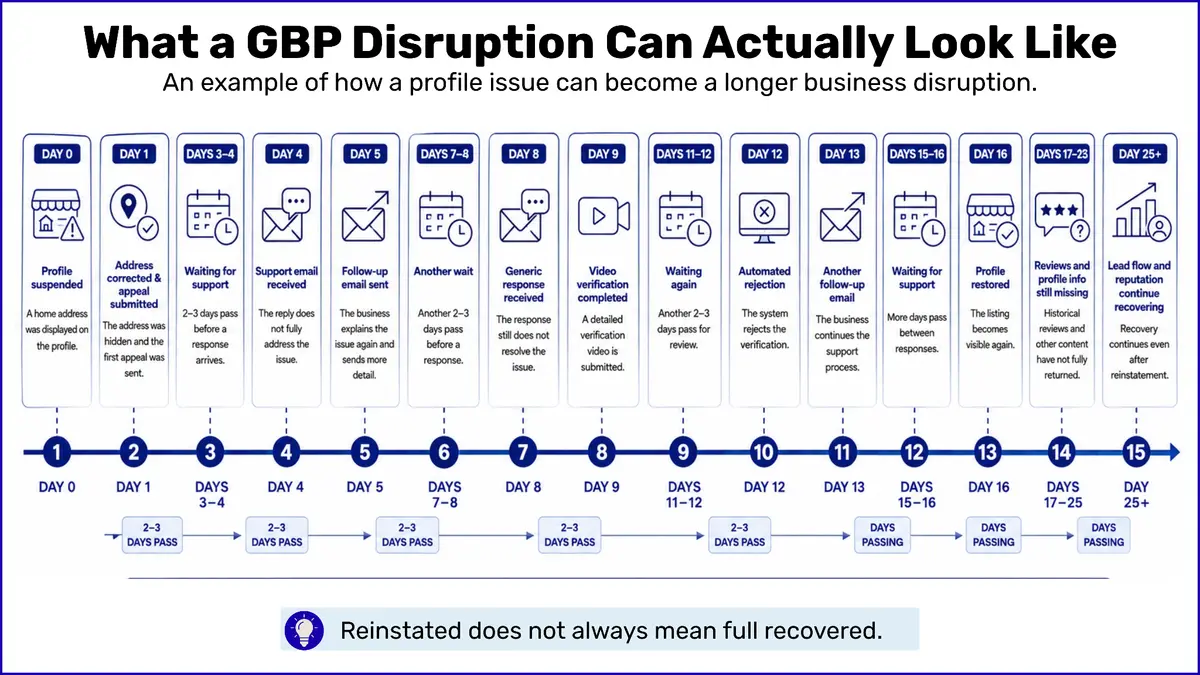
First, data disconnection is the biggest bottleneck. If a location's hours differ between your website, your map listings and your business profile, no amount of AI optimization moves forward. Conflicting signals lower AI's confidence.
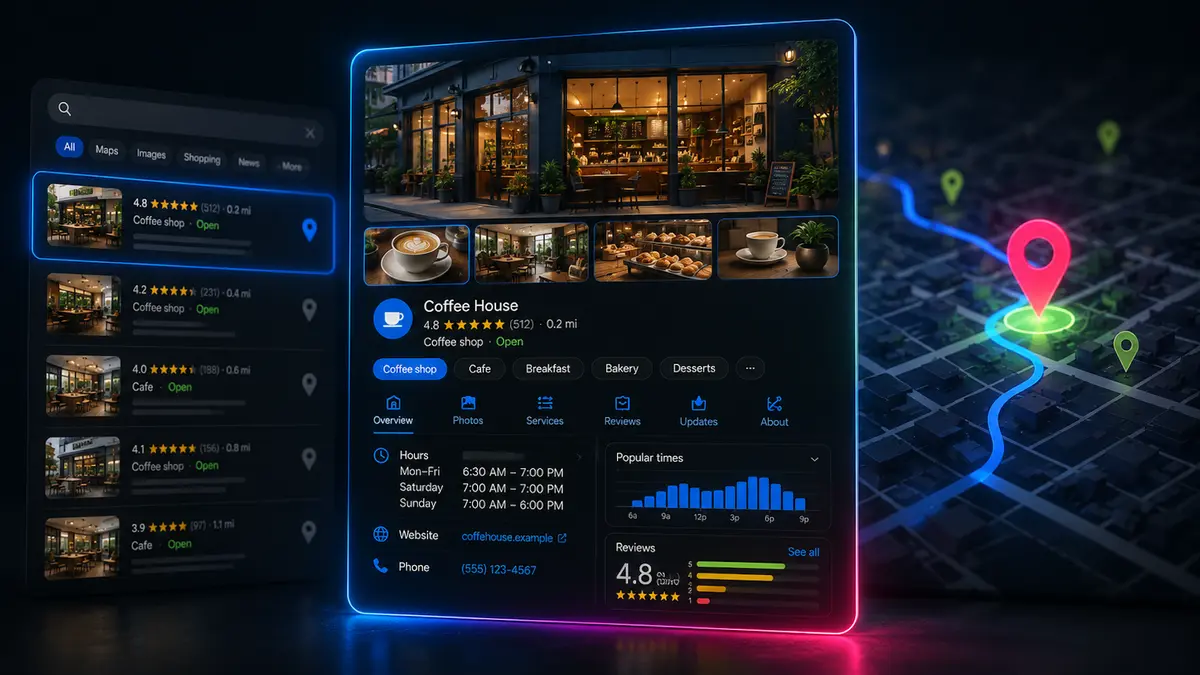
Second, read local ad inventory and organic visibility together. Map surfaces keep adding placements, as with Naver Maps adding Place Ads to transit and address detail screens. Cleaning up local data feeds paid performance directly.
And most of this work isn't glamorous new technology. As Most AI Visibility Gains Are Just Technical Debt Repayment argues, it is closer to a deferred chore: getting location information accurate and managing it in one place.