Tech/AI모비인사이드
OpenAI DevDay 2026 Recap — ChatGPT Becomes a Shared Workspace for People and Agents
OpenAI DevDay 2026 introduced the always-on agent Dots, GPT-6.1 Sol and ChatGPT Spaces. A recap of the shift from model races to work platforms.
The global mobile app market is still growing at a healthy double-digit pace — estimated between $330 billion (Fortune Business Insights, 15.1% CAGR) and $391 billion (Mordor Intelligence, 17.2% CAGR) in 2026. But inside the Korea mobile app market, the quality of that growth is changing.
AI as a default layer. ChatGPT crossed 1 billion global MAU in May 2026, and Gartner projects that 40% of enterprise apps will carry task-specific AI agents by the end of the year — AI is no longer a bolt-on feature but a baseline component of an app.
The rise of agentic AI. AI is evolving past simple Q&A toward autonomously judging and executing tasks; Deloitte projects the global agentic-AI market will reach $45 billion by 2030.
From downloads to time-on-app. Global app download growth has stalled below 1%, while in-app revenue and time spent keep climbing — the competitive center of gravity has shifted from new installs to holding users' attention.
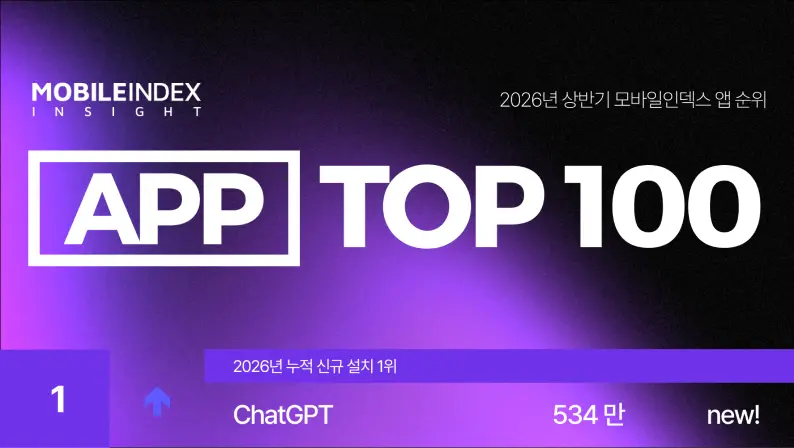
Korea's own data tells a sharper story. First, the big-tech top three — YouTube, KakaoTalk, Naver, in that order — held their ranks unchanged for six straight months. Second, ChatGPT's breakout: it hit 15.44 million MAU in the AI/productivity category (17th overall, +16.4% month over month) and topped new installs. Third, virality-driven growth stood out — setlog peaked at 2.73 million DAU in April–May, and Chzzk gained 1.52 million new installs riding World Cup coverage. Fourth, Toss's dominance in finance continued, absorbing most banking-app usage time with roughly 9x the gap over the #2 app. Fifth, brand competition re-centered on value-for-money — Mega MGC Coffee, not Starbucks, led new installs in F&B, and Uniqlo led new installs in fashion.
In commerce, Naver Plus Store (4.38 million) and Temu (4.36 million) ran a near dead heat. In F&B, Starbucks dominated overall (7.06 million MAU, 1.13 million new installs) while the #2–5 spots — Mega MGC, A Twosome Place, McDonald's, Kyochon — clustered within about 200,000 of each other. In fashion, Uniqlo led on scale while Zara led on time spent (1.97 million hours, 47.1 minutes per user). In AI entertainment, Zeta ran away with the category on an overwhelming 40 hours per user per month.
The message for marketers is unambiguous: new installs — the raw "acquisition" metric — no longer decide the winner. In a market where download growth has stalled, real competitive advantage now comes from how long you can hold a user's attention and in-app engagement, exactly as shown by Zara's lead in dwell time and Zeta's 40-hour monthly figure.
At the same time, as AI becomes a default layer inside apps, the point of contact for search, recommendation, and conversion is moving quickly toward AI agents. ChatGPT's explosive growth raises a new marketing question: how should your brand's app integrate with AI experiences, and how do you secure visibility inside AI-mediated recommendation environments (what's increasingly called GEO)? Value-driven brands leading new installs is itself a signal that practical choice can now outrun brand awareness. For a deeper look at topical authority in AI-driven discovery, see how topic authority wins in AI search, and for help building an engagement-first app or content strategy, explore Best Partner's services.
AI becoming a default layer inside apps (ChatGPT crossed 1 billion global MAU), the rise of agentic AI expected to reach a $45 billion global market by 2030, and a shift from download growth (stalled below 1%) to competition over time-on-app.
It reached 15.44 million monthly active users in the AI/productivity category — 17th overall, up 16.4% month over month — and topped the new-install rankings.
Zara led fashion in time spent (1.97 million hours, 47.1 minutes per user) despite Uniqlo leading on scale, and Zeta dominated AI entertainment with roughly 40 hours per user per month.
Since new-install growth has stalled, real competitiveness now depends on holding user attention and in-app engagement rather than acquisition alone, and brands need a strategy for visibility inside AI-mediated recommendation and agent experiences.
To apply what you just read to your own site, start with a free audit of where things are now.
A strategist replies within 24 hours on business days.
OpenAI DevDay 2026 introduced the always-on agent Dots, GPT-6.1 Sol and ChatGPT Spaces. A recap of the shift from model races to work platforms.

Zero-click GEO explained from TBWA's observations: 68% of U.S. Google searches end without a click, so extend existing SEO content into AI citations.
Claude Fable 5.1 improves coding and research while cutting cache costs, reducing false safety interventions, and introducing regulatory watermarking.