Tech/AI모비인사이드
OpenAI DevDay 2026 Recap — ChatGPT Becomes a Shared Workspace for People and Agents
OpenAI DevDay 2026 introduced the always-on agent Dots, GPT-6.1 Sol and ChatGPT Spaces. A recap of the shift from model races to work platforms.
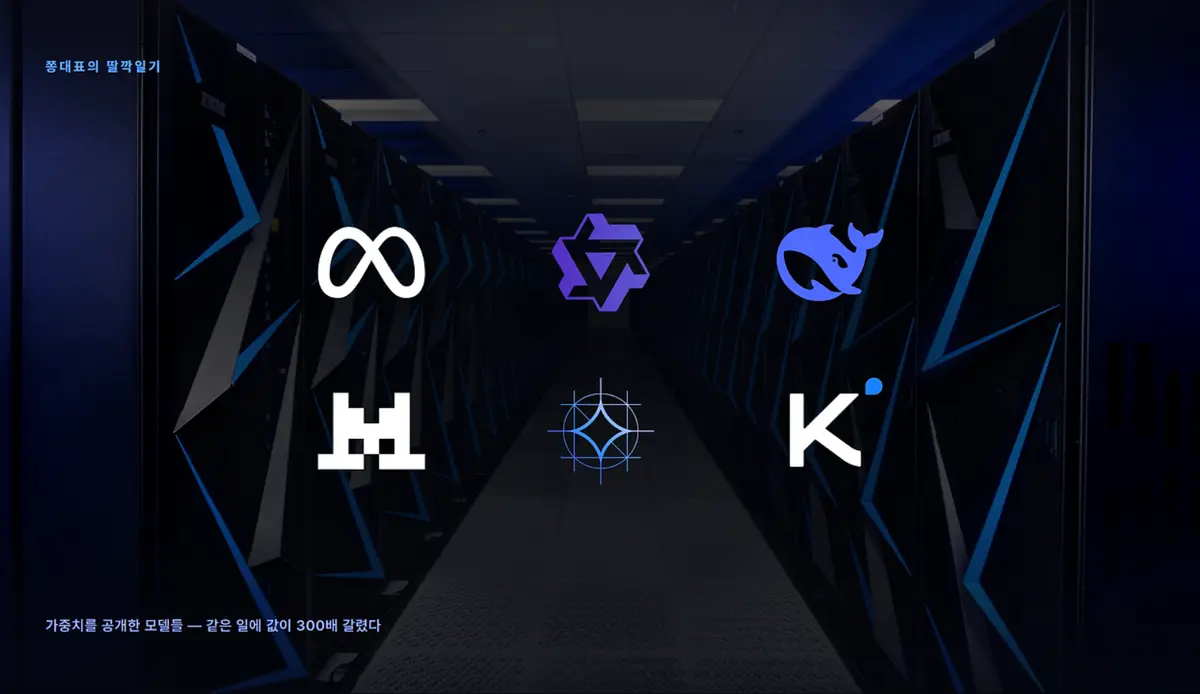
The same tasks went to two different AI models — summarizing documents, fixing code, drafting emails. The outputs were not noticeably different. The bills were: $50 on one side, 14 cents on the other. Three hundred times.
The usual reaction is skepticism, and it is reasonable. So here is the conclusion up front: saving 300x is not always a win, but for certain work it clearly is. Where that line sits is the whole point.
Open-weight means the model's weights are published. Weights are the numbers a model learned during training. In cooking terms, you are not receiving the recipe — you are receiving the finished stock someone else simmered.
Which matters, because free stock does not make the meal free. You still need a stove and a kitchen. The compute to run the model still costs money. That 14 cents is the stove. The model is free; the operation is not.
Meta's Llama opened this lane, with DeepSeek and Alibaba's Qwen following.
Based on published pricing aggregates:
Individual models widen the gap further:
That is roughly 16x on input and 25x on output.
Three things genuinely differ, and pretending otherwise is dishonest.
Hard problems separate them. Easy work looks the same. Summarizing, translating, reformatting — you will not feel the difference. Multi-step problems requiring judgment mid-chain are where the gap opens.
Setup effort. A paid API works the moment you open it. Open-weight needs installing, configuring, tuning. Price your own hours and that setup time can consume the entire 300x saving.
Someone to call. When something breaks, is there an accountable vendor? For work touching company data, that often outweighs price.
Open-weight is not equivalent across all workloads. Difficult reasoning, chains involving multiple tools, and top-tier coding still lag. Industry analysis says the performance gap has narrowed, not closed — roughly 12 to 16 months.
Write down what your company actually does in a day and the picture clarifies. Most of it is repetition:
Does that work need frontier performance? No. And that work is the highest volume. Hard tasks number a handful per day; easy tasks number in the hundreds. Cost multiplies by volume. The 300x is not the scary part — 300x multiplied by hundreds of daily jobs is.
So the answer is not choosing one. It is splitting: high-volume easy work to the cheap side, rare hard work to the expensive side.
Say you have a repetitive task running 300 times a day. Even at modest tokens per job, that is 9,000 jobs a month. Apply a 16x difference and a bill in the hundreds of dollars becomes tens.
Meanwhile, five hard judgment calls a day routed entirely to the expensive model still costs very little monthly. The failure pattern is economizing on the expensive thing while missing where the money actually goes.
This is not an either-or decision. It is attaching different tools to different jobs — the same way you draft in a word processor and move the numbers to a spreadsheet.
There is something that may matter more than price. Open-weight models can run on your own machines, which means company documents never leave. Contracts, HR files, unreleased results. If uploading those to someone else's servers has always felt uncomfortable, this removes the concern structurally — nothing gets uploaded.
There is a catch. Running it yourself means owning the security yourself. If someone else's servers felt unsafe, ask honestly whether yours are safer. Without anyone to maintain them, they are more dangerous, not less.
Blocking access is easy. The problem is that without an alternative, employees end up using personal accounts — data leaves through a channel the company cannot see, with no log at all.
That is why self-hosting comes up. It is not free either: hardware, someone to maintain it, and rework every time models change. Below a certain scale the overhead exceeds the benefit.
One test decides it: among the documents currently leaving for someone else's servers, is there anything that genuinely should not? If yes, bring that workload in first. If no, there is no urgency.
Skip the grand plan and follow this order.
Do you need to stand up your own server? Not at this stage. Several services run open-weight models and bill by usage, with integration close enough to what you already use that starting can mean changing an endpoint.
Hardware comes later — after the migration proves useful, volume justifies it, and a real data-residency reason emerges. Reverse that order and you buy equipment you never use.
The point is not cutting costs. It is operating with knowledge of what things cost. Until recently there was one option, so there was nothing to compare. Now there are options separated by 300x. If everything still routes to the expensive side, that is likely not a performance judgment — it is that no one has ever split the workload.
Splitting it takes a week.
One more thing: the gap will not hold. Closed models are cutting prices and open-weight models are gaining capability. Today's conclusion is not guaranteed to hold in six months, so re-measure quarterly rather than deciding once.
AI costs only make sense when you can see the contract structure behind them. The analysis of how much of Meta's real AI cost sits off the books in unreported commitments shows how platform pricing gets built. And any migration to cheaper models needs a verification step attached — making "done" provable supplies that framework.
How far to shift toward the cheap side is your call. But making the call requires looking at the numbers first — starting with last month's bill.
The weights are published, but operation is not free. Compute to run the model still costs money — the 14 cents in this comparison is exactly that operating cost.
Published aggregates put the median open-weight price at $0.53 per 1M tokens versus $2.63 for closed models. Individual comparisons reach roughly 16x on input and 25x on output.
High-volume, low-difficulty repetition — email drafts, meeting notes, copy polishing, number extraction, first-pass inquiry triage. Cost multiplies by volume, so savings concentrate there.
Industry analysis says it has narrowed but not closed — roughly 12 to 16 months. Closed models still lead on difficult reasoning, multi-tool chains, and top-tier coding.
To apply what you just read to your own site, start with a free audit of where things are now.
A strategist replies within 24 hours on business days.
OpenAI DevDay 2026 introduced the always-on agent Dots, GPT-6.1 Sol and ChatGPT Spaces. A recap of the shift from model races to work platforms.

Zero-click GEO explained from TBWA's observations: 68% of U.S. Google searches end without a click, so extend existing SEO content into AI citations.
Claude Fable 5.1 improves coding and research while cutting cache costs, reducing false safety interventions, and introducing regulatory watermarking.