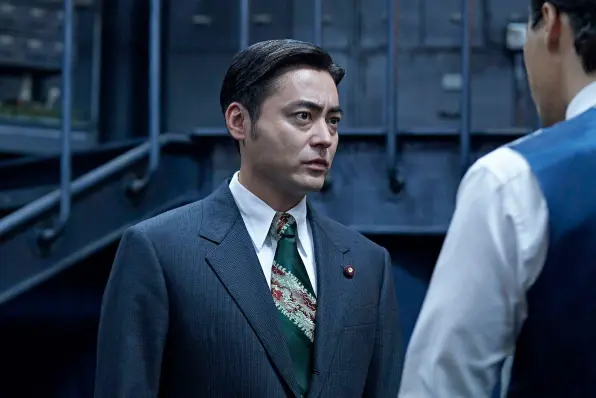
Scan recent Korean drama and film lineups and a pattern emerges. Sota Fukushi in Can This Love Be Translated?. Sho Kasamatsu in back-to-back appearances in Taxi Driver 3 and Good News. Lily Franky playing Ito Hirobumi in Harbin and again in Made in Korea. Miyavi in How to Become a Building Owner in Korea.
Too frequent to be coincidence, and too genre-agnostic to be a trend. Romance, noir and period pieces — works with entirely different grammars — are all casting Japanese actors.
Reading this purely as industry logic captures half the story. The other half is that Korean audiences receiving these casting choices have changed.
Supply side: global-first casting
A Netflix Korea marketing director said in a recent interview: "Since Squid Game, we don't finish a project and then think about going international. We consider the global audience from the planning stage." Translate that sentence into a cast list and you get the current lineup.
Japan is the second-largest and already-proven market for Korean content. Casting Japanese actors early to pull in domestic fandom there is a rational move.
Meanwhile, as Cine21 has noted, Korea's content market is in a conservative phase where investment and scheduling are difficult without star casting. The star talent pool simply widened across a border.
Demand side: favorability at a record high
For this strategy to work, one condition has to hold — Korean audiences must accept Japanese actors and Japanese characters without friction. The data says they do.
Per the 13th Korea-Japan Mutual Perception Survey by the East Asia Institute (EAI) and the International House of Japan (IHJ), conducted July 17–21, 2026, Korean favorability toward Japan reached 54.3% — the highest since the survey began in 2013. The figure had fallen to 12.3% in 2020, meaning a recovery of more than 42 percentage points in six years.
The surveying institutions named the driver directly: expanded private-sector exchange through travel, shopping, food and popular culture.
It runs both ways
Korea's Ministry of Culture, Sports and Tourism found Japanese favorability toward Korean content up 6.4 percentage points year over year, the second-largest increase among surveyed countries. Both curves rising simultaneously is unusual.
Music showed it first. After NewJeans' Hanni covered "Blue Coral Reef" at Tokyo Dome in 2024, the song entered Korea's Melon J-POP chart for the first time; in February the original artist Seiko Matsuda opened her first Korean concert with it; in August a J-POP REMAKE project selected the same song as its third remake. City pop and Showa nostalgia are being consumed simultaneously by people in their 20s and 30s on both sides.
Where the two graphs overlap
Producers folded Japanese actors into casting strategy with global sales in mind from the outset — supply-side logic. At the same time, Korean receptiveness to Japanese culture hit a record high, creating ground where that casting is consumed comfortably — demand-side change.
Neither alone explains the current density. Industry calculation and public sentiment happen to be pointing the same direction at the same moment.
One caution against over-reading it
The favorability rise should not be romanticized. In the same survey, "insufficient reflection on history" (74.9%) and "the Dokdo issue" (46.9%) remain the top reasons for negative perception.
Favorability is climbing fast in the private-exchange zone — content, travel, food — without erasing political and historical grievances. The accurate reading is not "relations improved" but "borders are thinning in content and cultural consumption."
What this changes for IP strategy
The phenomenon shows Korean content production shifting fully from a domestic-first model to a global standard that folds overseas markets and multinational talent in at the planning stage.
Two implications for brand and content marketers.
Casting has become part of distribution strategy. Talent decisions now determine not just the quality of a work but which market it captures initial attention in. Brands partnering with IP should ask the same question: which country's fandom does this collaboration actually bring?
The platform-IP relationship is being renegotiated. From Disney opening its IP to TikTok — see Disney Opened Its IP to TikTok — a Deal Built on Controlled Sharing, Not Money — to ByteDance's protection agreement with the Motion Picture Association in ByteDance Signs an IP Protection Deal With the Motion Picture Association, how far rights open and where control stays is now the core negotiation.
The thing to watch: whether cross-border casting settles into a pan-Asian casting standard where leading Korean, Chinese and Japanese actors move freely between each other's productions — or stays a passing burst of attention.