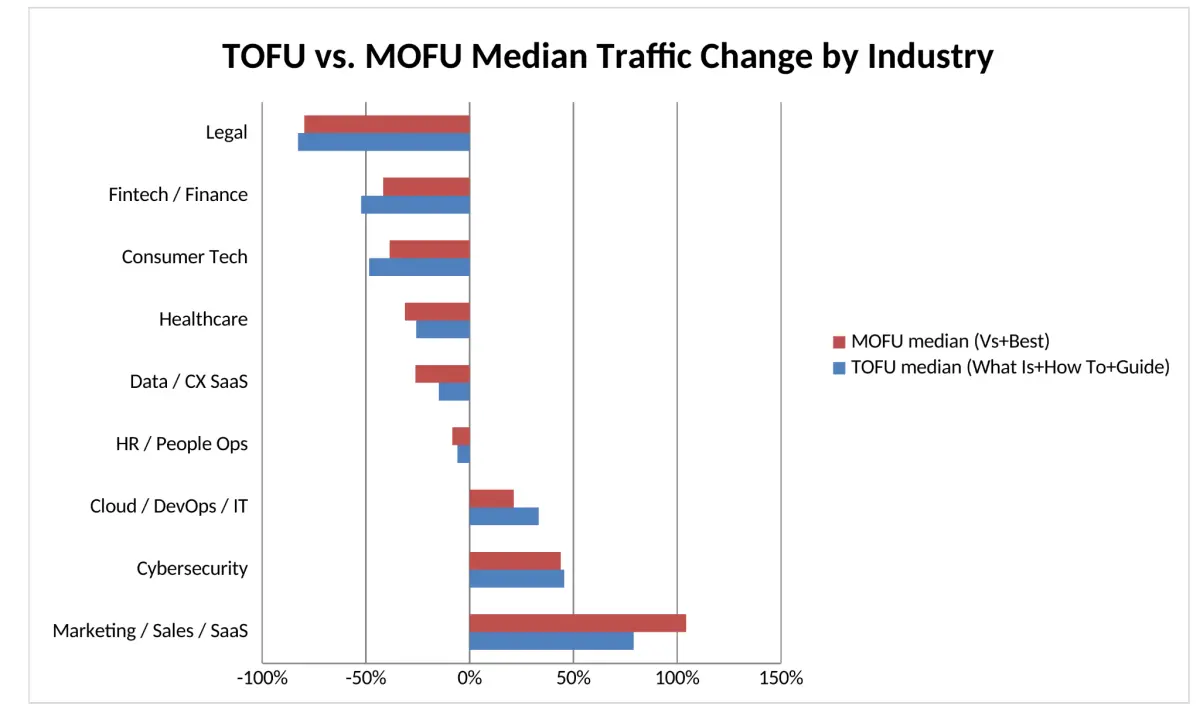
Organic search clicks have fallen 42% since AI Overviews began expanding, LLMs answer informational queries in-platform, and AI production has flooded the SERPs with top-of-funnel (TOFU) articles. Fewer clicks, more competition. Which forces the question every content team is asking: is TOFU content still worth writing? Adam Gnuse at Search Engine Land put data against it, comparing year-over-year organic traffic estimates for 30 of the largest publishers across nine industries.
What a year of data shows
YMYL collapsed; B2B tech grew
Every sampled domain in finance, healthcare, legal, and consumer tech publishing lost TOFU traffic — glossaries, how-tos, and guides all declining together. That maps exactly onto Google's Your Money or Your Life categories, where AI Overviews appear most aggressively. LegalZoom's 90% decline was the outlier, and the company attributed it directly to changing search patterns. Meanwhile, every domain in cybersecurity and marketing/sales software improved, and cloud infrastructure ended positive in aggregate.
Industry mattered more than funnel stage
Comparing the same industries' middle-of-funnel content — comparison pages ranking for "vs." and "best" keywords — TOFU and MOFU trended together in every industry reviewed. Two implications: a YMYL brand shifting TOFU budget into MOFU won't sidestep the AI search hit, and if the most authoritative publishers are losing this badly, smaller YMYL publishers competing for a thinner slice are almost certainly faring worse.
TOFU strategies that still look viable for 2027
Local, where AI is still weak
AI Overviews appear far less often for local queries, and LLMs still lack reliable location awareness — which is why local search traffic is holding. The bar, though, is genuinely local content tailored to each service area, not programmatic location pages. For what actually separates local winners, see What 1.8 Million Google Business Profiles Reveal About Local SEO Rankings.
Tools AI can cite but can't reproduce
Plain educational how-to content gets cited by LLMs only about 12% of the time — AI writes generic how-tos itself. But ungated calculators and screeners are different: nearly every tool page in the study picked up AI search traffic, and summaries recommend specific tools by name. Tools are one of the few TOFU formats an AI answer can point to but not replace.
Real subject-matter expertise
AI Overviews are quick, generic, and anodyne by design. They don't take positions, share mistakes, use humor, or engage with messy reality. A "what is X" piece written or shaped by someone who has actually run the process reads differently from a summary assembled out of five existing explanations — and it's a short path to original data, which raises your odds of being the source AI cites.
Our take: the question has changed from "should we write TOFU" to "does this page deserve to exist"
Hyper-scaled AI content keeps getting riskier: model-to-model writing gains have slowed, detection infrastructure is spreading, and Google keeps hitting scaled content in spam updates. The TOFU that survives starts from the reader's situation rather than a keyword's volume — the approach we detailed in Build Content Briefs Around Audience Situations, Not Keywords — the 7 W's Frame. And its value has to be measured as incremental contribution, not attributed traffic — the argument of When Review Content Turns Parasitic — Measure Incrementality, Not Attribution. Before hitting publish, one question: does this page deserve to be published?