Keyword research tells you what people search for. It does not tell you why they are searching or what they need next. Better briefs start from the situations your audience is in.
What happens when the keyword becomes the brief
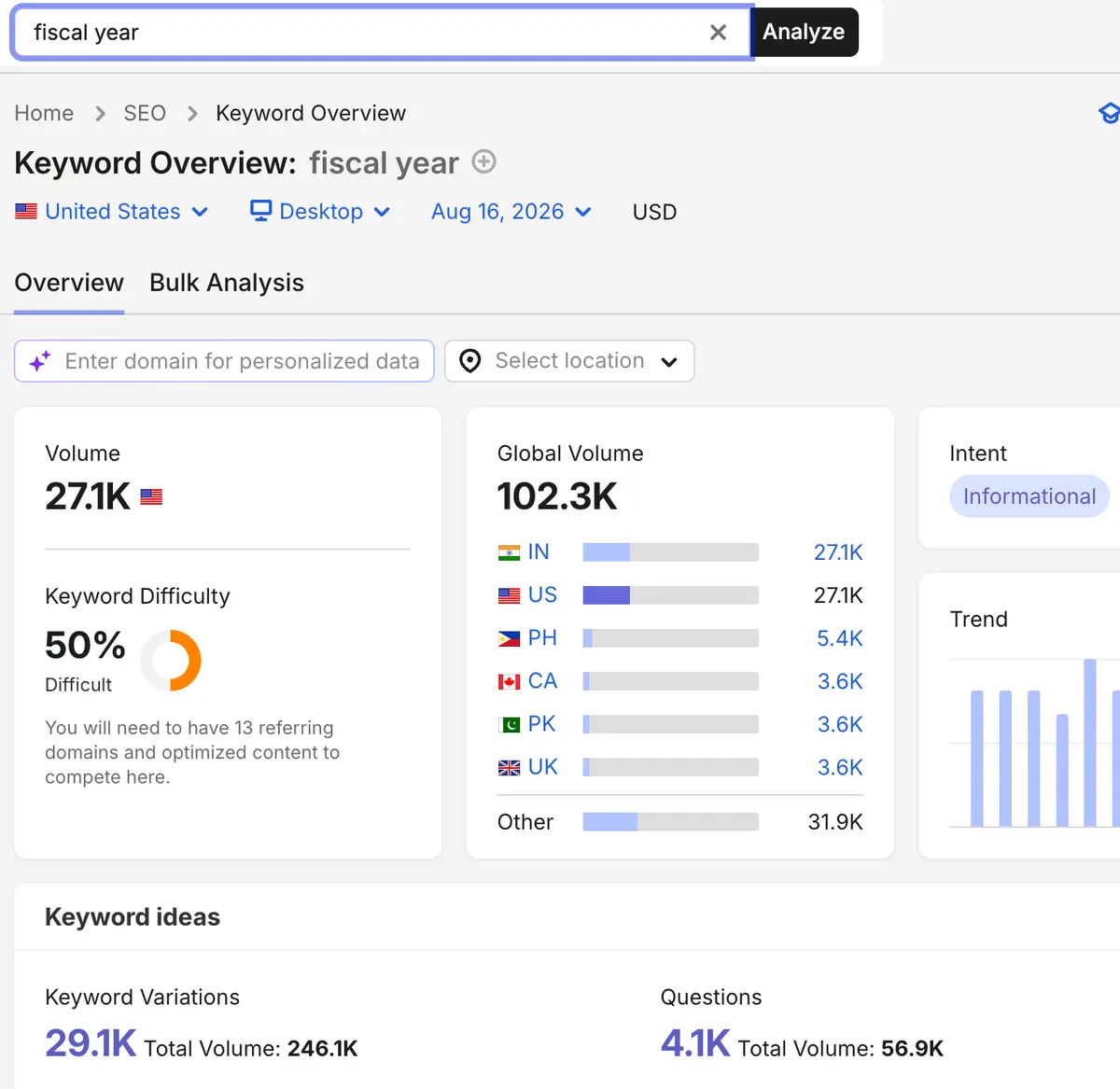
The result is the pile of 300-word articles written between 2015 and 2018 that teams are now cleaning up. It is why every accountant in the U.S. has an FAQ answering "what's the fiscal year?" somewhere on their site — chasing the impressions and clicks that answering such a question seemed to promise.
For a specialist service like accounting, answering basic questions like that does your expertise a disservice. You are lining up against the government agency that defines the standard and telling Google to serve your answer instead. That is never going to happen.
Two uncomfortable questions
Contributor Amanda King poses them directly:
- Why am I trying to outrank the entity that should clearly be the only answer served for this question?
- Why, as a business owner, would I want clients who do not already know the answer to this basic question or how to find it?
Step back from that and you see the bigger picture keywords were always trying to convey: what journey is our audience on, and how do we answer their concerns along the way?
From keywords to situations
Conversational search with large language models is a reminder that humans do not natively think in keywords. It is not "best new sweet snacks 2026." It is:
- "My wife is pregnant and craving weird sweets she's not tried before."
- "I want to give new candy out for Halloween this year."
- "I want to impress my friends with something different for dessert at the next dinner."
The situation aligns far better with topic-level thinking than with individual keywords — and with how large language models are trained to reason alongside the person using them.
The 7 W's
Topics are the first step into category entry points (CEPs). CEPs are qualitative and people-based; they are the jump from the topic back to the situation that created it. Jenni Romaniuk's Better Brand Health frames them as the 7 W's:
Why · When · Where · While · With whom · With/for what · How feeling
Answering those is the exercise to run when building a brief — and honestly, before creating anything new for your website or brand at all.
The people best positioned to help are the ones who interact with your audience most: support, sales, in-store staff, or anyone who has become a public brand representative.
Less measurable, more defendable
This process is grounded in brand science and marketing principles, so it does not compress into a single metric the way keyword volume does. But keyword volume has always been abstracted away from your actual audience and their concerns.
The 7 W's force you, your team and your leadership to ground choices in real people. "This is the feedback our support team gathered over six months" versus "this has the biggest search volume in the U.S. for our vertical." As a business owner, which would you rather act on?
What goes in the brief
- One line for each of the 7 W's, plus who on the team supplied it where possible — the traceability helps when someone needs to fact-check or get more detail.
- The scenario you are solving for: the panicky business owner near the end of their first financial year, someone taking over a new business, the young apprentice learning the ropes.
- Everything a typical brief carries: content type (informational, consideration, transactional), a short suggested outline, brand tone notes, an existing coverage check, length guidance, and the measure of success.
This gives content a shape focused on the situations your audience is in, and cements — with feedback from real people — where your brand is not answering their concerns.
Proving it to a skeptical leadership team
Test it. Write one traditional keyword-based brief and one built around the 7 W's and scenarios. Compare the quality of what comes back from your writers and, where possible, A/B test them on the site for scroll depth, interaction and impressions.
What this really does: it deletes the average customer
The 7 W's work because they remove the average customer from the process. Keyword volume flattens demand into one number, and content built from that number fits nobody's situation exactly. It is the same failure described in Your Customer Journey Doesn't Work Because It Was Built for an Average Customer.
The approach also survives whatever search becomes. When results shift from links to answers, content that started from a situation is still the raw material those answers are built from — which lines up with the argument in Build Your SEO Strategy as if Search Engines Didn't Exist. Long term, an audience whose concerns are answered before purchase is worth far more than ranking No. 1 for "what's the fiscal year" for your entire tenure.