Where UX began
To understand UX, you need to know where designing for people began. The first installment of Korean designer Yoo Hoon-sik’s history of UX focuses on Henry Dreyfuss, who established the principle of designing for people — shaping products around users rather than manufacturing convenience or fashion.
From the stage to industrial design
Born in Brooklyn in 1904, Dreyfuss began at about 16 as an apprentice to stage designer Norman Bel Geddes on Broadway, learning to consider actors’ movement and audience sightlines — people’s behavior before objects. He opened his own office in 1929 at 25 and turned down Macy’s request to restyle products’ appearance, believing form should come from how things are made and used. He favored long-term relationships with a few clients — Bell, John Deere, Hoover, Honeywell — because observe-improve-observe cycles take time.
Ergonomics, a science born of war
During World War II, trained pilots kept crashing sound planes on landing. Psychologist Alphonse Chapanis found that B-17 flap and landing-gear switches were identical and side by side; giving them different shapes sharply reduced accidents. “Pilot error” was design error. In 1949, British psychologist K.F.H. Murrell coined “ergonomics,” and the Human Factors Society was founded in the U.S. in 1957. In 1954, Paul Fitts quantified how distance and target size affect pointing time — Fitts’s law, later fundamental to on-screen interface design.
1955: ‘Designing for People’
In his 1955 book Designing for People, Dreyfuss wrote: “When the point of contact between the product and the people becomes a point of friction, then the industrial designer has failed.” If people become safer, more comfortable, more efficient or simply happier, the designer has succeeded. That “point of contact” later became the interface and touchpoint at the heart of UX. He drove tractors to design them and learned sewing to design sewing machines, making field observation standard practice.
Joe and Josephine: ancestors of personas
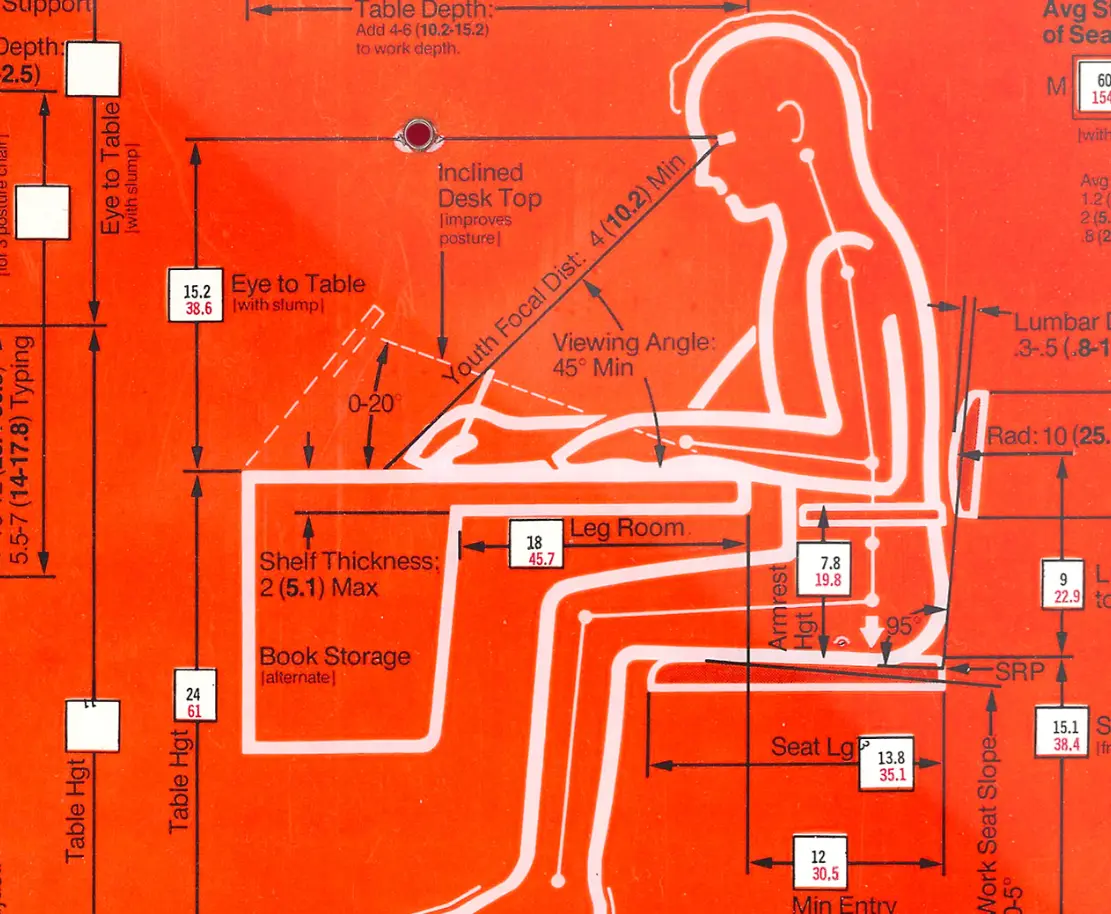
The book’s most famous figures are Joe and Josephine, drawings of average American adults defined by measurements. Designers pinned them to walls and checked whether every product let them sit, grip and reach comfortably. The 1960 portfolio The Measure of Man introduced percentiles to include people from small women to large men, plus children, older adults and wheelchair users — groundwork for accessibility and universal design. Joe and Josephine are considered the earliest ancestors of today’s UX personas.
Machines fitted to hands
- Bell telephones: he declined a 1930 sketch commission, insisting on designing from the inside with engineers. The 1949 Model 500 refined the handset with body-measurement data and moved numbers outside the finger holes to reduce misdials.
- John Deere tractors: seats and instruments redesigned for farmers who sit all day.
- The 20th Century Limited: every touchpoint of the journey, from locomotive to dining-car tableware and matchbooks, in one design language.
- The Honeywell Round thermostat (1953): a boxy device reduced to a single dial — later echoed by 2010s smart thermostats.
Principles marketers can inherit
Dreyfuss’s rule fits in a sentence: fit machines to people, not people to machines. Observe users, validate with data and remove friction at every point of contact — guidance that maps directly onto customer experience design, from personas built on distributions rather than one average user to unified journeys across ads, product pages and checkout. See it echoed in the invisible UX of bottle caps and in designers’ shift from making to choosing in the vibe design era.