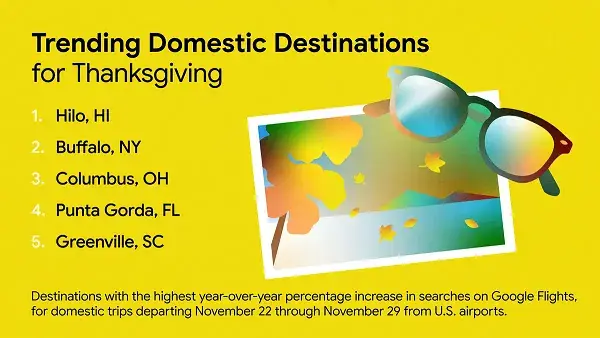
Google has released an overview of holiday travel trends for U.S. travelers, built on year-over-year increases in Google Flights searches. The insights are meant to help people plan trips, but they also give marketers useful timing signals for holiday campaigns.
Trending holiday destinations
New York and Orlando, Florida remain popular domestic destinations, while several other areas are seeing significant rises in travel activity. Internationally, Athens, Rio de Janeiro and Hanoi are gaining traction. Google says U.S. travelers are seeking warmer climates for Christmas and New Year’s Eve.
When flights are cheapest
Google also shared booking guidance:
- Domestic flights: cheapest 39 days before departure, with the lowest price range 22 to 57 days out.
- International flights: lowest prices 89 days before departure.
- Thanksgiving: lowest prices 34 days before departure.
- Christmas: the sweet spot is 56 days before departure, with the best deals between late October and mid-November.
What marketers should take from it
Time promotions to the booking window
If the best Christmas booking window runs from late October to mid-November, travel, hospitality and travel-gear brands should launch holiday campaigns slightly earlier to enter the consideration phase. Concentrating search and retargeting budgets in that window is likely to be more efficient.
Use the warm-weather signal in creative
Demand for warmer destinations can guide creative for resort stays, summer apparel and travel-size beauty products during the holidays. Because the data reflects U.S. travelers, brands in other markets should validate it with local search data.
What this means for marketers
Seasonal data published by platforms is a solid basis for campaign timing and creative direction, and it becomes sharper when combined with your own first-party data. To connect first-party data to your ads, see Google Expands Data Manager to Put First-Party Data to Work Across Analytics and DV360. For guardrails when automated bidding runs through peak season, read Google Ads AI Needs Guardrails, Not Blind Trust: Mike Ryan on AI Max Mistakes and Over-Segmentation.