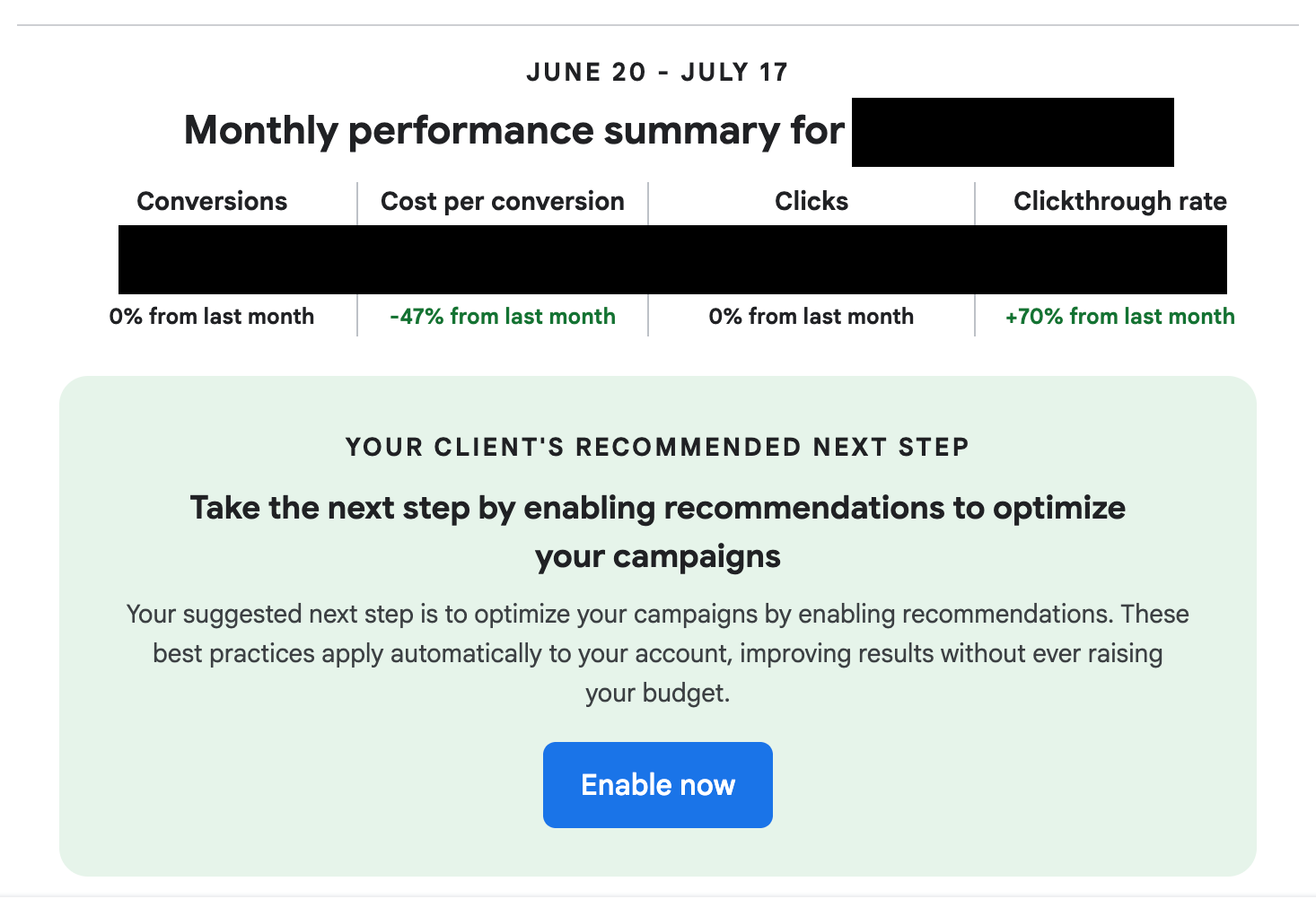
Some Google Ads recommendations improve performance. Others increase costs or make changes that don't align with your strategy. Here are four to review carefully before switching on.
1. Auto-apply
Google introduced auto-apply shortly after the Recommendations tab. Clear up the common confusion first: every account has a Recommendations tab, and it generates recommendations whether you accept them or not. Auto-apply is a separate setting that lets Google implement whichever recommendation types you select.
Those types vary widely — from routine options like Use Optimized Ad Rotation to more contested ones such as Improve Your Responsive Search Ads (letting Google generate headlines and descriptions) or Use Display Expansion.
The rule is simple: opt in only to types that match the client's strategy and brand guidelines. Regulated industries generally need to avoid auto-generated ad copy. If a client holds strict CPA or ROAS targets, don't enable "Set a target CPA" or "Set a target ROAS" unless you're comfortable letting Google pick those numbers — a judgment that matters more with Google's targeted bidding changes rolling out Aug. 17.
2. Display Expansion
Search and display serve different purposes. A good search ad is a pull ad: it shows users you have what they're already looking for. Display is a push ad that interrupts browsing to build awareness.
The metrics follow. Search ads earn high CTR and, matching existing intent, strong conversion rates. Display ads earn far lower CTR because they interrupt, and lower conversion rates because nobody is actively shopping. Display generates far more impressions at far lower CPC, since placements are nearly unlimited.
So while Display Expansion adds traffic, running display and search inside one campaign generally isn't advisable outside Performance Max — your efficiency metrics will simply look worse.
3. Network settings
Check which networks your Demand Gen campaigns are opted into. Google says performance improves with Display enabled, but campaigns that inadvertently had the Google Display Network selected have shown declining traffic quality. In one case a legacy campaign that performed well in Google Discover ended up serving only on Gmail and YouTube, with CPA nearly doubling.
Note that the control sits at ad group level, not campaign level. Segmenting by network in Demand Gen lets you evaluate performance by placement.
Search Partners deserve the same scrutiny. Google often recommends enabling them for volume, but evaluate them separately from the Google Search Network using the Network (with Search Partners) segment. If they underperform, staying opted out usually makes sense unless you have a volume goal you cannot otherwise meet.
4. Budget recommendations
Reps often surface opportunities to increase conversions, warnings about lost customers, or estimates of reaching 50% more people. What goes unmentioned is the added cost — a claimed 30% conversion lift can require a fivefold budget increase.
One concrete example: Google recommended a client double its daily budget for an estimated 0.75 additional conversions per week. Less than one extra conversion weekly did not justify spending twice as much per day, or fourteen times as much per week.
Another commonly forgotten point — once Google raises a budget, it does not lower it again. Owners approve the change, then wonder a month or two later why spend stays high. Monitor every change and revert what isn't working.
The through-line
Understanding where your ads appear, what you're paying, and what you should expect in return — then validating those assumptions against performance data — avoids most of these problems. For a related approach to testing automation before adopting it, see Google Moves Certification Applications Into Google Ads Accounts.