The holidays are just over 20 weeks away, which means brands should be assembling holiday campaign plans now, well ahead of peak shopping season.
Marketers also need to think about where to focus effort and where their audience is engaging. New platforms and evolving user behaviours may offer new ways to connect.
Threads is one key opportunity that might get overlooked.
Meta's answer to Twitter has become a significant force since launching three years ago. The app now has about 500 million monthly active users and is becoming a bigger focus of discussion every day.
1. Examine trends
Meta has not released any trend-tracking tools for Threads yet. So marketers have to use the app's search functions.
Search surfaces:
- Top posts by keyword
- Recent posts
- The most active users within each niche
Digging into the most popular content — both in general and from top influencers — offers insight into what the Threads audience is interested in.
The question mark trick
Here is a genuinely useful tactic.
Threads users can add a question mark to their queries in the app's search bar, which shows what questions people are asking about a given topic.
Searches can also uncover relevant Threads communities worth joining or keeping tabs on.
2. Note what's working
While analysing content, marketers should build a list of key influencers, common questions and the most relevant voices in a niche.
They should also note which formats are resonating:
- Do video posts gain more traction, and if so what kind?
- Are polls driving responses?
- Do still image updates work?
- Do link posts drive engagement?
Thinking about format provides more guidance for an organic strategy aligned with how Threads users actually engage.
3. Formulate a strategy
From that research, marketers can build a strategy aligned with organic trends on Threads, learning more about what people ask and how they ask it.
In the desktop version, marketers can set up monitoring columns, letting them track future discussions related to certain keywords or influencers.
Absent a trends tool, those monitoring columns are the effective substitute.
4. Consider influencer partnerships
Tapping the right influencers helps boost a brand's Threads presence. Influencers offer a link to key community discussions and groups.
Communication on Threads is fairly open, so it is not as reliant on specific content styles as short-form video apps like TikTok.
Even so, marketers need a means to connect with the right users in order to broaden brand awareness with target audiences.
5. Analyse and improve
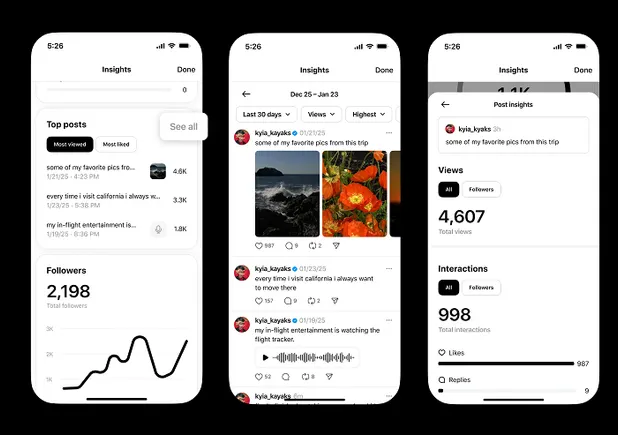
Once posting, brands can track performance in the Threads Insights tab, which provides data on followers, views, interactions and top posts.
The key, as always, is driving sales. Brands should focus on metrics related to growing presence with the right audiences rather than simply stacking numbers.
Tracking direct sales from organic Threads activity is not easy.
Practical notes
Use question-mark search as a content planning input. The questions people actually ask are raw material for FAQs and content topics — obtained without separate research spend.
Put monitoring columns into a recurring routine. No trends tool means building your own manual tracking system.
Widen your format experiments. Because Threads depends less on short-form video, there is room to test polls, text and images.
Split the approach by platform. For the sequences elsewhere, see Four Steps for Snapchat Marketing and Six Ways to Build a Brand on Pinterest.
Build recurring formats. The principle in The New Fundamentals of Social Brand Strategy applies here too.