The first half of 2026 moved money, traffic, jobs and market cap before anyone could prove how much value AI created.
Search behaviour changed, token budgets exploded, software stocks sold off, and companies blamed layoffs on AI.
Every major AI story in H1 2026 was really a story about attribution.
- We are still figuring out how to improve accuracy in measuring AI visibility
- Companies spent billions on inference, but there is no obvious answer to "What's the ROI?"
- Public markets punished software companies — but were investors reacting to actual or perceived disruption?
- We keep hearing "AI caused layoffs," but look deeper and the real causes are not connected
- It is clear where the traffic loss is coming from, but not what content marketplace model will replace it
The common thread: AI's economic impact is expanding faster than we can attribute it.
AI Search
AI Mode is now a click away from AI Overviews — two clicks from regular search results.
- AI Mode reached 1 billion monthly active users
- Queries run around 3x longer than classic search
- Google called it the biggest search box upgrade in 25 years at I/O 2026
- Gemini 3 auto browse is shipping inside Chrome
- Nick Fox says Google's AI Mode sends billions of clicks to the open web
Five conclusions about measurement
1. Tracking a brand's presence in AI Search is highly complex — engine, personalisation, reasoning levels, model updates and stochastic variability all factor in.
2. Measurement is fragmented. 91% of citations appear in only one of ChatGPT, Perplexity, or AI Overviews.
Prompt tracking should be closer to polling and focus groups than SEO rank tracking.
3. Brand mentions in AI answers are more impactful on business outcomes than citations. Most vendors and merchants need to watch how often they show up in a panel of prompts, in which context, with what sentiment, and whether they are recommended ahead of competitors.
The citation-versus-mention gap is covered in Ghost Citations.
4. Trust is the highest currency in AI search.
- Close to 75% of consumers pick the number one result in an AI shortlist
- But if they see a trusted brand anywhere on that list, they will pick it
- 88% of the time, users accepted AI Mode product recommendations as best there is
In AI Overviews, by contrast, users click, evaluate and compare a lot — classic search behaviour that does not carry over to AI chatbots.
5. Writing style, token budget and technical factors matter for agents. Lead with unique information, write directly, remove fluff, and keep your site technically fast and accessible.
AEO/GEO is a brand channel disguised as a performance channel
AI recommendations shape demand — not citations. The unit of optimisation is whether AI names, trusts and recommends your brand.
The token frenzy and its hangover
The second story of H1 2026 is money.
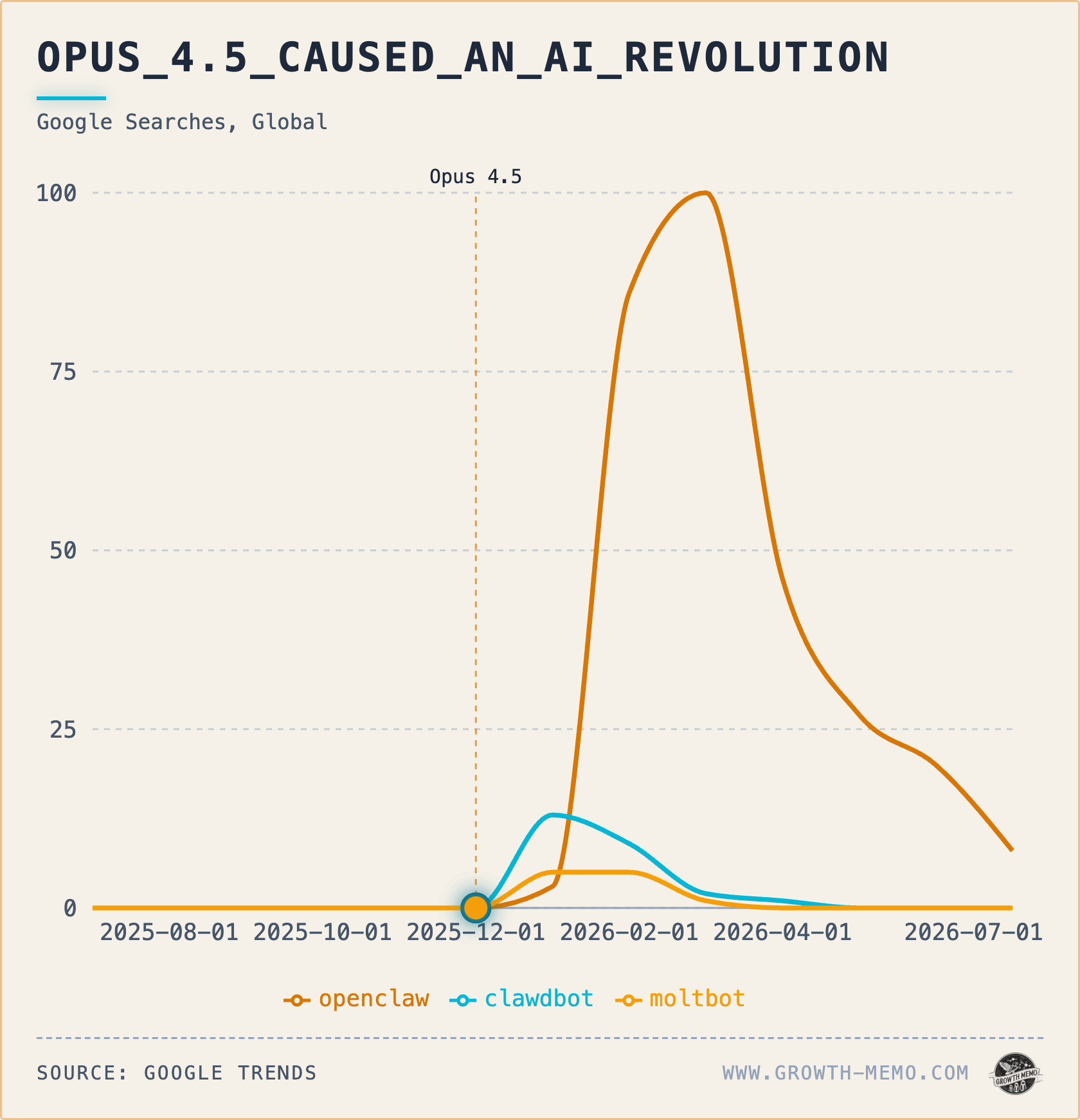
Peter Steinberger went viral with Clawdbot, leading to millions of installs, long lines in China, and Nvidia building a Nemoclaw clone.
Then it got stranger. Shopify, Uber, Meta and other tech giants built token leaderboards that incentivised engineers to light as many tokens on fire as possible.
"Let me give you a thought experiment. Let's say you have a software engineer or AI researcher, and you pay them $500,000 a year. At the end of the year, I'm going to ask him how much did you spend in tokens. And [if] that person said $5,000, I will go ape something else. If that $500,000 engineer did not consume at least $250,000 worth of tokens, I am going to be deeply alarmed." — Jensen Huang
Claudeonomics
A Meta engineer created an internal leaderboard dubbed "Claudeonomics" ranking over 85,000 employees by the number of AI tokens they burned.
It led to massive waste as employees left AI agents running on idle or useless tasks just to climb the ranks and earn titles like "Token Legend." Reportedly, Meta engineers consumed 73.7 trillion tokens in just 30 days.
In April, CFOs pumped the brakes after discovering employees had burned through their annual token budget in four months.
TokenMAXXXING shifted to valueMAXXXING. Meta's leaderboards shut down in April — but not before the #1 user averaged 281 billion tokens, which would cost over $1.4 million at standard API rates.
What remains
What survives the all-you-can-eat token craze is a step change in productivity that we cannot yet measure.
The author cites his own case:
- Designed landing pages end-to-end for a major travel brand that made it into production
- Automated topic prioritisation, SEO testing and SEO reporting for clients with full-blown apps
- Built an array of applications for himself, including research and charting agents
One outcome of the token tsunami is that a lot more people started using Claude, which in turn fired up growth engines for AI infrastructure companies Claude recommended, like Supabase.
The SaaS bloodbath
In February 2026, following the Opus 4.6 release and Claude Cowork, the software-as-a-service industry saw a severe market downturn wiping out hundreds of billions of dollars in market cap over just a few trading sessions.
The SaaS vertical saw a steep annual decline of over 30%. Valuations for high-growth software companies collapsed, with revenue multiples shrinking dramatically against pandemic highs.
Anyone in B2B likely felt it as lower conversion rates, longer sales cycles and softening brand searches.
But not all software
It is the bottom quartile of software companies that pulls the market down.
Interestingly, the decline is purely associated with how "the market" views a company's AI robustness.
Company valuation drops are not related to performance, but rather to whether people think AI will disrupt their product.
Over the last 30 trading days, both the top quartile and median IGV stock outperformed the ETF as a whole — the bottom quartile, including some of the largest companies, dragged overall performance down.
The practical advice: in B2B, if you are forced or privileged to take a new job, pick a company the market is optimistic about.
AI washing in the labour market
You have heard it: "We're laying off x% of our workforce due to AI." The narrative du jour.
Challenger, Gray & Christmas reported AI was the leading cited reason for May 2026 job cuts, cited in 87,714 cuts year-to-date — 22% of all 2026 announced layoffs through May.
Layoffs are real:
- Tech layoffs up ~66% year over year, toward 150K
- Oracle cut 21,000 citing AI
- Challenger lists AI as the top cited reason (~87,700 YTD by May)
- Block cut 40% and its stock rose (Bloomberg's "AI washing" framing)
The problem is AI is not the cause
The author has written extensively about the Big Labs using AI replacement as a marketing narrative. But it hasn't come true yet.
A lot of AI layoffs were really to offset capital expenditures, pandemic overhiring, and economic turbulence.
We can imagine a future where AI makes certain roles obsolete. That time is not now.
A year ago, in the H1 2025 report, the author predicted AI layoffs were a PR stunt — and was right:
Despite clear productivity gains from AI, the recent waves of layoffs show no indication of AI being the underlying cause. In fact, companies using AI as a reason to lay employees off are rehiring them.
The agent market fragmented
ChatGPT's market share decreased from 78% in July 2025 to 56% in July 2026, while Gemini went from 15% to 30% and Claude from 2% to 10%.
Google is now the most likely player to win the AI consumer market, and ChatGPT has lost its significance in AI Search to Google.
Where each stands
OpenAI still has ~1.1B users but refocused on an enterprise pivot — shutting down Sora, dropping video in ChatGPT, and killing Instant Checkout. Enterprise makes up ~40% of revenue, heading to ~50% ahead of a potential IPO.
The author is skeptical about buying OpenAI stock. According to Ed Zitron, OpenAI spends $2.8 billion every month to make $1.1B.
Anthropic's fight with the Pentagon pushed Claude to No. 1 among free apps on Apple's U.S. App Store. Months later, users seem less sure whether Anthropic can resist attacks from open-source models.
Open source applies pressure
The Big Labs massively subsidise tokens. SemiAnalysis found a $200 plan of the frontier models gives you $8–14K worth in tokens.
Recently, open-source models like Kimi K3, GLM 5.2 and Deepseek V4 have pressured US labs because of those subsidies.
Open-weight models also show that the model itself becomes commoditised, while the harness and application layer gain importance.
Forward-deployed-engineer job postings rose 800% in the first nine months of 2025 and were still up 729% year over year in April 2026. Frontier Labs now pay more than $500,000 in total compensation for people who can turn a model demo into a working system inside a customer's business.
From an execution perspective, model availability has become a business risk. Having options is good.
Publishers and the law
The author predicted up to 70% of 2024 organic traffic could be gone by 2026 — that was overeager.
The numbers land at ~33% referral loss year over year, with 68% of Google searches now ending without a click.
Publishers are moving the fight to the courts and regulators.
USA Today CEO Mike Reed:
"We're getting close now to the point where we'll block Google as well and abandon the traditional search traffic that we get today."
Lawsuit highlights
- A Munich court ruled Google liable for false statements generated by AI Overviews (June 2026)
- 400 newspapers sued OpenAI and Microsoft over unauthorised content use (June 2026)
- The UK CMA ordered Google to give publishers greater control and transparency over how content is used in AI search — including opt-outs from AI Overviews, AI Mode and Discover summaries, clearer attribution, and improved reporting
Google responded by adding an impression-based AI report in Search Console.
Parallel AI and Cloudflare are both trying to build publishing marketplaces for content owners and AI companies.
"Assume there's no search. You have to have your businesses planned as if search is zero." — Conde Nast CEO Roger Lynch
Open questions
Publishers are trying to replace the content-for-traffic bargain with a content-for-training market. That leaves several questions unresolved:
- Who sets the price and how?
- How can you prove that an article contributed to an AI agent's answer or purchase?
- Do publishers have negotiation power?
- Are smaller publishers even needed by AI labs?
Practical takeaways
Measure engines separately. If 91% of citations appear on only one engine, a single blended score is distortion, not an average.
Design tracking like polling. Fix a prompt panel, ask the same questions on a schedule, watch the movement. Build a trend line, not a leaderboard.
Log mention, sentiment and recommendation separately. Appearing tells you nothing on its own.
Reframe trust assets as AI visibility investment — a structure also visible in AI Models Search for Familiar Brands 3.2x More Often.
Do not take the AI layoff narrative at face value. Even where Challenger records AI as the leading cited reason, cited reasons and actual causes differ. Building hiring plans on that narrative means building on a false premise.
Separate token spend from outcomes. Meta's Claudeonomics episode shows usage metrics are not value metrics. Internal AI KPIs should measure output quality, not consumption.
Plan for a zero-search scenario. The Conde Nast CEO's line is not hyperbole but a planning principle in an environment where 68% of searches end without a click.
Check how machines understand your business first — see The AI Entity Footprint Audit — and for organising the metric set, "Do We Show Up in ChatGPT?".