Ask ChatGPT, Gemini, or Perplexity to explain your business. Not your website. Your business.
The responses can be surprisingly good. They often identify what a company does, who it serves, where it operates, and what differentiates it — drawing on websites, reviews, press mentions, social profiles and other public information.
They are also revealing. Sometimes AI explains a business exactly as the owner would. Other times it produces a generic description that could apply to dozens of competitors.
If AI systems are developing an understanding of organisations, how do we know what they actually understand about ours?
The next layer to audit
Google's "Data extraction using LLMs" patent explores how SEO is evolving from helping search engines understand webpages to helping AI systems understand entities. One idea described in it is synthesising a "deep, holistic characterization" of an entity from websites and other public sources.
Whether that patent runs in production is not the point. AI-powered search already goes beyond document retrieval — summarising organisations, comparing products, recommending businesses, and answering questions requiring broader understanding than any single webpage provides.
What existing audits do not tell you
We audit technical SEO, content, backlinks, structured data, Google Business Profiles, citations and reviews.
Each tells you something about one aspect of performance. None tells you whether those assets collectively create a clear, consistent, evidence-backed understanding of the business itself.
The audit prompt you can use today
The easiest starting point is asking an AI system to describe your business. The author's prompt:
"Tell me everything you know about [Business Name]. Include:
- Who they are
- What they do
- Who they serve
- Where they operate
- What products or services they offer
- What they appear to specialize in
- What differentiates them from competitors
- Why someone might choose them
- What evidence supports these conclusions
- Any information that appears missing, contradictory, outdated, or unclear
Don't make assumptions. If information can't be verified or confidence is low, explicitly say so."
Read the confidence, not the answer
Rather than focusing on the answers, pay attention to the confidence behind them.
- Does the AI confidently explain your business, or rely on vague language and generic descriptions?
- Does it support conclusions with evidence, or simply repeat claims found on your website?
- Does it consistently describe your areas of expertise, or appear uncertain what you are known for?
Run it across several tools — ChatGPT, Gemini and Claude — since responses vary. A browser extension such as ChatHub runs prompts across multiple LLMs side by side.
One important caveat: being understood is not the same as being recommended. As AI search evolves past document retrieval, businesses increasingly compete to be understood, compared and recommended.
What an AI entity footprint is
Continuing the experiment, the author realised he was not evaluating websites and owned assets — he was evaluating the collection of digital signals surrounding an organisation.
AI systems can also reference:
- Google Business Profiles
- Customer reviews
- LinkedIn pages
- Press mentions
- Industry directories
- Podcasts
- Videos
- Conference presentations
- Association memberships
- Other publicly available sources
Individually, none fully describes the organisation. Together, they form something much larger.
An AI entity footprint is the body of digital evidence that contributes to how AI systems understand an organisation.
It is not a new marketing channel or a replacement for SEO, digital PR, reputation management or brand building. It is the cumulative result of those activities.
Long before generative AI entered the SEO conversation, Bill Slawski encouraged thinking beyond keywords toward context, concepts and the relationships between entities. AI entity footprints build on that by shifting focus from individual assets to the broader understanding they create together.
Four categories of evidence
1. Owned signals
Establish how the business describes itself: website, service pages, About page, team pages, author profiles, product pages, structured data. As Martha van Berkel has written, structured data helps create a machine-readable understanding of entities and their relationships.
2. Customer signals
Independent perspectives from people who worked with the business. Reviews, testimonials and case studies reinforce, challenge or expand the story the website tells.
3. Third-party signals
Another layer of validation. Press mentions, podcasts, guest articles, directories, awards, certifications and industry publications add context outside the organisation's direct control.
4. Ecosystem signals
Establish relationships. Partnerships, associations, sponsorships, conferences, community involvement, speaking engagements and even job postings provide clues about where a business fits.
The website explains who you say you are. Reviews explain how customers experience you. Third parties explain how others perceive you. Relationships explain where your business fits.
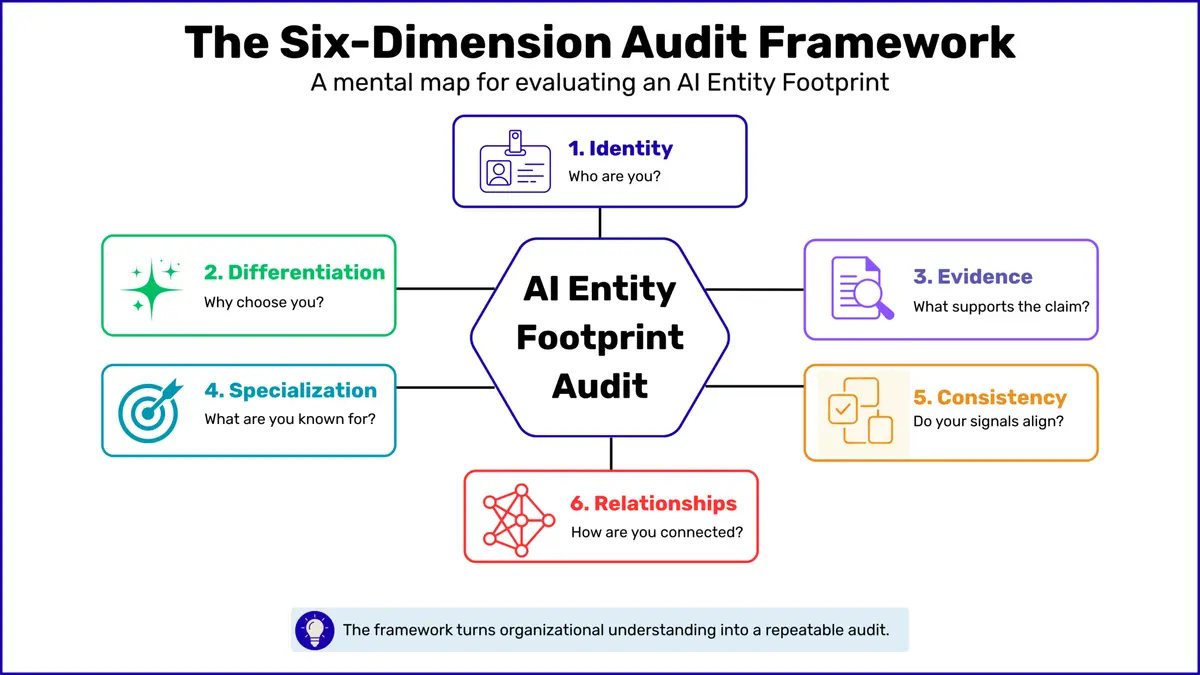
Six dimensions
An AI system does not need to know everything. It needs enough consistent, evidence-backed information to confidently answer the questions people ask.
Auditing repeatedly, the author returned to six dimensions.
1. Identity
Can AI identify the business? Beyond recognising a name: can it consistently explain what the organisation does, who it serves, where it operates and how it positions itself?
Does the website tell the same story as the Google Business Profile, LinkedIn page and directories?
Weak scores here usually mean a lack of clarity — different platforms describing the business differently, audiences shifting page to page, or positioning so broad the specialisation is unreadable.
2. Differentiation
AI is often much better at explaining what a business does than why someone should choose it. Many responses default to "trusted," "professional," "high-quality" — descriptions that could apply to almost every competitor.
Differentiation requires evidence: consistent signals explaining what makes the business unique, whether specialisation, customer experience, methodology, geographic focus, technology or expertise.
If AI cannot articulate that difference, prospective customers can struggle to see it too.
3. Evidence
Most businesses make claims about expertise, experience, service or reputation. Those claims become much stronger when supported by independent evidence.
Reviews, testimonials, case studies, certifications, awards, media coverage, conference presentations, published research and customer success stories tell AI what you want to be known for and demonstrate why those associations deserve confidence.
4. Consistency
One inaccurate description rarely defines an organisation, but patterns do.
You do not need identical wording everywhere — different audiences require different messaging. The goal is that sources collectively reinforce the same understanding.
Repeated inconsistencies introduce ambiguity: one platform emphasising residential services while another highlights commercial, a website positioned around one specialty while reviews describe another, team pages claiming expertise that appears nowhere else.
Individually minor. Together, they make the organisation harder to understand.
5. Relationships
Every organisation connects to industries, locations, associations, partners, certifications, communities, products, services and people.
This dimension is often overlooked in traditional SEO, yet relationships appear throughout the web — conference participation, association memberships, partner pages, podcast interviews, community involvement, software integrations, vendor relationships and customer success stories.
Clear relationships help establish when and where the business is relevant.
6. Specialization
Finally, a simple question: what is this business genuinely known for?
Not what the homepage claims or the mission statement says. What the evidence online consistently reinforces.
Rather than evaluating content, reviews, media mentions, speaking engagements, podcasts and case studies independently, look for recurring themes. Which services appear repeatedly? Which industries keep surfacing? What expertise is consistently reinforced by independent sources?
Expertise is not established by saying you are an expert. It is established when the broader digital ecosystem repeatedly associates your organisation with the same topics, industries and capabilities.
Scoring 0 to 5
Score each dimension on a 0 to 5 scale.
| Score | Standard |
|---|
| 0 | No meaningful evidence |
| 1 | Very limited evidence |
| 2 | Basic evidence exists but is fragmented |
| 3 | Clear foundational understanding |
| 4 | Strong, consistent and well-supported |
| 5 | Exceptional understanding reinforced across numerous independent sources |
The author scores intentionally conservatively.
A business can be outstanding in the real world and still receive an average entity footprint score if the available evidence online is limited or inconsistent. The score measures confidence in organizational understanding, not business quality.
And he adds that the conversations generated during the audit are often more valuable than the score itself. The exercise shifts attention from individual marketing assets to a broader question: how understandable is this business?
Running your first audit
Start with the website
Your website is where you define the business, making it one of the strongest owned sources. It should clearly communicate who the business is, what it does, who it serves, where it operates and what differentiates it.
Do not focus exclusively on keywords or on-page optimisation. Ask whether someone encountering the business for the first time could confidently explain it after reading the site.
Pay particular attention to the homepage, About page, service pages, team pages, author profiles and structured data.
Compare it with the Google Business Profile
For local businesses, GBP is another anchor. Review the description, categories, services, review themes, photos and posts, then compare with the website:
- Do both describe the same organisation?
- Do they emphasise the same services?
- Do they reinforce the same specialisation?
A mismatch is an opportunity to improve consistency.
Let customers describe the business
Reviews provide independent description. Rather than counting reviews or averaging ratings, read them collectively:
- What themes appear repeatedly?
- What services do customers mention?
- How do customers describe strengths?
- What words do they naturally use?
Those recurring themes reveal what the business is known for rather than what it hopes to be known for.
Look for independent validation
Determine whether positioning is supported beyond your own marketing materials: press coverage, podcast appearances, guest articles, industry directories, awards, certifications, conference presentations, association memberships, community involvement.
Step back and evaluate the whole picture
Instead of asking whether individual assets are optimised, ask whether they collectively tell the same story. If the six questions answer clearly, the footprint is strong.
Using AI for the first pass
Gathering this manually takes time. Even for a small local business, reviewing websites, profiles, reviews, LinkedIn, press mentions, directories and podcasts can take an hour or more.
The author built an AI Entity Footprint Starter Audit as a Custom GPT that performs the first pass in ChatGPT, analysing public information across the six dimensions and applying the same conservative scoring model.
The GPT explains each score, identifying missing evidence, conflicting information, weak differentiation, inconsistent positioning and opportunities to strengthen understanding.
It is not a replacement for professional analysis — it is a practical way to begin.
Putting it into practice
Start with three prompts. "What does this company do?", "Who is it for?", "Why should someone choose it over a competitor?" A blurred answer on the third is the finding.
Log generic answers as failures. If the description would work verbatim for a competitor, your differentiator does not exist in public information.
Trace where the evidence lives. A claim existing only on your own site is weak; a fact repeated across third-party sources is strong.
Fix basic identity data first. This layer breaks more often than expected — see AI Search Can't Verify Your Business: The 84% Identity Leak Found in 71 Audits.
Measure citations and mentions separately — the gap covered in Ghost Citations.
Translate entity structure into content architecture. On heading hierarchy and silos for topical authority, see Entity SEO: AI Search Looks for the Source of a Concept, Not a Keyword.
Better to run this audit yourself before AI systems begin doing it on your behalf. In an environment that structurally favours familiar brands — see AI Models Search for Familiar Brands 3.2x More Often — being understandable is not optional.