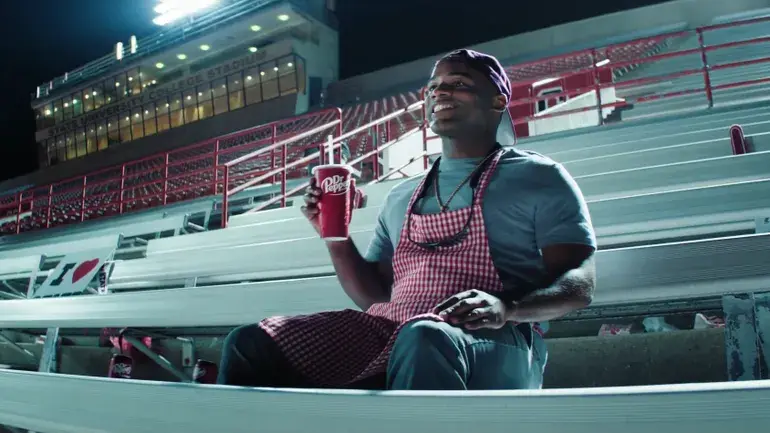
Dr Pepper kicked off the ninth season of "Fansville," its college football-themed parody drama, with new spots featuring an "iced" kicker with his leg in a block of ice, a sci-fi take on the transfer portal, and a character breaking the fourth wall to announce he's been recast. Derek Dabrowski, SVP and head of cold brand marketing at Keurig Dr Pepper, summed up the operating principle to Marketing Dive in one line: "Consistency doesn't mean sameness."
The structure behind a nine-year campaign
Separate what you protect from what you refresh
What Fansville protects is instant recognizability — the format, tone, and fictional world. What it refreshes is cultural currency: conference realignment, playoff expansion, player movement, and the growth of NIL deals into a multibillion-dollar market all become story material. This season features a cameo from LSU's famously divisive head coach Lane Kiffin — pulled over for an "illegal lane change" in a teaser, rolling up his window in defiance, a move Kiffin improvised on set.
2,500 permutations, double the lift
The campaign's business case is what elevates it beyond long-running IP. According to KDP, last season's Fansville ran more than 2,500 marketing permutations, driving more than double the sales lift and roughly 30% higher incremental return on ad spend than the company's national campaign average — numbers powered by precision targeting, personalization tools, first- and third-party data, and optimized workflows. This year launches across 50 markets with over 200 pieces of localizable content.
Creators as a media channel, not a tactic
Dabrowski flagged creator investment as the next stage of the platform, describing creators as evolving into a media channel in their own right. If the goal is to "understand college football fandom better than any other brand," the creators who actually fuel that fandom carry as much weight as national linear TV.
What marketers should take from this
The lesson isn't "build a long-running campaign." It's "build a structure that compounds." Brands that reinvent their campaign every year pay the awareness tax every year. Fansville compounds nine years of recognition and spends its creative budget on multiplying permutations instead of reintroducing itself. The principle scales down: fix one recognizable skeleton, then design which parts swap out.
The contrast with competing approaches to the same season is instructive. How Coca-Cola Is Playing College Football Season — Creators, Fantasy Sports, and a 74-Campus Tour competes on breadth of touchpoints; Fansville sells depth in a single world. And this season's choice to cut fan-made UGC into a TV spot belongs to the same "proof over claims" family of activation we covered in Why United Broadcast ESPN's Fantasy Football Show From 35,000 Feet — Proof Beats Claims.